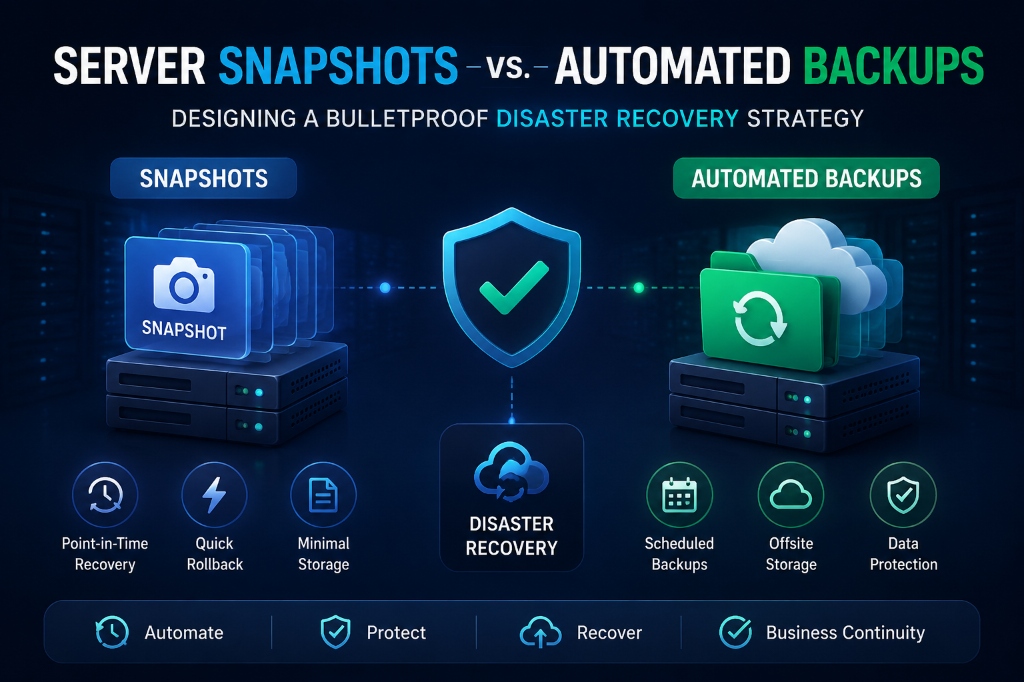


Perceive the essential variations between hypervisor snapshots and unbiased backups. Uncover RTO vs. RPO metrics, the 3-2-1 backup rule, and hands-on Linux automation.
📅 Up to date: October 2026
⏱️ 13 Min Learn
⚙️ Manufacturing Runbook
🛡️ 3-2-1 Enterprise Rule
⚡ Server Snapshots vs Automated Backups: Government Abstract
- Snapshots Are Not Backups: A snapshot is a brief Copy-on-Write (CoW) delta pointer tree. Moreover, it relies upon totally on the bottom disk. If the underlying storage fails, little one snapshots are destroyed alongside the first digital machine.
- RTO vs. RPO Optimization: Snapshots ship near-instant Restoration Time Goals (RTO < 30 seconds) for pre-upgrade security. In distinction, automated backups fulfill Restoration Level Goals (RPO) with off-site information sturdiness.
- The three-2-1 Enterprise Rule: Keep 3 copies of manufacturing information throughout 2 totally different storage media. As well as, retailer a minimum of 1 encrypted copy off-site in an unbiased facility.
- Managed Infrastructure: Deploying on a managed USA VPS internet hosting tier ensures automated each day snapshot retention, off-site replication, and 24/7 catastrophe restoration assist.
1. Introduction: The Harmful Catastrophe Restoration False impression
When evaluating server snapshots vs automated backups, many directors assume each provide equal safety. Consequently, organizations typically consider clicking “Take Snapshot” protects them from each catastrophic catastrophe.
Nevertheless, this assumption is harmful. When a bodily RAID controller fails or silent disk corruption strikes, the digital machine and its snapshots disappear collectively. Snapshots reside on the identical bodily storage pool because the working system. Due to this fact, dropping the host server destroys all related snapshot states.
In distinction, true enterprise resilience requires a multi-layered catastrophe restoration structure. For instance, pairing on the spot hypervisor snapshots with automated, deduplicated off-site backups gives complete safety. This technique safeguards your information towards ransomware, {hardware} failures, operator errors, and information middle outages.
Moreover, leaving unpruned snapshots energetic for weeks severely degrades disk efficiency. As Copy-on-Write delta timber increase, disk reads should traverse a number of pointer layers. This chain provides substantial storage I/O latency. Due to this fact, automated pruning is important to maintain digital disks working at peak NVMe speeds.
As well as, strict compliance frameworks (akin to SOC 2, HIPAA, GDPR, and PCI-DSS) mandate immutable off-site archives. Whereas transient snapshots fail regulatory compliance requirements, cryptographically signed off-site backups set up verifiable enterprise continuity audit trails.
2. Architectural Fashions: Snapshots vs. Impartial Backups
Reviewing information storage on the disk block stage highlights the basic distinction between snapshots and backups. Particularly, snapshots freeze state domestically, whereas backups duplicate information independently.
Hypervisor Pointer Tree
VPS Server Snapshots
Captures a Copy-on-Write (CoW) delta freeze. Affords on the spot creation and sub-30-second rollbacks. Nevertheless, it relies upon totally on base disk well being and can’t survive host failure.
Greatest For: Pre-upgrade security & speedy system rollbacks.
Remoted Off-Website Archives
Automated Offsite Backups
Full, compressed, encrypted, and deduplicated archives saved in distant amenities. Offers 100% unbiased information survival even when the host hypervisor is destroyed.
Benefit: Full catastrophe restoration & ransomware immunity.
3. Core Mechanics: Copy-on-Write vs. Deduplicated Archival
To design an efficient continuity plan, directors should study how snapshots and backups function on the disk block layer. Should you use management panels, discover the way to configure automated backups on Plesk to simplify distant repository setup.
The Mechanics of a Hypervisor Snapshot
When taking a snapshot on a KVM hypervisor (utilizing QCOW2 or LVM), the hypervisor doesn’t clone the digital disk. As a substitute, it marks the present base digital disk as read-only. Then, it creates a sparse delta overlay picture to document all future disk writes.
When the visitor OS requests a disk sector, the hypervisor checks the delta file first. If modified, it reads from the delta; in any other case, it pulls information from the unique base disk. Reverting a snapshot merely deletes the delta file, finishing in underneath 10 seconds.
Nevertheless, if the bottom digital disk suffers filesystem corruption, the delta overlay turns into ineffective. Due to this fact, a snapshot can’t exist with out its dad or mum disk.
To make sure transactional consistency, the hypervisor makes use of the qemu-guest-agent. Particularly, this agent executes the kernel fsfreeze command. It briefly flushes filesystem buffers and pauses database writes for milliseconds, guaranteeing a coherent, recoverable state.
The Mechanics of Automated Offsite Backups
In distinction, an automatic backup is a completely unbiased information duplication course of. Enterprise backup software program flushes database buffers, compresses information blocks, encrypts archives with AES-256 keys, and transfers information over TLS to distant storage.
Trendy backup engines make the most of chunk-level deduplication (akin to BorgBackup). Solely newly modified blocks are transmitted throughout subsequent incremental backups. Consequently, this drastically reduces storage utilization and backup home windows.
Immutable Object Storage & Ransomware Air-Gapping
Trendy ransomware variants actively seek for native snapshots and native backup folders to delete them earlier than encrypting information. To counter this menace, enterprise architectures use Immutable Object Storage (WORM – Write As soon as, Learn Many) with S3 Object Lock. As soon as written, archives can’t be modified or deleted by any consumer till the retention window expires.
The three-2-1 Enterprise Backup Rule
The trade gold commonplace for enterprise continuity is the 3-2-1 Backup Technique:
- 3 Copies of Information: Keep one main manufacturing copy and two distinct backup copies.
- 2 Completely different Storage Media: Retailer copies throughout totally different protocols, akin to native NVMe RAID arrays and distant S3 buckets.
- 1 Copy Off-Website: Hold a minimum of one backup in an unbiased, geographically separated information middle.
4. Catastrophe Restoration SLA Matrix: RTO vs. RPO Evaluation
Evaluating catastrophe restoration methods requires analyzing Restoration Time Goal (RTO) and Restoration Level Goal (RPO):
| Metric Dimension | Hypervisor Snapshot | Native Day by day Backup | Off-Website Deduplicated Backup |
|---|---|---|---|
| Restoration Time (RTO) | < 30 Seconds (Instantaneous) | 5 – 15 Minutes | 15 – 45 Minutes |
| Restoration Level (RPO) | Level of Snapshot set off | Final 24 Hours | 1 – 6 Hours (Incremental) |
| Host {Hardware} Failure Safety | Zero (Misplaced with host) | Low (If on similar SAN) | 100% Whole Immunity |
| Ransomware Air-Hole Safety | None | Low | Excessive (Immutable / Encrypted) |
| Disk I/O Influence Over Time | Degrades I/O if aged | Temporary CPU spike throughout compression | Negligible (Deduplicated) |
5. Actual-World Situations: When to Use Snapshots vs. Backups
Deciding on the suitable instrument depends upon the operational occasion. As an example, software rollbacks require pace, whereas {hardware} disasters require off-site sturdiness:
🔧 Main System & Kernel Updates
Take a snapshot proper earlier than working OS upgrades or main PHP model bumps. If a bundle battle breaks Apache, revert in 10 seconds.
🗃️ Unintentional Desk Drops & Information Corruption
When an inaccurate SQL question truncates buyer data, restore a granular each day database dump with out rolling again your entire working system.
🔒 Ransomware & Malicious Exploits
If root credentials are compromised and native drives are locked, immutable off-site backups permit a clear bare-metal restoration.
🏢 Regional Information Middle Catastrophe
Throughout a catastrophic facility outage, provision a recent VPS in an alternate area and restore your off-site backup archive in minutes.
6. Palms-On Runbook: Linux Backup Automation with BorgBackup
Execute these manufacturing instructions in your Linux terminal to create transactional database dumps, configure BorgBackup deduplication, and schedule automated retention. Moreover, for software rollbacks earlier than updating plugins, verify our information on the way to obtain a backup from the WordPress dashboard.
Step 1: Export Constant Database Dumps
Create an ACID-consistent snapshot dump of your InnoDB database with out locking tables:
sudo mkdir -p /var/backups/mysql
mysqldump -u root -p --single-transaction --quick --routines --triggers production_db | gzip > /var/backups/mysql/db_$(date +%F).sql.gz
Step 2: Initialize Encrypted Repository with BorgBackup
Arrange a client-side AES-256 encrypted repository on distant storage:
sudo apt set up borgbackup -y
export BORG_PASSPHRASE='SuperSecurePassphrase2026!'
borg init --encryption=repokey-blake2 /mnt/remote_backup_repo
Step 3: Execute Incremental Backup with LZ4 Compression
Deduplicate and archive internet directories and database dumps:
borg create --stats --progress --compression lz4
  /mnt/remote_backup_repo::'{now:%Y-%m-%d_percentH:%M}'
  /var/www/html /and so forth/nginx /var/backups/mysql
Step 4: Automate Backup Retention Pruning
Implement automated retention insurance policies to eradicate storage sprawl:
borg prune -v --list /mnt/remote_backup_repo
  --keep-daily=7 --keep-weekly=4 --keep-monthly=6
Step 5: Confirm Archive Integrity and Check Restoration
Usually check backup consistency to make sure dependable information restoration:
borg verify /mnt/remote_backup_repo
borg extract --dry-run /mnt/remote_backup_repo::2026-10-01_03:00 var/backups/mysql
Step 6: Configure Automated Nightly Backup Cron Execution
Schedule automated off-peak backups with detailed logging:
echo "0 3 * * * root /usr/native/bin/backup-script.sh >> /var/log/backup.log 2>&1" | sudo tee /and so forth/cron.d/nightly-backup
sudo chmod 644 /and so forth/cron.d/nightly-backup
💡 Professional Tip: By no means Hold Snapshots Older Than 48 Hours: Delete or merge hypervisor snapshots inside 24–48 hours of finishing a upkeep activity. As snapshots age, delta information increase, forcing the hypervisor to traverse prolonged pointer chains and degrading disk throughput.
⚠️ Catastrophe Alert: The Single-Level-of-Failure Lure: By no means depend on snapshots as your sole catastrophe restoration mechanism. If the host hypervisor suffers unrecoverable {hardware} corruption, all snapshots saved on it are misplaced ceaselessly.
7. Steadily Requested Questions (FAQs)
Can I restore a person file or database desk from a VPS snapshot?
No. A snapshot is an all-or-nothing picture of your entire digital disk. Reverting a snapshot rolls again your entire working system, erasing all adjustments made for the reason that snapshot was taken. For granular file or desk restoration, use file-level automated backups.
Does taking a reside snapshot freeze or pause my working web sites?
With fashionable KVM hypervisors and QEMU visitor brokers, snapshots execute in milliseconds utilizing Copy-on-Write pointers with out requiring a server reboot or inflicting perceptible downtime.
Why do long-running snapshots decelerate server disk efficiency?
When a snapshot stays energetic, each write creates new blocks in a delta file. Because the delta grows, learn operations should verify each the bottom picture and the delta tree, rising I/O search latency and consuming extreme storage IOPS.
What’s the distinction between RTO and RPO?
Restoration Time Goal (RTO) is the length of time it takes to revive your server again on-line after an outage. Restoration Level Goal (RPO) is the utmost acceptable age of knowledge misplaced (e.g., dropping at most 1 hour of transactions).
How typically ought to I check restoring from my backups?
You need to carry out an automatic or handbook backup restoration dry-run a minimum of as soon as a month. An untested backup archive isn’t a legitimate catastrophe restoration technique.
8. Strategic Structure Roadmap for Resilient Infrastructure
Constructing a bulletproof catastrophe restoration structure requires balancing short-term agility with long-term information survival. For instance, hypervisor snapshots present on the spot rollbacks throughout code deployments. In distinction, automated off-site backups guarantee your online business survives complete {hardware} failure or ransomware outbreaks.
By imposing the 3-2-1 backup technique and deploying on high-performance KVM digital non-public servers, organizations obtain enterprise uptime and full enterprise continuity throughout world markets.