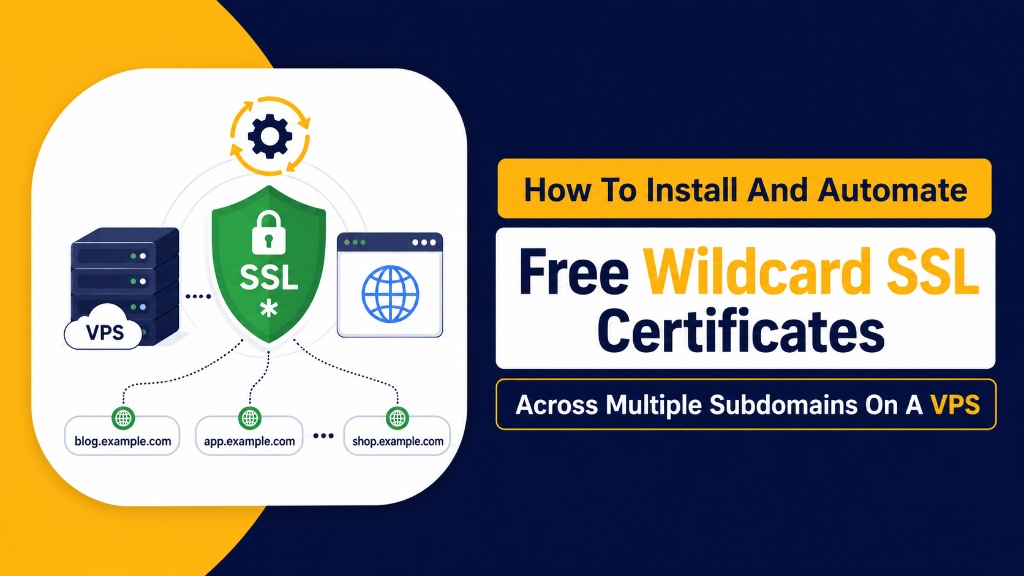


⚡ Wildcard SSL Set up on VPS: Government Abstract
- Limitless Subdomain Encryption: A single Wildcard SSL certificates (
*.yourdomain.com) encrypts all current and future first-level subdomains underneath a unified cryptographic id. - DNS-01 ACME Problem: Automated DNS API integration (by way of Cloudflare/Route53) permits Certbot to show area possession with out requiring open HTTP port 80.
- TLS 1.3 & HSTS Hardening: Imposing TLS 1.3 cipher suites, OCSP Stapling, and HTTP Strict Transport Safety (HSTS) ensures an A+ score on Qualys SSL Labs.
- Enterprise Internet hosting: Deploying on a trusted USA VPS internet hosting supplier delivers devoted KVM hypervisor safety, excessive NVMe I/O, and 99.99% uptime.
1. Introduction: Modernizing Enterprise TLS Infrastructure with Wildcard SSL
In fashionable internet structure, enterprise functions not often reside on a single root area. Trendy software program ecosystems routinely distribute performance throughout dozens of devoted subdomains: api.yourdomain.com for REST/GraphQL APIs, app.yourdomain.com for single-page internet functions, auth.yourdomain.com for OAuth SSO authentication, and retailer.yourdomain.com for e-commerce checkout funnels.
Strategic Concerns & Core Structure Drivers
Managing particular person, separate SSL/TLS certificates for every subdomain introduces extreme operational complexity: monitoring staggered expiration dates, managing rate-limit thresholds on certificates authorities, and troubleshooting certificates mismatch errors. If a person certificates silently expires, buyer belief is immediately eroded by browser safety warning screens.
The definitive answer is deploying an automatic Let’s Encrypt Wildcard SSL Certificates (*.yourdomain.com). A wildcard certificates encrypts the foundation apex area and a vast variety of subdomains underneath a single cryptographic certificates, robotically protecting new microservices and staging environments the moment they’re deployed. This unified structure drastically cuts administrative overhead whereas sustaining steady end-to-end encryption.
As a result of certificates authorities can not validate wildcard area possession by way of customary HTTP internet server challenges, wildcard certificates require the DNS-01 ACME validation problem. By leveraging DNS API automation (akin to Cloudflare, AWS Route 53, or DigitalOcean DNS APIs), Certbot robotically creates ephemeral TXT verification information, requests certificates, and configures computerized renewal seamlessly within the background.
Moreover, pairing wildcard encryption with hardened TLS 1.3 cryptographic protocols, OCSP Stapling, and HTTP Strict Transport Safety (HSTS) ensures zero-latency SSL handshakes and whole safety towards downgrade assaults.
Deploying on an enterprise platform backed by a trusted USA VPS internet hosting supplier ensures most community reliability and low latency for cryptographic handshakes. On this complete technical information, we consider ACME validation mechanics, overview TLS cipher benchmarks, clarify OCSP stapling, and supply an actionable PuTTY set up runbook.
2. Architectural Fashions: HTTP-01 Single-Area vs. DNS-01 Wildcard Validation
Evaluating customary HTTP-01 problem limitations towards automated DNS-01 API validation clarifies why wildcard structure is superior for scaling infrastructure.
|
Internet Server Validation HTTP-01 ProblemValidates possession by inserting a token in Limitation: Requires open port 80 & separate cert per subdomain. |
DNS API Automation DNS-01 Wildcard ProblemProves management by way of DNS API by provisioning Benefit: Works on personal backends, no port 80 & limitless subdomains. |
3. Core Idea: The 5 Pillars of Enterprise Wildcard TLS Hardening
Constructing a production-grade SSL/TLS infrastructure entails 5 interconnected architectural elements:
Seamless certificates automation ensures steady HTTPS compliance; uncover how low cost VPS servers present SSL encryption with zero downtime throughout multi-site internet stacks.
1. DNS-01 ACME Automated Problem Circulate
The Automated Certificates Administration Surroundings (ACME) protocol allows zero-touch certificates issuance. When requesting a wildcard certificates, Certbot calls your DNS supplier’s REST API (e.g., Cloudflare) to create a brief TXT document at _acme-challenge.yourdomain.com containing a cryptographic digest. Let’s Encrypt nameservers question the document, confirm area authority, concern the certificates, and Certbot deletes the TXT document in seconds.
2. Imposing Pure TLS 1.3 & Trendy Cipher Suites
Legacy TLS 1.0, 1.1, and even older TLS 1.2 configurations undergo from sluggish multi-roundtrip handshakes and weak cipher modes. Imposing TLS 1.3 reduces handshake latency from 2 round-trips to only 1-RTT (or 0-RTT session resumption). Proscribing ciphers to TLS_AES_256_GCM_SHA384 and TLS_CHACHA20_POLY1305_SHA256 ensures excellent ahead secrecy (PFS).
3. OCSP Stapling (On-line Certificates Standing Protocol)
When a browser connects to an HTTPS website, it historically contacts the Certificates Authority’s OCSP server to verify if the certificates has been revoked, inflicting DNS lookup delays. Enabling OCSP Stapling instructs your Nginx/Apache internet server to periodically question the CA, cache the timestamped cryptographic revocation proof, and ‘staple’ it instantly into the preliminary TLS handshake, accelerating web page load occasions by as much as 150ms.
4. HTTP Strict Transport Safety (HSTS) & Preloading
To forestall man-in-the-middle SSL-stripping assaults, the net server injects the Strict-Transport-Safety response header. With the includeSubDomains directive enabled, browsers robotically drive HTTPS connections throughout all present and future subdomains earlier than any community packets are transmitted.
5. Automated Systemd Timer Silent Renewals
Let’s Encrypt certificates are legitimate for 90 days. A manufacturing deployment depends on background systemd timers (certbot.timer) that execute twice day by day. When a certificates reaches 30 days earlier than expiration, Certbot robotically re-verifies DNS-01 challenges, downloads new certificates information, and reloads Nginx gracefully by way of deploy hooks with zero downtime.
6. Light-weight ACME Automation by way of acme.sh
In minimal Linux VPS environments the place Python and Snap dependencies are undesirable, acme.sh affords a zero-dependency, pure POSIX shell script various. It natively integrates with over 150 DNS supplier APIs, helps automated cron scheduling, and points ECC-384 wildcard certificates with minimal disk and reminiscence footprint.
7. Emergency Certificates Revocation & Key Rollover
If an SSL personal secret is ever uncovered or suspected of compromise, safety groups should instantly revoke the certificates and generate a contemporary key pair. Executing certbot revoke --cert-path ... immediately broadcasts cryptographic revocation proofs to international Certificates Revocation Lists (CRLs) and OCSP responders, stopping impersonation assaults.
8. Dynamic Traefik & Envoy SNI Proxy Routing
Trendy containerized Docker architectures deploy edge reverse proxies akin to Traefik or Envoy. These ingress controllers terminate Wildcard SSL handshakes on the container perimeter utilizing Server Identify Indication (SNI) and ahead unencrypted site visitors over remoted personal bridge networks on to inside utility microservices.
9. Certificates Transparency (CT) Log Auditing
Each publicly issued Let’s Encrypt certificates is completely recorded in public Certificates Transparency logs. Integrating automated CT monitoring companies alerts safety engineers the second any Certificates Authority points a certificates for his or her area identify, detecting unauthorized certificates issuance or area takeover makes an attempt in actual time.
10. TLS 1.3 Zero Spherical-Journey Time (0-RTT) Session Resumption
For repeat guests, TLS 1.3 allows 0-RTT session resumption. By storing pre-shared encryption keys in safe browser session tickets, returning purchasers can transmit HTTP GET requests together with the preliminary handshake packet, attaining absolute instantaneous web page loading on high-latency cellular networks.
4. SSL Validation & Cryptographic Protocol Comparability Matrix
Evaluate certificates problem strategies, cipher protocols, and safety scores:
| Technical Dimension | Customary HTTP-01 SSL | DNS-01 Wildcard SSL | Industrial Wildcard |
|---|---|---|---|
| Subdomain Protection | Express single area solely | Limitless (*.area.com) | Limitless (*.area.com) |
| Annual Software program Price | $0 (Free Open Supply) | $0 (Free Open Supply) | $80 – $300+/12 months |
| Open Port 80 Required | Sure (Necessary HTTP) | No (DNS API solely) | No (E mail / DNS validation) |
| Automated 0-Contact Renewal | Sure (Systemd timer) | Sure (Certbot DNS hook) | Handbook yearly re-issue |
| Qualys SSL Labs Ranking | A to A+ (Config dependent) | A+ (With TLS 1.3 & HSTS) | A to A+ |
5. Actual-World Eventualities: Structure Benefiting from Wildcard SSL
Uncover the operational environments the place Wildcard SSL structure delivers unmatched effectivity:
🏢 Multi-Tenant SaaS Platforms
Mechanically provision HTTPS encryption for buyer self-importance subdomains (clientname.platform.com) with out requesting particular person certificates.
🚀 Microservice API Clusters
Defend a number of inside and exterior microservice routing endpoints (auth.*, api.*, billing.*) utilizing a single consolidated certificates file.
⚙️ Ephemeral CI/CD Staging Previews
Spin up dynamic staging subdomains for pull requests (pr-58.stage.area.com) with instantaneous, legitimate HTTPS encryption out of the field.
🛒 E-Commerce Multi-Retailer Networks
Handle country-specific or brand-specific storefronts (uk.retailer.com, us.retailer.com) with streamlined centralized TLS administration.
6. Arms-On Implementation: Certbot DNS-01 & Nginx TLS 1.3 Setup (PuTTY Terminal Information)
Execute these manufacturing instructions instantly in your PuTTY terminal to put in Certbot, configure Cloudflare DNS API tokens, concern a Wildcard SSL certificates, and harden Nginx TLS 1.3:
Managing ACME TXT problem validation requires mastering nameserver zones; seek the advice of our area registration, DNS information, and area safety information to format DNS information accurately.
Step 1: Set up Certbot and Cloudflare DNS Plugin on Ubuntu 22.04/24.04
Set up official Certbot binaries by way of snap or apt bundle supervisor:
Step 2: Securely Retailer Scoped Cloudflare DNS API Token
Create credentials configuration file with restricted 600 root permissions:
Step 3: Subject Wildcard SSL Certificates by way of Certbot DNS-01 Problem
Request certificates protecting apex area and all first-level wildcard subdomains:
Step 4: Configure Nginx TLS 1.3, OCSP Stapling & HSTS (/and many others/nginx/conf.d/ssl.conf)
Implement enterprise SSL configuration for max safety and efficiency:
Step 5: Check Automated Dry-Run Renewal with Nginx Reload Hook
Confirm that background renewal hooks execute easily with out human intervention:
Step 6: Audit Stay OCSP Stapling and Handshake by way of OpenSSL s_client
Verify that your internet server is delivering legitimate stapled OCSP responses:
Step 7: Light-weight Wildcard Setup by way of acme.sh (Different Technique)
Subject wildcard certificates utilizing zero-dependency shell shopper:
Step 8: Automated SSL Expiration Monitoring by way of Bash CLI
Question precise remaining days on lively reside certificates by way of OpenSSL:
💡 Professional Tip: Generate ECDSA Personal Keys for Quicker Cell Handshakes
All the time use --key-type ecdsa when requesting certificates in Certbot. Elliptic Curve Digital Signature Algorithm (ECDSA) keys are considerably smaller and sooner to compute than RSA keys, lowering TLS handshake CPU overhead by over 50% on high-traffic cellular connections.
⚠️ Safety Warning: Scope Cloudflare API Tokens Strictly to DNS:Edit
By no means use your international Cloudflare account API key in /and many others/letsencrypt/cloudflare.ini. Create a customized API token with permissions restricted strictly to Zone:DNS:Edit in your particular zone. In case your VPS is ever compromised, the attacker can not tamper with account billing, firewalls, or different area zones.
🎯 Key Takeaways & Wildcard SSL Abstract
- Limitless Subdomains: Encrypts apex and all subdomains underneath a single auto-renewing certificates.
- DNS-01 ACME Validation: Points certificates securely by way of DNS API automation with out requiring open internet ports.
- TLS 1.3 & OCSP Stapling: Delivers 1-RTT handshake speeds and achieves an A+ rating on Qualys SSL Labs.
- Enterprise Platform: Deploying on a USA VPS internet hosting platform offers high-performance KVM computing and dependable low-latency networks for cryptographic companies.
Incessantly Requested Questions (FAQ)
Conclusion: Strategic Structure Roadmap for US Companies
Constructing a high-performance, safe, and scalable cloud infrastructure requires aligning compute sources, community proximity, and storage subsystems with utility calls for.
By deploying on devoted KVM digital personal servers powered by fashionable Linux kernels and enterprise {hardware}, US organizations guarantee most operational uptime, seamless scalability, and superior consumer experiences throughout North American and international markets.