

What line of protection do you’ve gotten towards malicious site visitors and software program? Do you’ve gotten a firewall defending your infrastructure?
Safety is on the forefront of the expertise dialogue. Because the business innovates and builds web sites, functions, and platforms, securing the environments the place this stuff stay is more and more important.
Within the hosting house, there are a lot of choices for securing your infrastructure. However how have you learnt which safety choices to decide on?
A firewall can show to be a easy, efficient, and modest answer for information safety.
What’s a Firewall?
A firewall is a tool utilized in community safety to watch incoming and outgoing community site visitors and decide whether or not to permit or block it primarily based on a predetermined set of safety guidelines. You may refuse entry to unauthorized site visitors whereas respectable site visitors could be allowed to succeed in its vacation spot. Firewalls additionally block malicious software program from infecting your pc.
What’s the Objective of a Firewall?
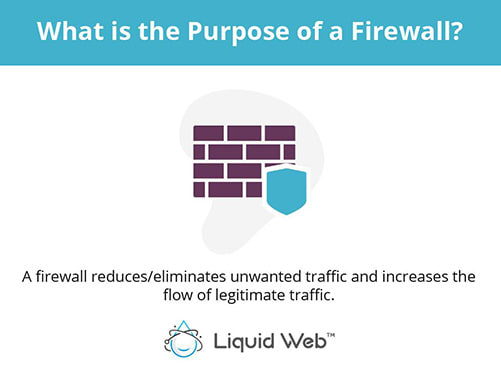
The aim of a firewall is to cut back or remove undesirable community connections and improve the free circulation of respectable site visitors. Firewalls are a vital addition to your infrastructure as a result of they can assist isolate computer systems and servers from the Web to supply safety and privateness of information. As beforehand talked about, not solely do they monitor site visitors to and out of your server, however they restrict that site visitors in some circumstances as nicely.
For instance, if we take into consideration a Denial of Service (DoS) assault, inaccurate site visitors floods your website and may doubtlessly deliver down the focused web site’s server. Appropriately configured firewalls can assist defend your atmosphere from such conditions. You may filter site visitors and search patterns for anomalies that time to an assault being underway.
How Do Firewalls Work?
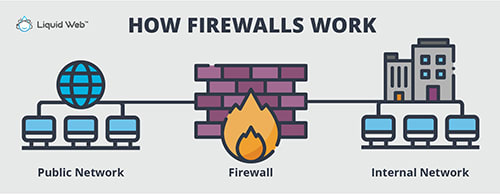
A firewall screens all information site visitors to permit good information and block dangerous information primarily based on preset guidelines. It makes use of one or any mixture of three strategies: Packet Filtering, Stateful Inspection, and Proxy Service.
- The Packet Filtering technique will get carried out to watch community connectivity. Knowledge packets are models of information packaged collectively that journey alongside a given community path. The packages are analyzed and in contrast towards the configuration guidelines or “access-list.” The firewall then determines what’s allowed or denied entry to your atmosphere.
- Stateful Inspection technique permits the evaluation of site visitors circulation patterns in line with state, port, and protocol. The firewall screens exercise on a connection from open to shut. It retains observe of recognized, trusted packets to find out approved information from the web site or software versus any information from hackers or different web site safety breaches.
- The Proxy Service technique prevents direct community connections between Web site visitors and the server. This sort of implementation takes stateful inspection a step additional. The firewall acts as an middleman between your server and the requests made by the tip person. Whole information packets are examined and both blocked or allowed primarily based on the principles set.
Is a Firewall a Kind of Software program?
Firewalls could be software-based or hardware-based. Every kind of firewall has its distinctive professionals and cons. Nonetheless, the first objective of a firewall is to dam malicious site visitors requests and information packets whereas permitting respectable site visitors via.
Each {hardware} and software program firewalls assist to watch and filter incoming and outgoing community site visitors primarily based on beforehand established safety insurance policies. In different phrases, a firewall determines whether or not to permit or block the community site visitors primarily based on a predetermined set of safety guidelines.
What’s the Distinction Between a {Hardware} vs Software program Firewall?
The important thing distinction between a {hardware} firewall and a software program firewall is {that a} {hardware} firewall runs on its bodily system, whereas a software program firewall is put in on a number of machines.
What’s a {Hardware} Firewall?
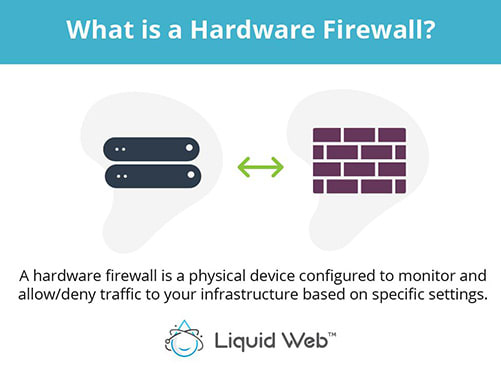
A {hardware} firewall is a bodily system configured to watch and permit/deny site visitors to your infrastructure primarily based on particular settings. A {hardware} firewall additionally permits for the very best efficiency in your servers by retaining the firewall separate out of your server, thereby not utilizing any server assets.
Having a {hardware} firewall ensures you’ve gotten one hundred pc management of the site visitors in your community. With a single system, you possibly can determine what site visitors ought to or mustn’t attain your servers. There isn’t a want to put in or allow software program firewalls as packets are to be intercepted and analyzed earlier than reaching your servers.
{Hardware} firewalls are additionally simply configured. There are normally default guidelines you possibly can set and apply to all site visitors. Granular management to drill guidelines right down to distinct ports and providers like SSH (Safe Shell) and RDP (Distant Desktop Protocol) makes fine-tuning easy.
One other profit to {hardware} firewalls is the flexibility to arrange a Digital Personal Community (VPN) connection on to your atmosphere. Wherever there’s a secure Web connection, you possibly can entry your infrastructure.
What’s a Software program Firewall?
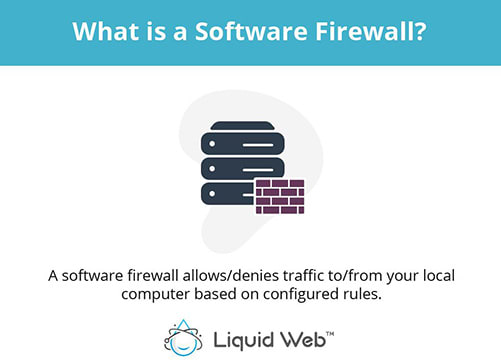
A software program firewall is a firewall put in in your native pc that enables or denies site visitors to and out of your pc primarily based on configured guidelines; it doesn’t require any bodily setup.
Software program firewalls are put in regionally on the system or units you are attempting to guard. You might have rather more granular management of the principles arrange for every particular system working the software program. Site visitors could be analyzed right down to the content material and blocked primarily based on key phrases contained therein.
For the reason that software program firewall is native, it’s usually environment friendly with safety alerts. Whether or not managing guidelines or customers, directors can consult with logs or notifications to find out what is occurring on the units. Realizing what’s happening in your methods at a second’s discover works in your favor.
Nonetheless, for software program firewalls to work, the software program would have to be put in on every system in your community. If there is no such thing as a {hardware} firewall between the Web and your system, your infrastructure may very well be prone to assaults.
It is usually important to make sure compatibility between your working system and the software program you want to use. Irrespective of how good the software program is, compatibility points weaken the effectiveness of your safety.
One small issue to notice is that software program firewalls could be intensive in your system’s assets. Whereas computer systems and servers with extra succesful {hardware} might not discover a lot of a distinction, these with restricted assets can decelerate with some software program firewalls. The extra light-weight the software program, the higher your atmosphere will run.
What’s the Distinction Between a Firewall and Antivirus?
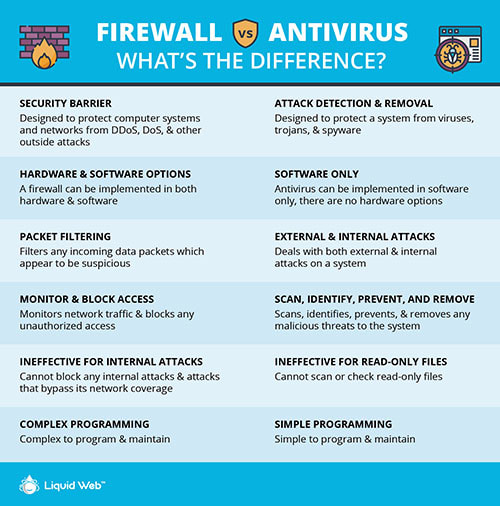
Discover out the precise distinction between a firewall and antivirus software program:
Firewall
A firewall is the state model of a router. Right here, all the info packets are getting into or leaving the community by passing via a firewall, and after inspecting them, the firewall decides whether or not to permit or block the packets. Site visitors passes via the firewalls, and solely approved site visitors is given entry.
In different phrases, the safety is achieved by solely permitting the respectable site visitors/accesses and filtering out all of the unauthorized customers from accessing the personal community.
Antivirus
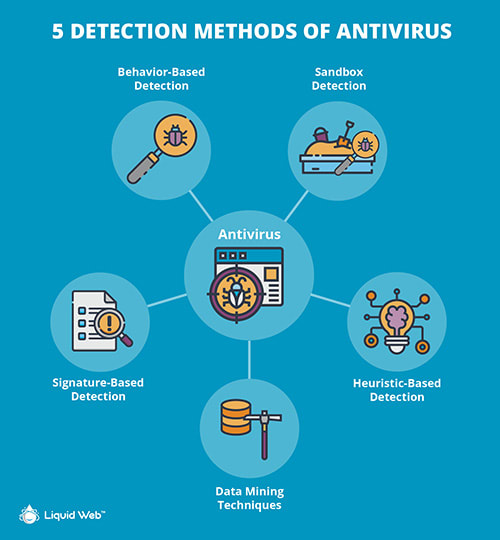
Antivirus is an software or software program that gives safety from malicious information coming from the Web. Antivirus works on the three steps precept:
- Detection: First, the antivirus detects the virus from the system.
- Identification: After the detection, it identifies the kind of virus or the habits of the virus.
- Elimination: After identification of the virus, it really works on elimination from the pc. It really works as a precaution in order that it removes the virus and prevents any potential virus from infecting your system sooner or later.
What are the Benefits and Disadvantages of a Firewall?
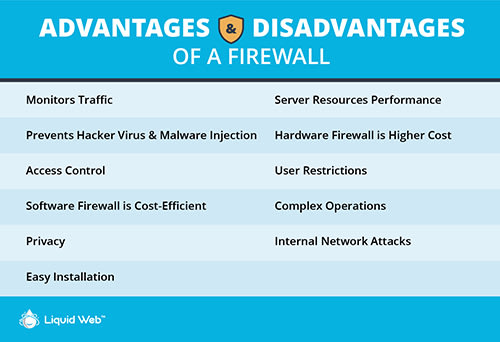
What are the Benefits of a Firewall?
As we have now already mentioned, the firewall is a barrier that forestalls hackers from attacking a community. It is going to assist to guard your community from suspicious exercise resembling malware, unauthorized site visitors, and rather more.
Screens Site visitors
The firewall screens the site visitors passing via it and checks if there’s any harmful malware or code connected to the packet. If any malicious packets are discovered, it instantly blocks them.
Prevents Hacker Virus and Malware Injection
The firewall helps to guard the server from hackers injecting viruses and malware. It does this by blocking unsolicited and undesirable incoming community site visitors. As well as, a firewall validates entry by assessing this incoming site visitors for something malicious like hackers and malware that would infect your pc.
Entry Management
A firewall is constructed with an entry coverage that may be executed for sure hosts and providers. To stop exploitation by hackers, it’s best to dam such hosts from accessing the system.
Software program Firewall is Price-Environment friendly
A software program firewall is cheaper and comes with the newest options and up to date working methods. There are even some software program firewalls that include premium antivirus software program that can present extra safety. {Hardware} firewalls are typically a bit costlier than software program firewalls.
Privateness
On the subject of Web entry, privateness is among the foremost considerations of a person. Hackers all the time search for personal info. On this case, a firewall with a VPN helps to cover private info just like the area identify service (DNS) and IP handle in order that hackers can’t get any personal particulars.
Simple Set up
Putting in a software program firewall is kind of easy and doesn’t want any skilled steerage. There are tutorials obtainable on the Web that can enable you to full the set up course of. These days, all trendy working methods include pre-installed firewalls.
What are the Disadvantages of a Firewall?
Defending and securing your enterprise’s information is among the most essential duties your organization can undertake to forestall fraud or theft. Intrusion deterrence by way of firewall is usually a dependable protection between your organization’s community and hackers. Nonetheless, a firewall ought to by no means be your organization’s solely line of protection.
Server Assets Efficiency
On the subject of efficiency, a software-based firewall has the potential to restrict your pc’s general efficiency. RAM assets and processing energy are a few of the components which restrict the efficiency. For instance, the software program firewall continually working within the background makes use of extra processing energy and RAM assets, which hinders the system efficiency.
Nonetheless, a {hardware} firewall does not trigger any system efficiency points as it’s a separate system fully.
{Hardware} Firewall is Greater Price
As mentioned, a software program firewall is cheaper and comes with the newest working system. There’s a myriad of choices to select from ranging in value. Normally, the {hardware} for a firewall will begin someplace within the $700 vary for a tiny enterprise and may rapidly get into the $10,000 vary. Nonetheless, most corporations with 15 to 100 customers can count on the firewall’s {hardware} to value between $1,500 and $4,000.
Buying, putting in, and sustaining a {hardware} firewall is extra sophisticated and dear than a software program firewall and would require skilled recommendation from a managed host resembling Liquid Internet.
Consumer Restrictions
We all know {that a} firewall prevents unauthorized entry to our system from the community. Nonetheless, this is usually a downside for giant organizations. The insurance policies utilized by the firewall could be rigid, stopping workers from performing sure operations. Generally, this will result in safety issues for the reason that information handed via a backdoor exploit (a kind of malware that invalidates regular authentication procedures to entry a system) will not be examined correctly.
Because of this, distant entry is allowed to assets inside an software resembling recordsdata, servers, and databases. It gives the flexibility to remotely subject system instructions and replace malware.
Advanced Operations
Firewalls for a big group require a distinct set of workers (a devoted safety workforce solely to keep up the firewall) for working and sustaining them. This workforce will monitor and be sure that the firewall is secure sufficient to guard the community from violators.
What are the Kinds of Firewalls?
There are six various kinds of firewalls:
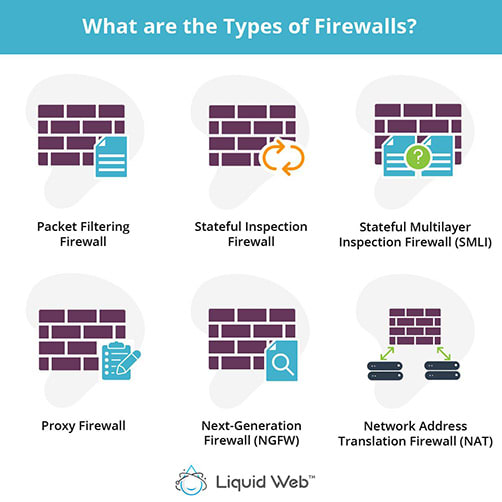
1. Packet Filtering Firewall
Packet Filtering is a selected technique for implementing a firewall to watch community connectivity. Knowledge packets are analyzed and in contrast towards the configuration guidelines or “access-list.” The firewall then determines what’s allowed or denied entry to your atmosphere.
2. Stateful Inspection Firewall
Stateful Inspection strategies permit the evaluation of site visitors circulation patterns in line with state, port, and protocol. The firewall screens exercise on a connection from open to shut. Subsequent, the firewall retains observe of recognized, trusted packets to discern approved information from the web site or app versus any information from unauthorized sources.
3. Stateful Multilayer Inspection Firewalls (SMLI)
Stateful Multilayer Inspection Firewalls filter information packets on the community, transport, and software layers. SMLI firewalls study total information packets and evaluate them towards trusted ones. These kind of firewalls solely permit information packets to move in the event that they move the filters at every layer individually, making certain all communication takes place with trusted sources.
4. Proxy Firewall
Proxy-based firewalls take stateful inspection a step additional, stopping direct community connections between Web site visitors and the server. The firewall acts as an middleman between your server and end-user requests. Whole packets are examined and both blocked or allowed primarily based on set guidelines.
5. Subsequent-Technology Firewalls (NGFW)
Whereas conventional firewalls solely examine packet headers, Subsequent-Technology Firewalls mix typical firewall expertise with further performance. Like SMLI firewalls, Subsequent-Gen Firewalls analyze information inside the packets to determine and cease malicious information extra successfully. An NGFW contains further performance resembling:
- Encrypted site visitors verification.
- Intrusion prevention.
- Antivirus.
- Web site filtering.
- Intrusion prevention.
- Deep packet inspection (DPI).
6. Community Deal with Translation Firewalls (NAT)
NAT firewalls are just like Proxy firewalls, appearing as intermediaries between a gaggle of computer systems and outdoors site visitors. They act as personal networks, permitting a number of units with unbiased community addresses to connect with the Web with a single IP handle. Gadgets behind this firewall stay hidden, and unsolicited communication is blocked.
Do You Want a Firewall to Preserve Your Knowledge Safe?
Sure, a firewall is as important to safety as an antivirus program. Firewalls cease malware from spreading and circulating to a community and defend towards hackers making an attempt to penetrate a focused system.
Disabling a firewall can:
- Trigger malware injection and go away a enterprise susceptible to abuse, permitting viruses to contaminate interconnected units and cybercriminals to execute malicious code remotely.
- Enable all information packets to enter and exit the community unrestricted. This contains anticipated site visitors and malicious information, thereby placing the community in danger.
- Have an effect on all units that connect with the community.
It isn’t simply the related pc that is in hurt’s means, both. Worms, a kind of malware, can unfold throughout a community connection, infecting all the computer systems connected to the native space community (LAN).
What are Some Firewall Use Circumstances?
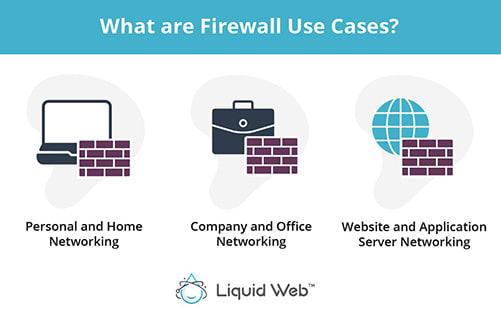
Private and House Networking
People who work or play from their house Web connection most definitely want a firewall. Most often, some firewall kind will get utilized in most working methods, house community routers, and antivirus software program. Except there’s a want past these commonplace strategies, not a lot else is critical in addition to a firewall. You may definitely seek the advice of together with your Web Service Supplier or an Data Know-how skilled for help with house networking.
Firm and Workplace Networking
Your workplace or workplace wants safety exterior of the fundamentals. Whether or not your infrastructure is about up in-house or hosted with a supplier, making certain information to and out of your servers is respectable and guarded is a necessity. It’s worthwhile to discover options for shielding your information and your servers.
Web site and Software Server Networking
Internet hosting websites and functions with a managed supplier nonetheless warrants a safe atmosphere. DoS assaults, malware, and different exploits to software program vulnerabilities are just some issues hackers deploy. With the correct configuration and guidelines in place, you possibly can lock down your web sites and functions from these out to get your information.
The way to Set up a Firewall
Right here’s tips on how to set up a firewall in six steps:
1. Safe Your Firewall
Administrator entry to your firewall ought to be restricted to solely these you belief. To preserve out any potential attackers, make certain your firewall is secured by at least one of the under configuration actions:
- Replace your firewall to the newest vendor-recommended firmware.
- Delete, disable, or rename any default person accounts, and change all default passwords. Make certain that you simply’re utilizing robust passwords.
- If a number of folks handle the firewall, create further accounts with restricted privileges primarily based on tasks. Don’t share person accounts. Observe the adjustments and observe who made what adjustments and why.
- Restrict the subnet of IPs from which firewall configuration adjustments could be made.
2. Architect Firewall Zones and IP Addresses
To guard your community’s information, it’s best to first acknowledge the kind of information. Subsequent, create a plan the place all the information is assembled in line with the enterprise and software wants. Construction your plan round information sensitivity stage, perform, and networks (or zones).
Usually, all servers that present web-based providers (e mail, VPN, and so on.) ought to be organized right into a devoted zone that limits inbound site visitors from the Web. This zone is commonly referred to as a demilitarized zone (DMZ). Accordingly, servers not accessed instantly from the Web ought to be positioned beneath inner server zones. These zones normally comprise workstations, database servers, and any level of sale (POS) or voice over web protocol (VoIP) units.
In case you are utilizing IP model 4, inner IP addresses ought to be used for all your inner networks. The community handle translation (NAT) have to be configured to permit inner units to speak on the Web when it is important (e.g., connecting modem, cable, and so on.).
After you have developed your community zone system and established the corresponding IP handle technique, you are ready to create your firewall zones and assign them to your firewall interfaces.
3. Configure Entry Management Lists
As soon as the community zones are specified and assigned to interfaces, you’ll develop firewall guidelines referred to as entry management lists (ACLs). ACLs decide which site visitors wants the authorization to circulation out and in of every zone. Your ACLs ought to be made as particular as doable.
To filter out unauthorized site visitors, create a deny-all rule on the finish of each ACL. Subsequent, use each inbound and outbound ACLs (entry management listing) for every interface. If doable, disable your firewall administration interfaces from public entry. Bear in mind to be as detailed as doable on this part.
Make certain to look into the firewall’s capability to regulate next-generation stage flows:
- Can it block site visitors primarily based on internet classes?
- Are you able to activate superior scanning of recordsdata?
- Does it comprise some stage of intrusion prevention system (IPS) performance?
4. Configure Your Different Firewall Providers and Logging
If most popular, the firewall ought to work as a community time protocol (NTP) server, dynamic host configuration protocol (DHCP) server, intrusion prevention system, and so on. Disable any providers you don’t plan to make use of.
5. Take a look at Your Firewall Configuration
Confirm that your firewall is obstructing site visitors that ought to be blocked in line with your ACL configurations. This could embody each penetration testing and vulnerability scanning. Make sure that you are retaining a safe backup of all firewall configurations in case of any failures.
If all the things checks out, your firewall is prepared for manufacturing. Earlier than making any adjustments, take a look at the method of reverting again to a configuration, make a remark, and take a look at your restoration process.
6. Firewall Administration
As soon as your firewall is configured and working accurately, you have to to keep up it to perform optimally. Make certain to replace firmware, carry out vulnerability scans, monitor logs, and assessment your configuration guidelines at the least each six months.
The way to Set up a Software program Firewall
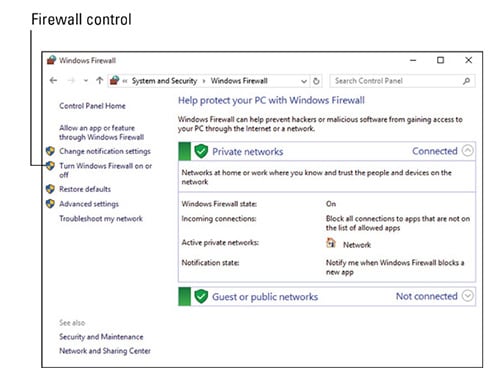
Home windows comes with a firewall referred to as Home windows Firewall. It’s accessed from the Management Panel. Please observe these steps to make sure the firewall is turned on:
- Open the Management Panel.
- Click on on the System and Safety heading.
- Click on on Home windows Firewall heading.
- Click on the Flip Home windows Firewall On or Off hyperlink on the left facet of the Home windows Firewall window.
The firewall has now been turned on.
Get Safe with a Liquid Internet {Hardware} Firewall
Liquid Internet is a proud Cisco store and shares a number of variations of its {hardware} firewall units. These units are additionally highly effective sufficient to deal with site visitors from a number of servers, together with devoted servers. We additionally make use of a full workers of devoted networking professionals 24/7/365 who can handle and preserve your fully-managed networking infrastructure. Get began with a {hardware} firewall at the moment.