

What’s SAN (Storage Space Community)?
SAN (storage space community) is a high-performance, high-speed community of storage, servers, and gadgets that permits entry to consolidated, block-level storage. A number of consumer gadgets can entry it, and it normally seems to the consumer OS as a disk. SAN storage separates the storage system from the remainder of the native space community (LAN). This manner, they enhance utility efficiency, information safety, and catastrophe restoration if wanted.
What Does SAN Storage Consist Of?
As already talked about, storage space networks are normally bodily separated from the remainder of the LAN and might span a number of websites. They’re composed of SAN switches, hosts, and storage gadgets which are related internally by means of a wide range of SAN applied sciences.

What are the Benefits of SAN?
The 5 benefits of system space networks are:
- Scalability: SAN storage might be scaled simply to go well with evolving enterprise wants. Must you want extra storage, extra capability might be added when and as it's required. That approach, you'll by no means have extra storage than you want.
- Backup: Information backup ought to at all times be a serious consideration, and if utilizing SAN, you solely want a single backup server for information that's probably scattered throughout a number of places.
- Reduces LAN Bandwidth Points: LAN-based storage techniques might be topic to bandwidth bottlenecks on account of the truth that a big chunk of the community site visitors is brought on by information transfers. Since SAN takes that a part of site visitors onto itself, the efficiency of all the LAN would enhance and reduce the time wanted for different duties.
- Information Safety: Utilizing a SAN, information safety algorithms are constant. Everytime you want it, you have got entry to correct copies of any information on it. Moreover, ought to the LAN change into compromised, your information could be safe since it's saved on a separate community.
- Catastrophe Restoration: Centralized information might be simply copied to a separate restoration system that’s ideally saved at a separate location as effectively. As such, if and when wanted, the information may also be simply recovered, ought to something disastrous occur.
What are the Disadvantages of SAN?
Listed here are three frequent disadvantages of utilizing SAN:
- Complexity: A SAN can add extra layers of complexity to present techniques, rising workload administration.
- Price: Implementing and managing a SAN might be cost-prohibitive for first-time customers.
- Administration: A SAN could also be difficult to handle and will require a devoted specialist to manage it.
The Most Frequent SAN Protocols
Listed here are three of the most typical SAN protocols used:
- Fibre Channel Protocol (FCP): That is essentially the most broadly used SAN or block protocol. It's deployed within the majority of the SAN market. FCP makes use of Fibre Channel transport protocols embedded with SCSI instructions.
- Web Small Laptop System Interface (iSCSI): iSCSI incorporates SCSI instructions inside an Ethernet body. For information transport, it makes use of an IP Ethernet community.
- Fibre Channel over Ethernet (FCoE): It's much like iSCSI because it incorporates an FC body inside an Ethernet datagram. It additionally makes use of an IP Ethernet community for transport.
How Does SAN Work?
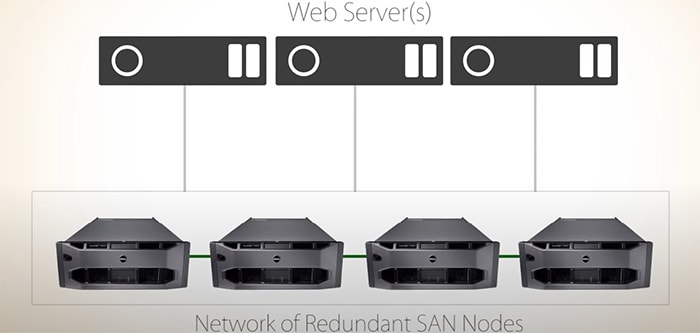
SAN gives a high-speed infrastructure connecting servers to their logical disk models. A logical disk unit is an array of blocks allotted from a pool of storage models which are introduced to the server as a logical disk.
Due to this fact, when connecting to a SAN from a LAN or a server, the SAN really seems like a neighborhood disk. It does that in a approach that any consumer system can retailer information on the logical unit, as it might on any native sort of storage system.
A well-designed and distributed SAN can face up to a number of system or element failures, retaining the information protected.
Use Instances for SAN
SAN has its personal native file system that allows the servers to partition and format the blocks to make use of because the native storage models they seem as. Storage space networks are used as help for performance-sensitive functions equivalent to:
- Oracle Databases: These are sometimes business-critical, and require the best efficiency and availability.
- Microsoft SQL Server Databases: MS SQL Server databases additionally normally retailer an enterprise’s most dear information. Due to this fact, additionally they require the best efficiency and availability.
- Virtualization Deployments utilizing KVM, Microsoft Hyper-V, or VMware: These environments can lengthen to 1000's of digital machines operating a variety of working techniques and functions, typically with various efficiency necessities. These environments help many functions, so infrastructure reliability turns into much more vital as a result of a failure could cause a number of utility outages.
- Giant Digital Desktop Infrastructures (VDIs): These environments serve digital desktops to typically giant numbers of a company’s customers. A few of them quantity tens of 1000's of digital desktops. By centralizing them, organizations can extra simply handle information safety.
- SAP, Giant ERP, or CRM Environments: SAN architectures generally is a excellent match for various useful resource planning and different useful resource administration workloads.
Relating to the {hardware}, HDDs are being changed or mixed with SSDs, thus creating hybrid arrays, in addition to all-flash SANs.
So then, what are the important thing variations between San vs NAS (network-attached storage)?
What's Community-Hooked up Storage (NAS)?
Community-attached storage (NAS) is a network-based storage answer. NAS storage is a technique of managing storage centrally and sharing that storage with a number of servers.
Not like SAN, which makes use of Ethernet and FC, NAS makes use of Ethernet. Moreover, NAS focuses on ease of use, decrease value of possession, and manageability.
One other distinction between the 2 is that NAS storage controllers partition the storage. This makes a NAS server seem like every other file server to the client-server related to it. Whereas SAN shops information on the block degree, NAS accesses it as recordsdata. Due to this fact, it’s normally related to unstructured information, equivalent to photographs or video content material, whereas SAN normally handles structured workloads like databases.
Hybrid and all-flash NAS {hardware} can be out there as a result of influence flash storage has had on storage mediums.
What are the Benefits of NAS?
Listed here are 5 benefits of utilizing NAS:
- Structure: NAS information lives in volumes of recordsdata and folders as an alternative of blocks in a typical client-server structure.
- Safety: NAS gives safety by way of consumer entry controls and redundant information constructions.
- Effectivity: NAS permits for a straightforward, fast, and low-cost methodology for information storage.
- Cheap: NAS is cheaper to buy and preserve, though the price of a high-end NAS will value greater than an entry-level SAN.
- Stability: Using NAS removes particular person servers as single factors of failure.
What are the Disadvantages of NAS?
There are a number of disadvantages to contemplate when selecting NAS:
- Single Level of Failure: As a result of NAS is taken into account a neighborhood on-site backup drive, failures can happen, resulting in information loss.
- Pace: Heavy use of a NAS system could cause vital community congestion and decrease switch pace.
- Scalability: NAS gadgets are usually not simply scalable as a result of limitations of the {hardware}.
- Quotas: System admins should implement consumer quotas to stop overutilization of shared area.
- Administration: Primary networking information is required to implement a NAS.
- Performance: Capabilities will fluctuate relying on producer, chip, and measurement. Sometimes, NAS is just used for storage.
The Most Frequent NAS Protocols:
Listed here are the 2 mostly used NAS protocols:
- Frequent Web File Companies/Server Message Block (CIFS/SMB): That is the protocol that Home windows normally makes use of.
- Community File System (NFS): NFS was first developed to be used with UNIX servers and can be a standard Linux protocol.
SAN vs NAS: An Overview
Make the most of the chart beneath to simply evaluate SAN vs NAS:
| SAN (Storage Space Community) | NAS (Community Hooked up Storage) |
|---|---|
| Often Extra Costly | Much less Costly |
| Excessive-Pace Connections Utilizing the Fibre Channel | Pace is Depending on the Native Ethernet Community |
| Sometimes Utilized in Enterprise and Skilled Environments | Sometimes Utilized in Houses or Small to Medium-Sized Companies (SMBs) |
| Requires Extra Administration | Simpler to Handle |
| Simply Scalable | Often Not Extremely Scalable |
| Requires Architectural Adjustments | No Architectural Adjustments Required |
| Redundant Functionalities and Fault-Tolerant Community | Usually Has Single Factors of Failure |
| Not Affected by Community Visitors Bottlenecks | Prone to Community Bottlenecks |
NAS or SAN: How Do You Select?
Sometimes, SMBs could be higher served to make the most of a NAS system, whereas bigger entities with the assets to put money into the structure and administration would revenue from using a SAN.
Here's a guidelines of things for consideration when reviewing the necessity for storage choices:
- Structure wants.
- Information processing fashions.
- Community protocols and capabilities.
- Efficiency constraints.
- Scalability necessities.
- Administration belongings.
- Backup challenges.
- Redundancy imperatives.
- Catastrophe restoration dictates.
- Storage virtualization choices.
- Worth (TCO).
Evaluating these parameters previous to investing in a storage system will present a clearer image when defining the wants of a company.
Selecting Versatile Storage
Whether or not you are storing databases or different kinds of information, a versatile space for storing like SAN storage is at all times a good suggestion. Community storage is cost-effective, distant, and secured, making it an ideal alternative for our more and more distant workforce of as we speak.
Test Out Liquid Net SAN Storage At the moment For Excessive-Efficiency Block-Stage Storage For Your Rising Infrastructure