

You might have heard about “robo-advisors” like Betterment and Wealthfront. Robo-advisors are funding corporations that use pc algorithms to speculate your cash (“robo” refers to a pc investing for you versus an costly adviser).
You’re in all probability questioning if they’re a very good funding and if you happen to ought to use one. As a NYT best-selling creator on private finance, let me break it down for you.
NOTE: When you’re searching for extra info on investing, I like to recommend trying out these different articles I wrote:
OR, make it straightforward on your self, and simply enter your e mail to get my Final Information To Private Finance under.
Why Robo-Advisors Turned Well-liked
Robo-advisors took the elite monetary planning companies supplied to purchasers of economic advisers and full-service funding corporations like Constancy and made them accessible to the common individual.
You know the way Uber made non-public vehicles extra accessible and handy than taxis? That’s type of what robo-advisors have carried out to the funding trade.
Robo-advisors carried out new expertise to supply funding suggestions for low charges. They improved the consumer interface so you possibly can join on-line, reply a couple of questions, and know precisely the place to speculate your cash in a couple of minutes.
They usually personalised the expertise so you possibly can add in your objectives—like while you wish to purchase a house—and robotically allocate cash apart for it.
Are Robo-Advisors a very good Funding?
I’ve a robust opinion on robo-advisors:
Whereas they’re good choices, I don’t assume they’re well worth the prices, and I imagine there are higher choices.
For instance, I particularly selected Vanguard and have caught with them for a few years.
Let me clarify the professionals and cons of robo-advisors so you can also make your personal determination.
Execs & Cons Of Robo-Advisors
Execs To Utilizing A Robo-Advisor
In the previous few years, robo-advisors have turn into more and more common for 3 causes:
■ Ease of use. They’ve stunning interfaces on the internet and in your cellphone. They provide low minimums and make it straightforward to switch your cash over and get began investing.
■ Low charges. Basically, their charges began off decrease than these of full-featured funding corporations like Constancy and Schwab. (These corporations shortly realized their competitors and lowered their charges accordingly, whereas the charges at low-cost corporations like Vanguard have at all times been low.)
■ Advertising claims. Robo-advisors make a lot of advertising and marketing claims. Some are true, similar to their ease of use. Some are disingenuous, bordering on absurd, like their concentrate on “tax-loss harvesting.”
As you’ve in all probability realized if you happen to’ve learn any of my different weblog content material on private finance, I’m an enormous proponent of something that expands using low-cost investing to unusual individuals.
Lengthy-term investing is a crucial a part of residing a Wealthy Life, so if corporations can strip away complexity and make it simpler to get began—even charging a typically low price—I’m a fan.
These robo-advisors have added phenomenal options which can be genuinely useful, together with planning for medium-term objectives like shopping for a home and long-term objectives like retirement.
What’s extra, you possibly can typically inform how good one thing is by who hates it.
For instance, Financial institution of America hates me as a result of I publicly name them on their bullshit. Good! Within the case of robo-advisors, commission-based monetary advisers typically hate them as a result of they use expertise to realize what many advisers have been doing—however cheaper.
Advisers’ logic on this isn’t particularly compelling. Monetary advisers primarily say that everybody is totally different they usually want particular person assist, not one-size-fits-all recommendation (unfaithful— relating to their funds, most individuals are largely the identical).
Robo-advisors have responded by including monetary advisers you possibly can speak to over the cellphone. Conventional monetary advisers say their recommendation supplies worth past the mere returns. (My response: Wonderful, then cost by the hour, not as a share of belongings underneath administration.)
Robo-advisors emerged to serve an viewers that was beforehand ignored:
younger people who find themselves digitally savvy, upwardly prosperous, and don’t wish to sit in a stuffy workplace getting lectured by a random monetary adviser.
Consider an worker at Google who doesn’t know what to do with their cash, which is simply sitting in a checking account. Robo-advisors have carried out a very good job of interesting to that viewers.
However the true concern right here is “Are they value it?”
My reply isn’t any—their charges don’t justify what they provide. The preferred robo-advisors have excellent consumer interfaces, however I’m not keen to pay for that. Since they opened, many robo-advisors have dropped their charges, typically even decrease than Vanguard.
The Downside With Robo-Advisors
However there are two issues with that: In an effort to run a sustainable enterprise on charges decrease than 0.4 %, they’ve to supply new, costlier options and handle large quantities of cash—we’re speaking trillions of {dollars}.
For instance, Vanguard at the moment manages 9 occasions greater than Betterment and ten occasions extra belongings than Wealthfront. That sheer, large scale is a large aggressive benefit to Vanguard, which constructed itself over many years to maintain on tiny fraction-of-a-percentage charges.
New robo-advisors can’t maintain on these low charges until they develop their enterprise quickly, which is unlikely. As a substitute, they’ve raised cash from enterprise capital buyers, who need fast progress.
In an effort to entice extra prospects, robo-advisors have begun utilizing advertising and marketing gimmicks like highlighting a minuscule a part of investing, “tax-loss harvesting”—which is mainly promoting an funding that’s right down to offset tax good points—that they blew up right into a seemingly critically essential a part of an account.
Why Tax Loss Harvesting Isn’t That Necessary
This could be like a automobile producer spending thousands and thousands of {dollars} advertising and marketing a triple coat of paint as some of the essential components of shopping for a automobile. Certain, tax-loss harvesting would possibly prevent a bit of cash over the long run . . . however not so much.
And in lots of circumstances, it’s pointless. It’s a “good to have” function, however hardly one thing on which it is best to base the essential determination of selecting what agency to speculate your cash with.
Some robo-advisors have additionally begun providing merchandise with increased charges, because the Wall Road Journal reported in 2018.
Wealthfront added a higher-cost fund of its personal. The providing makes use of derivatives to copy a well-liked hedge fund technique referred to as “risk-parity.”
Some purchasers—joined by client advocates and rivals—shortly took to on-line boards to criticize the fund’s prices and complexity. In addition they took Wealthfront to process for robotically enrolling sure prospects within the fund.
“I simply checked out my account & it’s true. There was cash moved into your ‘Threat Parity’ fund with out my consent,” Wealthfront buyer Cheryl Ferraro, 57 years outdated, of San Juan Capistrano, California, lately posted on Twitter.
“I had to enter my account and inform them I needed my cash moved out of that fund. It shook my confidence in them for positive,” Ms. Ferraro mentioned in an interview.
That is the predictable consequence when a low-cost supplier raises enterprise capital and must develop quickly. It both finds extra prospects or finds a method to earn more money from every buyer.
The Backside Line
I imagine Vanguard has the sting, and I make investments by means of them.
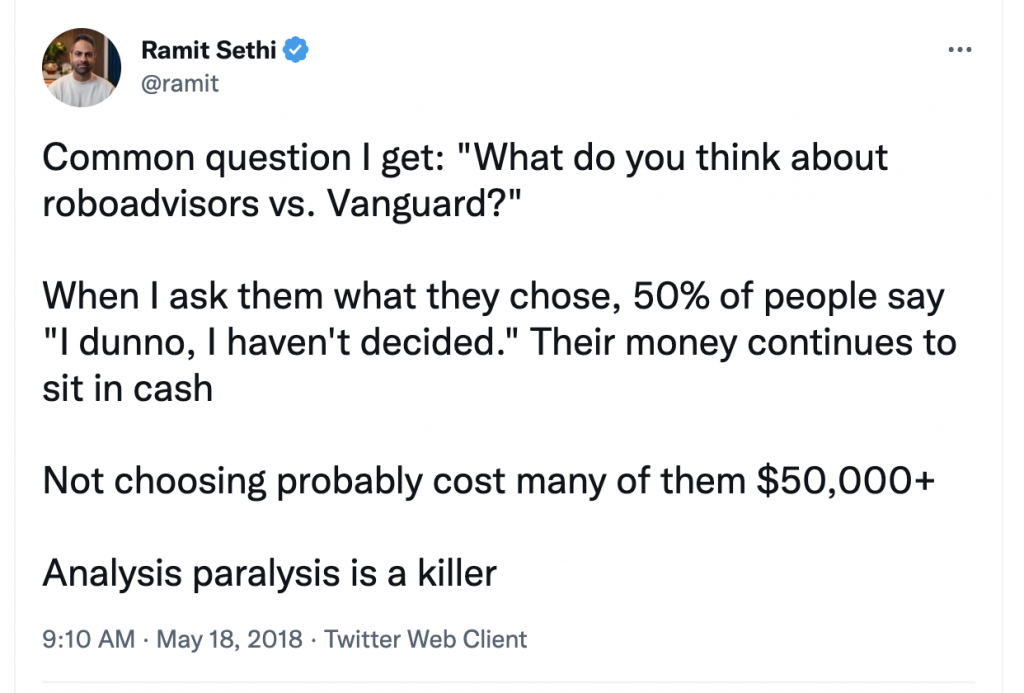
However notice this: By the point you’ve narrowed down your investing determination to a low-cost supplier like Vanguard or a robo-advisor, you’ve already made a very powerful alternative of all: to begin rising your cash in long-term, low-cost investments.
Whether or not you select a robo-advisor or Vanguard or one other low-fee brokerage is a minor element. Decide one and transfer on.