

What if there is a option to ensure you’re not overspending on know-how?
That is the place server consolidation will help. Consider it as decluttering your IT closet. Similar to how we sometimes clear out our wardrobes and do away with issues we don’t use, your IT infrastructure wants an identical type of tidying up. That is very true after your online business has grown or modified.
Server consolidation helps you ensure you’re solely utilizing the tech you actually need and nothing extra.
On this article, you’ll study all about server consolidation and why it’s so vital. As well as, you’ll uncover the very best instruments to make use of on this enterprise and perceive the best way to preserve your pc programs working easily and cost-effectively.
Understanding server consolidation
Server consolidation refers back to the means of combining a number of servers into fewer machines.
Think about you’ve a number of half-empty water bottles in your fridge. It isn’t the very best use of house, proper? Equally, many organizations run servers with out absolutely utilizing them—they’re like these half-empty water bottles.
By consolidating servers, you mix their duties into fewer machines, resulting in extra environment friendly use of every server and, importantly, chopping down on prices. Not solely that, you save on electrical energy and even the bodily house wanted to deal with these servers. It additionally simplifies your IT system, making administration and upkeep simpler.
Whereas the core thought of server consolidation is to make use of fewer servers extra effectively, there are alternative ways to do that. The commonest technique is thru virtualization.
The function of virtualization in server consolidation
Virtualization turns a single bodily server into a number of digital ones. It entails shifting from bodily to digital elements, permitting a number of digital programs to run on a single bodily {hardware} platform.
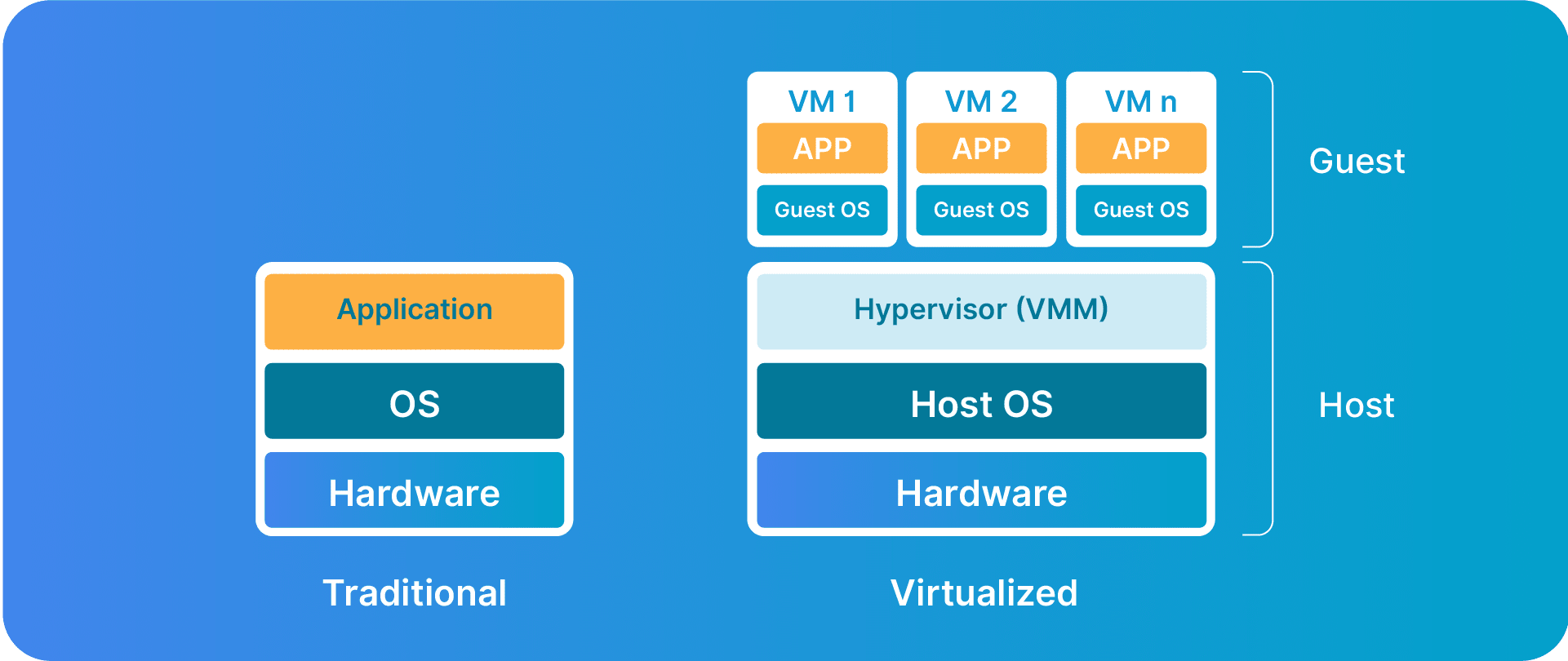
- Environment friendly useful resource use: Digital servers can share bodily assets like CPUs and storage extra effectively than bodily servers.
- Isolation and performance: Every Digital Machine (VM) is an remoted entity with the complete performance of a bodily server. This isolation ensures that the processes in a single digital server don’t have an effect on others.
The hypervisor is important for virtualization. It acts as a platform to handle the digital machines and permits the bodily host to assist a number of digital environments. The hypervisor handles the distribution of bodily assets among the many digital machines, making certain every will get what it must function successfully.
There are two kinds of hypervisors:
- Kind 1 (naked steel): This hypervisor runs immediately on the host’s {hardware} to manage the {hardware} and handle visitor working programs. Examples embrace VMware ESXi and Microsoft Hyper-V.
- Kind 2 (hosted): This hypervisor runs on a standard working system, similar to different pc applications. Examples embrace VMware Workstation and Oracle VirtualBox.
Benefits of virtualization in IT operations
- Scalability: Virtualization makes it simple to scale IT operations. New VMs or digital servers could be created with out the necessity for extra bodily {hardware}.
- Flexibility: It permits for fast deployment and reconfiguration of assets as wants change, providing a excessive diploma of operational flexibility.
- Safety: The isolation of VMs implies that if one is compromised, the others stay unaffected. Additionally, safety insurance policies could be utilized uniformly throughout all digital machines.
- Price-effectiveness: Reduces {hardware} prices and operational bills associated to energy, cooling, and upkeep.
- Catastrophe restoration and backup: Virtualization simplifies backup and catastrophe restoration processes, as digital machines could be simply replicated and restored.
The advantages of server consolidation
Think about a corporation with three servers: one working at full capability (100%), one other at 50%, and the third solely at 15%. This setup signifies an imbalance in useful resource utilization.
The underutilization of the second and third servers means that their workloads might be mixed, permitting the group to function successfully with simply two servers as an alternative of three. It is a prime state of affairs for server consolidation, the place virtualization can merge the workloads of the lesser-used servers onto a single machine.
Monetary advantages
- Discount in {hardware} prices: By consolidating servers, the necessity for bodily {hardware} diminishes. This discount results in important financial savings in {hardware} acquisition and substitute prices.
- Decrease power use: Fewer servers imply much less power consumption for operation and cooling, leading to decrease utility payments.
- Decreased upkeep prices: Fewer servers to take care of means decreased {hardware} upkeep prices, together with repairs and upgrades.
Operational advantages
- Improved effectivity: Server consolidation sometimes results in extra environment friendly use of server assets, making certain that computing energy and storage usually are not wasted.
- Simpler server administration: Managing fewer servers simplifies duties corresponding to updates, monitoring, and troubleshooting.
- Greater server utilization: By consolidating servers, every machine is used extra successfully, maximizing its potential.
- Improved load balancing: A consolidated server atmosphere can extra successfully distribute workloads, making certain optimum efficiency.
- Higher enterprise continuity planning: With fewer however extra environment friendly and dependable servers, implementing backup and catastrophe restoration options turns into extra easy, enhancing enterprise continuity.
Flexibility advantages
- Sooner deployment instances: In a consolidated and virtualized atmosphere, deploying new purposes and providers could be carried out extra shortly.
- Simpler scalability: As enterprise wants change, it is simpler to scale assets up or down in a consolidated atmosphere. Virtualization permits for the addition of digital servers with out the necessity for brand spanking new bodily {hardware}.
- Versatility in operations: Consolidated servers, notably by means of virtualization, can run a number of working programs and purposes on a single server. This versatility is essential for companies that use a wide range of software program and platforms.
Related prices of server consolidation
Whereas server consolidation presents quite a few long-term advantages, it is important to acknowledge and plan for the related prices that include this course of. These prices could be categorized into preliminary funding, planning and execution, potential downtime, and coaching.
Preliminary funding prices
- Virtualization software program licenses: To implement server consolidation successfully, organizations usually have to buy virtualization software program. Relying on the chosen platform (like VMware or Hyper-V), these licenses can characterize a big preliminary funding.
- New {hardware}: In some instances, server consolidation might require upgrading or buying new {hardware}. This might embrace extra highly effective servers to deal with the consolidated workloads or further storage options.
Planning and execution prices
The planning part is essential for profitable server consolidation. It entails assessing present server utilization, figuring out the best way to mix workloads successfully, and creating an in depth implementation plan. This part requires important time and assets, usually involving IT employees and doubtlessly exterior consultants.
Prices related to downtime
In the course of the consolidation course of, there could also be durations of downtime, which may have an effect on enterprise operations. The price of this downtime varies relying on the character of the enterprise and the period of the consolidation course of.
Coaching prices
Managing the consolidated server atmosphere successfully might require new expertise. This could embrace coaching on the particular virtualization platform used and greatest practices for managing and sustaining a consolidated server setup.
Regardless of these upfront and related prices, server consolidation is usually an economical technique in the long term. It’s important to plan and implement the consolidation course of fastidiously:
- Minimizing prices: By totally assessing present and future wants, organizations can keep away from pointless expenditures on {hardware} and software program.
- Easy transition: A well-planned consolidation course of can cut back downtime and disruption, thereby minimizing the impression on enterprise operations.
- Efficient coaching: Investing in correct coaching for IT employees ensures that they handle the brand new system successfully, maximizing the advantages of consolidation.
Strategies of server consolidation
Server consolidation could be achieved by means of numerous strategies, every with its personal implications for system configuration, downtime, and price effectivity. Understanding these strategies helps in deciding on probably the most acceptable strategy for a corporation’s particular IT infrastructure and consolidation objectives.
Technique 1: Bodily-to-physical consolidation
This technique entails changing a number of older servers with fewer, extra highly effective servers or server clusters. As a substitute of a number of underperforming machines, this technique consolidates the workload onto a smaller variety of servers. These newer servers are sometimes extra superior, providing higher processing energy, larger storage capability, and higher power effectivity.
Bodily-to-physical consolidation carries a number of implications that organizations want to think about:
- System configuration adjustments: Introducing new {hardware} usually requires important adjustments within the IT infrastructure. This may embrace reconfiguring community settings, adjusting storage options, and probably updating or changing different associated {hardware} elements to make sure compatibility with the brand new servers.
- Integration challenges: New servers might have totally different specs and capabilities, necessitating changes in software program configurations, working programs, and even the purposes being run.
- Information migration: Transferring information from older servers to new ones could be a vital course of, usually requiring cautious planning to make sure information integrity and safety. Relying on the quantity and nature of the information, this course of could be complicated.
- Downtime administration: Changing bodily servers usually entails some degree of downtime, throughout which providers will not be out there. Planning for this downtime and minimizing its impression on enterprise operations is important.
- Funding: Buying new, extra highly effective servers represents a big capital expenditure. Whereas that is an upfront price, it must be balanced in opposition to the long-term financial savings and advantages.
The success of this technique depends on balancing the fast wants and prices with the long-term operational efficiencies and alignment with the general IT technique.
Technique 2: Bodily-to-virtual (P2V) consolidation
P2V consolidation is a particular technique of server consolidation the place bodily servers are transformed into digital machines. This course of is a part of implementing virtualization in an IT atmosphere.
This consolidation strategy comes with a number of challenges:
- {Hardware} compatibility and upgrades: The present bodily {hardware} have to be evaluated for compatibility with virtualization. In some instances, {hardware} upgrades is likely to be essential to assist the virtualized atmosphere effectively.
- Community and storage reconfiguration: Virtualization usually requires adjustments in community structure and storage configurations to accommodate the digital machines and guarantee optimum efficiency.
- Downtime administration: Whereas virtualization can reduce downtime in the long term, the preliminary setup and migration may require taking programs offline, impacting enterprise operations.
- Server administration and upkeep: The strategy to server administration adjustments considerably in a digital atmosphere. Duties corresponding to backups, updates, and monitoring will should be tailored to the digital setup.
Technique 3: Digital-to-virtual (V2V) consolidation
V2V, also called rationalized consolidation, entails combining digital servers with frequent workloads into fewer digital servers. The first intention is to reinforce the usage of assets like CPU, reminiscence, and storage throughout the digital atmosphere. This results in higher efficiency and may cut back the necessity for extra bodily {hardware}.
Nevertheless, you must preserve the next implications in thoughts:
- Digital machine administration: The consolidation course of might require important administration of VMs, together with merging, reallocating, or decommissioning some VMs.
- Community configuration: Changes in digital community settings is likely to be essential to accommodate the consolidated digital servers and guarantee optimum communication and efficiency.
- Potential software program prices: There could also be prices related to virtualization administration instruments or software program required to facilitate the consolidation course of.
Technique 4: Cloud migrations
Cloud migration entails shifting information, purposes, and different enterprise parts from a corporation’s on-premise bodily servers to cloud-based servers. This could be a public cloud, a personal cloud, or a hybrid of each.
Cloud migrations can considerably cut back the necessity for bodily servers and {hardware} within the group, because the cloud supplier takes over the duty for sustaining the bodily infrastructure.
Transferring to the cloud represents a shift from a capital expenditure mannequin (the place you put money into bodily {hardware}) to an operational expenditure mannequin (the place you pay for cloud providers based mostly on utilization). It usually presents higher scalability and suppleness, permitting organizations to shortly modify assets based mostly on their present wants.
Implications of cloud migrations
Among the implications of cloud migrations embrace:
- Infrastructure overhaul: Migrating to the cloud usually requires re-architecting purposes for cloud compatibility, which could be a complicated and technical course of.
- Information migration challenges: Safely transferring information to the cloud is a vital activity that requires cautious planning to make sure information integrity and reduce the chance of knowledge loss.
- Integration with present programs: Guaranteeing seamless integration between cloud providers and present on-premise programs could be complicated, notably in hybrid cloud setups.
- Change in IT employees roles: The function of IT employees might shift from conventional server upkeep to extra strategic duties like managing cloud providers, overseeing safety within the cloud, and optimizing cloud useful resource utilization.
- Price construction shift: Migrating to the cloud sometimes adjustments the price construction from a Capital Expenditure (CapEx) mannequin to an Operational Expenditure (OpEx) mannequin. This shift can impression budgeting and monetary planning.
- Ongoing subscription prices: Cloud providers often contain persevering with subscription charges, which require cautious administration to keep away from price overruns.
- Information sovereignty and privateness legal guidelines: Organizations should take into account information sovereignty and cling to relevant information privateness rules like HIPAA and PCI, which could be difficult when information is saved in cloud servers probably positioned in numerous jurisdictions.
- Regulatory compliance: Guaranteeing compliance with industry-specific rules turns into vital, particularly in sectors like finance and healthcare.
Selecting the very best technique
The collection of the very best technique for server consolidation will depend on a number of components:
- Present IT infrastructure: Assess the present setup to find out which technique aligns greatest with the present {hardware}, software program, and community structure.
- Enterprise necessities: Contemplate the group’s particular wants, together with efficiency, scalability, and information safety necessities.
- Price range constraints: Consider the out there funds for preliminary investments and ongoing prices.
- Future development and scalability: Anticipate future wants to make sure the chosen technique can accommodate development and altering calls for.
- Experience and assets: Assess the in-house experience and assets out there to handle the consolidation course of and the post-consolidation atmosphere.
Planning the steps for server consolidation
Planning and executing server consolidation is a multi-step course of that requires cautious consideration at every stage to make sure a clean transition and profitable implementation. Right here’s an in depth information on the best way to strategy every step:
1. Preparatory evaluation and decision-making
Start with an intensive evaluation of your present server infrastructure. This consists of understanding the capability, efficiency, and utilization of present servers. Align the consolidation plan with enterprise wants and goals. Contemplate components like scalability, efficiency necessities, and future development.
After you have carried out this, consider potential dangers related to consolidation, together with information loss, safety vulnerabilities, and compatibility points.
2. Selecting the very best technique of server consolidation
Primarily based on the preliminary evaluation, take into account probably the most appropriate consolidation technique(s): physical-to-physical (P2P), physical-to-virtual (P2V), virtual-to-virtual (V2V), or cloud migrations.
Conduct a cost-benefit evaluation for every technique, contemplating each short-term and long-term monetary implications. If wanted, chat with IT consultants or consultants to assist make an knowledgeable resolution.
3. Planning for downtime and mitigation
Plan for potential downtime, scheduling it throughout off-peak hours to reduce enterprise disruption. Develop a communication technique to tell stakeholders concerning the consolidation course of and anticipated downtimes.
Be sure to set up contingency plans for surprising points through the consolidation course of.
4. Testing and troubleshooting post-consolidation
Arrange a testing atmosphere to guage the consolidated servers earlier than going reside. Conduct complete assessments to make sure all purposes and providers are functioning as anticipated. Develop a troubleshooting protocol to handle any points that come up throughout or after the consolidation.
5. Steady monitoring and efficiency checks
Implement monitoring instruments to constantly monitor the efficiency of the consolidated server atmosphere. Set up key efficiency metrics to evaluate the effectivity and success of the consolidation. Additionally, schedule common opinions of the server atmosphere to make sure it continues to fulfill enterprise wants and operates effectively.
6. Making a timeline
Develop an in depth timeline for the consolidation course of, outlining every part and its anticipated period. Be sure that all mandatory assets, together with bodily elements, digital licenses, and human assets, can be found as wanted.
7. Contemplating exterior help
If in-house experience is restricted, take into account hiring a specialist accomplice to information and help within the consolidation course of. Alternatively, partnering with an IT infrastructure service supplier could be an choice, particularly for cloud migrations or in case you are searching for to outsource server administration.
The success of server consolidation hinges on cautious planning, knowledgeable decision-making, and efficient execution. Every step, from preliminary evaluation to steady monitoring post-consolidation, performs a vital function in making certain that the consolidation delivers the specified advantages of improved effectivity, decreased prices, and enhanced efficiency.
Server consolidation with Liquid Internet
Liquid Internet is a proficient and dependable supplier with regards to server consolidation, providing an array of providers tailor-made to reinforce IT infrastructure effectivity and efficiency.
Core IT infrastructure choices by Liquid Internet
- Devoted server internet hosting, which incorporates server virtualization, which is crucial for environment friendly server consolidation.
- Excessive-quality VMware choices, which give a number of VMware options. Its strong options are perfect for creating and managing digital machines, that are essential in server consolidation.
Server consolidation assist
- White-glove migrations that facilitate the graceful transition of your present information facilities or host infrastructures to their platform. This service is especially precious for companies seeking to reduce downtime and guarantee information integrity through the migration course of.
- Optimization and consolidation that guarantee your servers usually are not solely hosted but in addition optimized and consolidated for optimum effectivity, cost-effectiveness, and efficiency.
- Totally managed consolidation service the place Liquid Internet’s consultants take the reins in managing server consolidation, making certain that your IT infrastructure operates optimally with out requiring fixed oversight out of your finish.
Supported strategies and strengths
- P2V: Liquid Internet’s virtualization options, notably with VMware, assist P2V consolidation, serving to to transition from bodily servers to a extra versatile and environment friendly digital atmosphere.
- V2V: For companies already working in a virtualized atmosphere, Liquid Internet can help in additional optimizing these digital servers for improved efficiency and useful resource utilization.
- Cloud migrations: Liquid Internet’s experience extends to cloud providers, serving to prospects migrate information and purposes to cloud-based options, whether or not public, non-public, or hybrid.
Advantages of utilizing Liquid Internet for server consolidation
- Totally managed internet hosting: Liquid Internet’s managed internet hosting takes away the complexity of managing server infrastructure, permitting companies to deal with their core actions.
- Business-leading customer support: Identified for its distinctive customer support, Liquid Internet ensures that you’ve entry to assist and experience at any time when wanted.
- Seamless consolidation expertise: Their infrastructure and providers are designed to facilitate clean and efficient server consolidation with minimal disruption to enterprise operations.
- Aggressive edge: Liquid Internet’s capabilities usually exceed these of its rivals, notably by way of reliability, scalability, and safety.
- Strong assist choices: With a variety of assist choices out there, Liquid Internet ensures that every one your server consolidation and internet hosting wants are met promptly and successfully.

Selecting Liquid Internet for server consolidation means entrusting your IT infrastructure to a supplier that provides a completely managed, hands-off expertise. You’ll acquire the benefit of superior know-how coupled with distinctive buyer assist, making certain your server consolidation is profitable.
Get a hands-off, optimized IT infrastructure with Liquid Internet
Navigating by means of quickly evolving applied sciences and sustaining effectivity could be overwhelming, and creating an efficient IT infrastructure presents a fancy problem for companies and organizations.
Server consolidation is a vital step towards optimizing your IT infrastructure, streamlining operations, and enhancing general efficiency. It considerably reduces IT prices by minimizing {hardware} expenditures, reducing power consumption, and chopping down on upkeep and operational bills. It additionally results in a extra streamlined IT atmosphere, with improved useful resource utilization, simpler administration, and enhanced system reliability.
Partnering with a specialist IT service supplier like Liquid Internet can considerably ease the consolidation course of. Liquid Internet providers carry experience, assets, and assist that is likely to be past the scope of in-house capabilities.
Take step one towards a cheaper and highly effective IT atmosphere by exploring server consolidation choices. Contact Liquid Internet as we speak to raise the efficiency and effectivity of your IT infrastructure!