

Final Up to date: October 2026
10 Min Learn
Peer-Reviewed & Manufacturing-Examined
⚡ CI/CD Deployment on VPS: Govt Abstract
- Limitless Concurrency & Zero Metered Minutes: Operating self-hosted GitHub Actions or GitLab CI runners on a devoted VPS eliminates costly SaaS build-minute overages and queue throttling.
- Persistent Docker Construct Caching: Native NVMe storage preserves Docker layer caches throughout construct runs, slicing steady integration pipeline execution occasions from 10 minutes to below 45 seconds.
- Zero-Downtime Blue-Inexperienced Deploys: Automated containerized pipelines swap visitors between utility variations seamlessly through Nginx/Traefik reverse proxies with out dropping customer requests.
- Agile Cloud Compute: Deploying on a versatile USA VPS internet hosting server gives devoted multi-core CPUs and quick NVMe storage to energy steady software program supply.
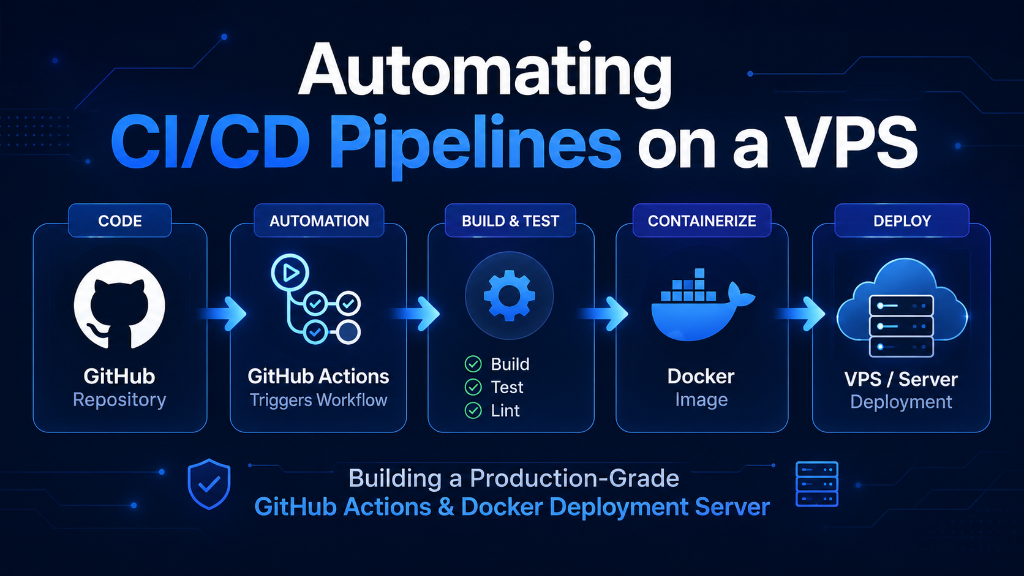
Fast Reply: Automating CI/CD Pipelines on a VPS: Constructing a Manufacturing-Grade GitHub Actions & Docker Deployment Server
✓ Professional Verified
Automating CI/CD deployment pipelines on a VPS includes configuring GitHub Actions self-hosted runners and Docker containerization. This isolates construct environments, streamlines steady supply, and permits zero-downtime rolling updates with automated rollback triggers.
1. Introduction: Modernizing Software program Supply Pipelines
In high-velocity software program engineering, handbook utility deployments—equivalent to dragging information over FTP, working unversioned handbook shell instructions through SSH, or executing database migrations throughout reside upkeep home windows—signify extreme operational anti-patterns. Handbook releases are inherently vulnerable to human error, atmosphere drift, lacking dependencies, and extended surprising downtime. Fashionable engineering requirements demand automated, repeatable, and audited deployment pipelines.
Strategic Concerns & Core Structure Drivers
To realize engineering velocity and software program reliability, improvement groups standardize on Steady Integration and Steady Deployment (CI/CD). CI/CD automates each stage of the discharge lifecycle: working automated unit and integration check suites on each pull request, compiling optimized manufacturing belongings, packaging functions into immutable Docker containers, and executing zero-downtime rolling deployments.
Whereas managed SaaS CI/CD runners (like GitHub-hosted or GitLab-hosted shared runners) are handy for small initiatives, they rapidly turn into an costly bottleneck as improvement groups scale. Public cloud runners implement strict concurrency limits, meter execution minutes at premium charges, and wipe Docker layer caches between each job run, forcing lengthy, repetitive construct cycles.
Deploying a devoted, self-hosted CI/CD construct and staging runner on a high-compute Digital Non-public Server utterly transforms pipeline economics. With devoted multi-core CPUs, persistent native NVMe construct caches, and limitless execution minutes, improvement groups speed up deployment suggestions loops by over 80% whereas dramatically lowering operational overhead.
Moreover, self-hosted CI/CD infrastructure permits seamless integration with non-public knowledge heart networks, remoted staging databases, and proprietary inside packages with out exposing inside API endpoints to public networks. This architectural management ensures end-to-end safety compliance throughout regulated improvement environments.
By leveraging standardized container packaging with Docker Compose, groups set up full parity between native improvement machines, staging environments, and manufacturing clusters. Eliminating the traditional ‘it really works on my machine’ dilemma permits speedy iteration and assured every day manufacturing releases. This streamlined workflow reduces time-to-market for brand new options whereas sustaining excessive platform stability.
Deploying on versatile USA VPS internet hosting delivers the uncooked compute energy and NVMe storage bandwidth wanted to run strong CI/CD automation. On this complete technical information, we analyze self-hosted runner structure, evaluate construct efficiency benchmarks, clarify Blue-Inexperienced zero-downtime deployments, and supply an actionable hands-on runbook.
2. Architectural Fashions: Handbook FTP/SSH Deploys vs. Automated CI/CD VPS
Evaluating handbook deployment fragility in opposition to automated containerized CI/CD pipelines illustrates why trendy DevOps groups automate releases.
|
Handbook & Fragile Handbook FTP / SSH DeploymentBuilders manually copy information, execute reside database migrations, and restart companies through SSH. Excessive threat of human typos, model mismatch, and surprising downtime. Vulnerability: Zero rollback automation & excessive error charge. |
Automated & Resilient Automated CI/CD VPS EngineGitHub Actions triggers automated testing, builds cached Docker pictures, and executes zero-downtime Blue-Inexperienced container deployment with 1-click rollback. Benefit: 100% automated, zero downtime & persistent layer caching. |
3. Core Idea: Constructing a Self-Hosted CI/CD Deployment Structure
An enterprise CI/CD deployment server on a VPS is structured round 5 core architectural pillars:
Software program improvement groups profit immensely from provisioning devoted VPS internet hosting environments for builders and staging to check container builds in an remoted sandbox earlier than manufacturing launch.
1. Self-Hosted Runner Orchestration
The GitHub Actions runner or GitLab Runner daemon runs as an remoted systemd service in your VPS. It maintains a safe outbound long-polling connection over HTTPS (port 443) to GitHub/GitLab servers. As a result of the connection is outbound solely, you do not want to open incoming firewall ports or expose your deployment server to public web scans.
2. Persistent Docker Layer & Bundle Caching
SaaS-hosted CI runners spin up contemporary, ephemeral digital machines that begin with chilly caches. Each job should re-download giant Docker base pictures, node_modules dependencies, and composer libraries. On a self-hosted VPS runner, Docker BuildKit caches layers domestically on enterprise NVMe storage. When code modifications are pushed, solely the modified utility layer is rebuilt, slashing construct occasions from minutes to seconds.
3. Blue-Inexperienced Zero-Downtime Deployment Switching
To stop customer disruption throughout releases, the CI/CD pipeline deploys new utility containers to a secondary port (Inexperienced atmosphere). The pipeline executes automated well being checks in opposition to the Inexperienced container. As soon as verified wholesome, Nginx or Traefik seamlessly reloads its upstream configuration to direct reside manufacturing visitors to Inexperienced, terminating the outdated Blue container with zero dropped connections.
4. Ephemeral Staging & Dynamic PR Preview Environments
A devoted CI/CD VPS can routinely provision remoted preview environments for open Pull Requests (e.g., pr-142.staging.yourdomain.com). QA engineers and stakeholders can interactively check options earlier than merging to manufacturing. When the PR is merged or closed, the runner routinely dismantles the container and reclaims sources.
5. Enterprise Secrets and techniques Administration & GitOps Governance
Securing API credentials, database passwords, and TLS certificates is significant throughout steady supply. Manufacturing pipelines inject atmosphere secrets and techniques dynamically at runtime utilizing encrypted secret administration shops (equivalent to HashiCorp Vault or GitHub Encrypted Secrets and techniques) fairly than hardcoding delicate tokens in supply repositories. This ensures strict GitOps governance and compliance audits.
6. In-Reminiscence tmpfs RAM Mounts for Excessive-Pace Check Execution
Unit check suites and SQLite check database fixtures carry out 1000’s of ephemeral file write operations that may saturate bodily disk controllers. By mounting momentary check directories on in-memory tmpfs RAM filesystems (e.g., /tmp/build-cache), check runners execute I/O operations immediately in bodily server reminiscence at over 40,000 MB/sec. This optimization reduces integration check suite runtimes by as much as 75% in comparison with disk-bound runners.
4. Efficiency & Economics Matrix: Hosted SaaS CI vs. Self-Hosted VPS
Assessment the operational variations and monetary economics between cloud-hosted SaaS runners and a devoted VPS deployment server:
| Operational Metric | GitHub-Hosted SaaS Runners | Devoted Self-Hosted VPS Runner |
|---|---|---|
| Construct Minutes & Quotas | Metered (2,000 free, then $0.008/min) | 100% Limitless (Zero Overage Charges) |
| Docker Layer Caching | Chilly Cache (Re-download base pictures) | Persistent Native NVMe Layer Caching |
| Common Construct Length | 6 – 12 Minutes (Chilly begin) | 30 – 60 Seconds (Cached) |
| Parallel Job Concurrency | Restricted by billing tier plan | Full Multi-Core Parallel Execution |
| Month-to-month Price at Scale | $150 – $600+/month | Flat $20 – $60/month (Fastened VPS) |
5. Actual-World Purposes: Workloads Excelling on CI/CD VPS Servers
Uncover how improvement groups leverage devoted VPS deployment engines to streamline operations:
Steady deployment pipelines signify only one side of contemporary server utility; uncover extra important use circumstances and functions for Linux VPS internet hosting to maximise server effectivity.
💻 Full-Stack Internet Apps (Subsequent.js / Laravel)
Automate TypeScript compilation, database migrations, and container restarts on each push to foremost with zero handbook intervention.
🐳 Multi-Service Docker Fleets
Run parallel integration check suites with Redis, PostgreSQL, and RabbitMQ sidecars on devoted NVMe storage with out useful resource throttling.
⚡ Ephemeral PR Preview Environments
Mechanically spin up staging previews for function branches with dynamic subdomains, tearing them down upon pull request merge.
📦 Non-public Bundle & Docker Registries
Host safe non-public Harbor or Verdaccio registries domestically in your VPS for speedy, unmetered artifact distribution throughout your infrastructure.
6. Deployment Runner Comparability: Self-Hosted VPS vs. Alternate options
Examine core runner deployment fashions throughout trendy DevOps environments:
| Characteristic Dimension | Self-Hosted VPS Runner | GitHub-Hosted Runner | Kubernetes Runner Cluster |
|---|---|---|---|
| Setup Complexity | Easy (5 minutes) | Zero (Managed) | Excessive (Kube manifests) |
| Construct Pace & Caching | Quickest (Native NVMe) | Sluggish (Chilly ephemeral) | Reasonable (PV mounted) |
| Non-public Community Entry | Direct VLAN / Localhost | Requires VPN / OIDC tunnel | Direct Cluster Ingress |
| Useful resource Price Effectivity | Most (Fastened VPS worth) | Low (Metered minutes) | Reasonable (Cluster overhead) |
7. Arms-On Implementation: Setting Up GitHub Actions Runner & Docker on VPS (PuTTY Terminal Information)
Execute these manufacturing instructions immediately in your PuTTY terminal to put in Docker, configure the GitHub Actions runner daemon, and deploy a zero-downtime Blue-Inexperienced deployment pipeline:
Step 1: Set up Docker Engine and Docker Compose V2 on Ubuntu 22.04/24.04
Arrange official Docker repository and set up container runtimes:
Step 2: Set up and Register GitHub Actions Runner Daemon as a Systemd Service
Obtain runner binaries and register together with your repository token:
Step 3: Outline Manufacturing CI/CD Workflow (.github/workflows/deploy.yml)
Configure automated testing, cached Docker builds, and zero-downtime deployment:
Step 4: Configure Blue-Inexperienced Zero-Downtime Nginx Proxy Switching
Create zero-downtime upstream visitors switcher script in /usr/native/bin/switch-env.sh:
Step 5: Lock Down Runner Permissions & Allow Automated Cache Pruning
Schedule automated Docker picture cleanup to forestall disk exhaustion:
Step 6: Configure Docker Container Well being Checks and Automated Rollback
Outline native container well being probes in docker-compose.prod.yml to set off instantaneous rollback if containers fail:
💡 Professional Tip: Leverage Docker BuildKit for Quick Multi-Stage Builds
Add export DOCKER_BUILDKIT=1 to your runner’s atmosphere. BuildKit executes unbiased construct phases in parallel, skipping unused construct targets and slicing compilation occasions by as much as 60%.
⚠️ Safety Warning: By no means Connect Self-Hosted Runners to Public Repositories
By no means register self-hosted runners on public GitHub repositories. Anybody can open a malicious Pull Request containing arbitrary workflow instructions that execute immediately with Docker root privileges in your VPS. Prohibit self-hosted runners completely to non-public repositories and guarded branches.
🎯 Key Takeaways & CI/CD Abstract
- Limitless Construct Minutes: Remove SaaS overage charges with a devoted self-hosted CI/CD VPS runner.
- Blazing NVMe Caching: Persistent Docker layer caching reduces pipeline execution occasions from minutes to seconds.
- Zero-Downtime Blue-Inexperienced Deploys: Launch manufacturing updates seamlessly through Nginx upstream reload switching.
- Enterprise DevOps Basis: Deploying on a dependable USA VPS internet hosting platform gives devoted CPU threads and excessive NVMe IOPS to energy steady deployment pipelines.
Often Requested Questions (FAQ)
FINAL VERDICT & CONCLUSION
Strategic Advice
Conclusion: Driving Enterprise Progress with Enterprise VPS Internet hosting
Deploying mission-critical functions on high-performance Enterprise VPS Internet hosting infrastructure gives the devoted processing energy, community pace, and reliability demanded by trendy internet customers.
Whether or not managing high-traffic e-commerce portals, streaming media, or company databases, Onlive Server delivers enterprise-grade {hardware}, 24/7 technical help, and aggressive pricing for world success.
Conclusion: Strategic Structure Roadmap for US Companies
Constructing a high-performance, safe, and scalable cloud infrastructure requires aligning compute sources, community proximity, and storage subsystems with utility calls for.
By deploying on devoted KVM digital non-public servers powered by trendy Linux kernels and enterprise {hardware}, US organizations guarantee most operational uptime, seamless scalability, and superior consumer experiences throughout North American and world markets.