


Safety threats could cause severe hurt to on-line companies. Attackers use varied instruments and methods to do malicious actions throughout the community, all of those impacting the corporate’s income. Therefore, it’s important to have tight safety in your community methods. Any intrusion can lead to extreme monetary and reputational loss. Among the frequent safety points embrace coverage breaches, unauthorized community penetration, or insider assaults. That is the place an intrusion detection system (IDS) may also help. It analyzes exercise and sends an alert notification if any suspicious exercise is recognized.
This information incorporates all of the related data you could perceive the mechanism of a host-based intrusion detection system and the way it works.
What’s a Host-Primarily based Intrusion Detection System (Host-Primarily based IDS)?
A number-based intrusion detection system (HIDS or host-based IDS) makes use of built-in intrusion signatures to detect potentially-suspicious actions that might trigger injury to your community system. It helps you retain your units repeatedly in test by observing purposes and units working in your system so as to stop an intrusion. Host-based IDS gives software program that tracks adjustments and processes the knowledge collected from pc methods.
What Does a Host-Primarily based Intrusion Detection System IDS Do?
Listed here are 5 issues you may anticipate a HIDS to perform:
- Consider Visitors: Consider the incoming and outgoing site visitors on a selected pc on which the IDS software program is put in.
- Signature-Primarily based Detection: Make the most of a signature-based detection technique to match the signatures discovered within the community site visitors towards a database of malicious signatures.
- Menace Intelligence: Incorporates risk intelligence options akin to HIDS brokers which assist acknowledge and remove any malicious exercise current throughout the system.
- Monitor Essential Information: Scrutinize essential system information.
- Notification of Intrusion: Establish and notify you if there was any try to overwrite essential information.
Therefore, your units and purposes will stay protected the entire time.
How Does a Host-Primarily based Intrusion Detection System Work?
Right here is how a host-based IDS works:
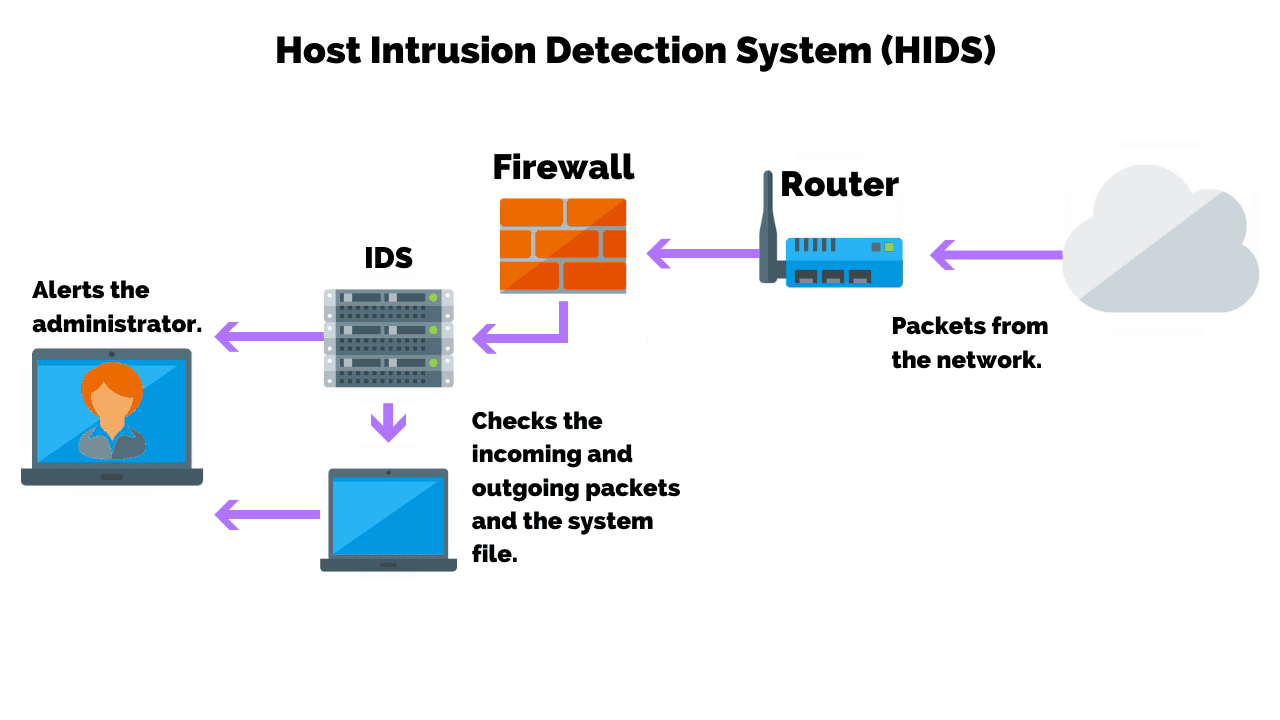
- Information Assortment: The IDS collects the info from pc methods.
- Community Commentary: The IDS observes the community site visitors and matches all of the site visitors patterns to all recognized assaults. This technique is also called sample correlation.
- Exercise Detection: The IDS confirms if a very uncommon exercise was a cyber assault or not.
- Exercise Alert: As soon as suspicious exercise is confirmed, the IDS will warn you by way of an alarm. These alarms will provide help to shortly discover the reason for the difficulty so your group can cease the assault.
What Methods Does a Host-Primarily based Intrusion Detection System Defend?
The host-based IDS system detects threats and patterns of assault inside your community system. It protects all of your useful information property. With the rise of safety tendencies, HIDS helps shield the cloud atmosphere on which it’s put in. It might probably work on completely different platforms akin to AWS, Microsoft Azure, or Liquid Internet. There are completely different IDS methods for Home windows, Linux, and Mac.
What Threats Does a Host-Primarily based Intrusion Detection System Protect Towards?
There are numerous threats that may be eradicated with the assistance of a host-based IDS:
1. Malicious Assaults
Each time malicious actions happen inside a system akin to unauthorized authentication assaults, HIDS detects the assault and sends it for evaluation. As soon as a cyber assault is confirmed, it generates an alert and can ship the details about the assault to you. This real-time monitoring helps to attenuate the injury when an assault occurs.
2. Uneven Routing
When information packets touring by way of the community take a selected path to their vacation spot and take a unique route again, it’s referred to as uneven routing. This mechanism permits the attackers to carry out a DDoS assault. HIDS helps decide such routes and can ask you to show these routes off for enhanced community safety.
3. Buffer Overflow Assaults
When extra information is written than a buffer can deal with, it’s referred to as a buffer overflow, and it may well trigger your complete system to break down. This type of assault makes an attempt to infiltrate segments of reminiscence within the system on which the host-based IDS is put in. It replaces the conventional information in these reminiscence areas with suspicious information, which can be carried out later in an assault. Within the majority of circumstances, buffer overflow assaults are meant to show right into a type of DDoS assault however can be used to reveal delicate data or carry out distant code execution. A number-based intrusion detection system will assist remove such assaults by figuring out the patterns related to this assault kind.
4. Scanning Assaults
Scanning assaults contain sending information to the community to gather information concerning the community, site visitors, ports, and hosts. Attackers typically attempt to determine open ports the place a virus will be inserted to make an assault within the system. Nonetheless, a host-based intrusion detection system prevents the attacker from moving into the system within the first place. Within the occasion that an attacker is ready to breach this preliminary stage of safety, a HIDS will assist reduce these assaults utilizing superior options akin to a internet software firewall to guard the info throughout the system.
Use Instances for Host-Primarily based Intrusion Detection System

Listed here are two use circumstances that exemplify how IDS is evolving companies all through the world:
Provide Chain Administration
As an intrusion detection system gives monitoring and tracing methods, you may simply mix them with digital providers to make the provide chain extra profitable. Supplies will be recognized with the assistance of barcodes or RFID know-how. With the usage of such a system, trusted shareholders inside an organization can get data by way of the IDS information framework, which is able to make the availability chain trade safer and cloud monitoring simpler.
HIPAA and PCI Compliance
Your group might have some customary necessities which it’s important to meet so as to work. With an IDS, your group can simply meet necessities akin to HIPAA compliance and PCI compliance.
Why Select Menace Stack Host-Primarily based IDS and Liquid Internet
Liquid Internet’s Menace Stack host-based IDS delivers substantial safety advantages to purchasers for a small worth. It additionally gives full-stack cloud safety with uninterrupted safety in monitoring, reporting of any recognized safety threats, and supply of IDS throughout the system’s community to make sure the security of the units from attackers.
Menace Stack helps present extra complete safety in your methods and pairs with Liquid Internet’s 24/7/365 help. Contact us now to be taught extra about Menace Stack.