

It’s exhausting to think about operating many companies nowadays with out info know-how enjoying a pivotal function in your operations. Even the best of corporations are in some way tethered to the Web or have a measure of reliance on some easy IT infrastructure. So, what do you do when that little little bit of IT infrastructure that your corporation depends on all of a sudden falls sufferer to these malicious hackers? With the rising fee of cyberattacks, it’s only a matter of time earlier than you encounter some hacking try, which is why your group requires a cyber incident response plan.
Let’s discover what an incident response plan is, why it is essential to have one for each enterprise, a very powerful elements to incorporate in your plan, and the steps to create your first plan at this time.
What’s an Incident Response Plan?
An incident response (IR) plan is a documented set of instruments and directions put collectively to assist your workforce of data know-how professionals determine, tackle, and get well from cybersecurity threats. A well-designed IR plan will assist your IT workers shortly determine safety threats and effectively reply to them.
With an acceptable IR plan, if a safety breach happens, you may have the precise folks, processes, and applied sciences to successfully deal with the breach and decrease the injury that it may trigger.
Why is Having an Incident Response Plan Essential?
The obvious cause for having an incident response plan is to forestall a enterprise loss resulting from cyberattacks. It looks like safety analysts uncover a brand new software program vulnerability each different day, or there’s a report a few safety breach exposing private info for hundreds of thousands of individuals.
Based on some analysts, knowledge breaches uncovered over 36 billion information within the first half of 2020.”
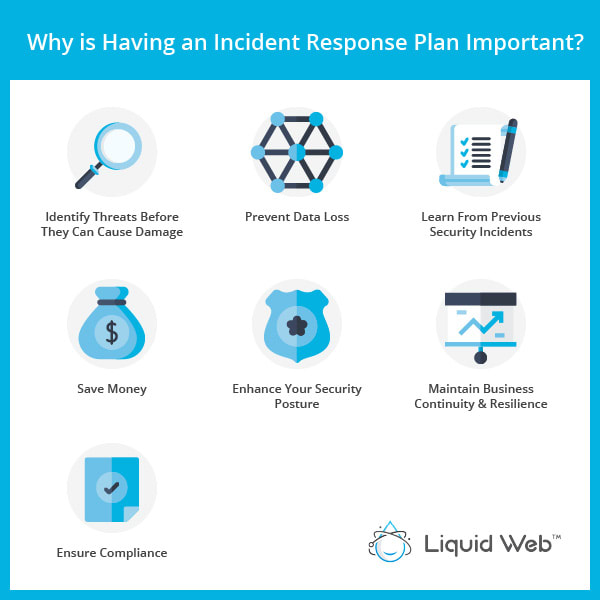
Falling sufferer to even considered one of these cyberattacks could cause irreparable injury and cripple your operations. An IR plan performs a significant function in serving to you:
- Determine threats earlier than they will trigger injury. Quite than ready to grow to be one other statistic within the ever-growing variety of cyberattack victims, a cyber incident response plan will assist your workforce reply to the seemingly inevitable consideration from malicious actors.
- Forestall knowledge loss in the event you expertise a knowledge breach from an intrusion try that was profitable regardless of your greatest efforts. That’s as a result of your planning actions will embody knowledge restoration procedures that may guarantee your knowledge is safe.
- Be taught from earlier safety incidents and enhance your group’s capability to deal with future intrusion makes an attempt.
- Get monetary savings that you’d have spent on recovering from the injury that an sudden safety incident would have induced in case your group didn’t have an IR plan in place with procedures to mitigate the injury.
- Improve your safety posture. Typically, this is sufficient to function a deterrent to these trying to exploit weaknesses in your techniques. It additionally implies that when incidents happen, your workforce will spend much less time determining what’s taking place and as an alternative give attention to a swift decision.
- Keep enterprise continuity and resilience as a result of your group should proceed to ship worth to its clients it doesn’t matter what occurs. A correct incident response plan performs a significant function in your group’s enterprise continuity planning.
- Guarantee compliance with an rising variety of new legal guidelines and trade rules demanding that corporations have procedures for detecting, responding to, and reporting safety incidents.
The Six Levels of Each Incident Response Plan
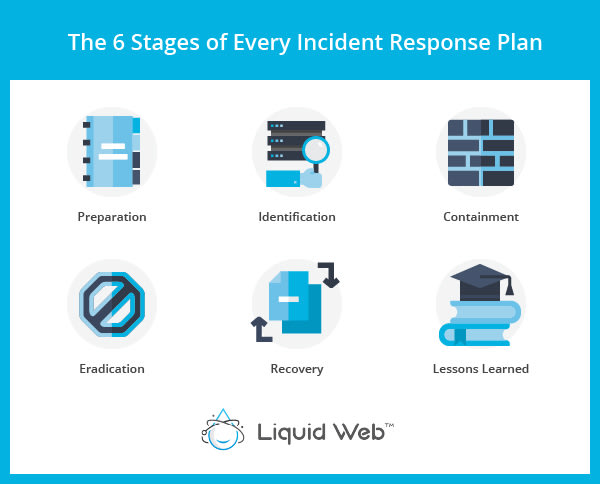
Hopefully, you’re following alongside and are satisfied concerning the significance of a cyber incident response plan to your group’s sustainability. In that case, you also needs to know that each correct IR plan ought to have the next phases if it’s going to serve its objective successfully:
1. Preparation
The preparation stage of your IR technique entails laying the groundwork to make sure your corporation shall be able to face a safety breach. Actions on this stage embody finishing up a threat evaluation and utilizing the outcomes to develop the safety insurance policies that may shield your crucial infrastructure from recognized cybersecurity threats. Along with this, coaching your safety groups on their roles and tasks, together with common incident response drills, will assist consider your readiness and determine and repair gaps.
2. Identification
Laying the correct basis within the preparation stage will depart your workforce adequately ready for what comes on this subsequent part. Whereas monitoring your group’s operations, the IR Staff ought to be fast to determine uncommon exercise and decide if a safety breach causes these actions.
If a safety breach has occurred, the fast focus ought to be on gathering and documenting as a lot proof as attainable concerning the incident. This documentation will inform your selections within the subsequent stage of your response plan.
3. Containment
You’ve accurately recognized a breach in your techniques and perceive the assault’s scale and what elements of your infrastructure are affected. The following step is containment, and the proof you’ve collected concerning the assault will decide your containment protocols.
Your objective right here is to forestall the attackers from infiltrating extra of your infrastructure. Brief-term containment methods could contain isolating the affected techniques or spinning up backup servers, and diverting site visitors to them in order that enterprise features tied to these techniques stay operational. Lengthy-term containment protocols contain forensic operations on the affected techniques and making use of safety patches to revive performance.
4. Eradication
When you’ve efficiently contained the incident and prevented it from spreading, the eradication part begins. Relying on the kind of breach, eradication actions can embody bettering authentication techniques, eradicating malware, disabling compromised accounts, and patching software program vulnerabilities. The results of this ought to be the entire elimination of threats and vulnerabilities out of your working atmosphere.
5. Restoration
The restoration part entails restoring all affected techniques to straightforward working capability and guaranteeing there are not any repeat incidents. Techniques are recovered from backups and carefully monitored for a set time to make sure optimum efficiency.
6. Classes Discovered
The final stage of your incident response plan happens when you may have totally neutralized the risk and all techniques have resumed regular operations. On this part, your incident response workforce members will meet to doc and analyze every part concerning the safety breach. Asking questions throughout this part will assist determine areas that want strengthening. Strive asking questions akin to:
- How did the breach happen?
- How shortly did we reply?
- What wants enchancment?
A lot of these questions will assist solidify and shut any missed loopholes or vulnerabilities.
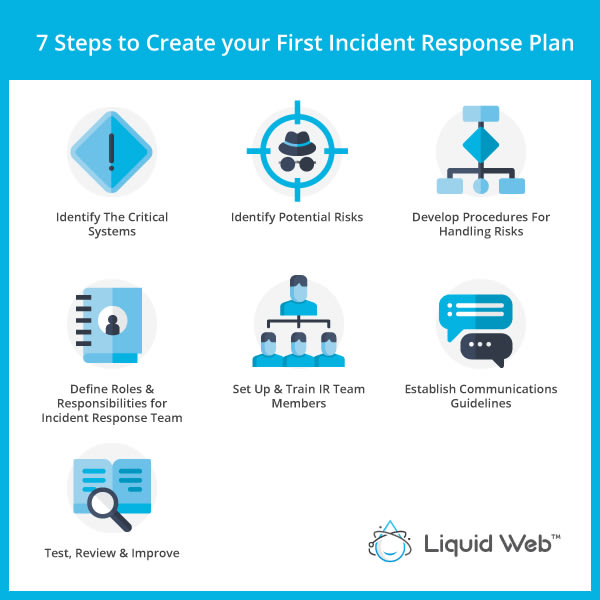
Seven Steps to Create your First Incident Response Plan
You don’t have to start out from scratch when creating your incident response plan since there are a number of templates to get you began. The Nationwide Institute of Requirements and Know-how’s Laptop Safety Incident Dealing with Information is a superb start line.
Nonetheless, in order for you an incident response plan that fits your group’s distinctive setup, some actions should happen. These actions purpose to offer you a greater understanding of your group’s safety posture, which is able to allow you to create a more practical IR plan.
1. Determine the Vital Techniques
To adequately shield your infrastructure towards cybersecurity incidents, you will need to first determine these techniques which might be most important to your corporation operations. Ask your self what items of kit or knowledge would trigger your corporation probably the most hurt if hackers attacked. When you’ve recognized them, prioritize them in keeping with significance and threat publicity.
2. Determine Potential Dangers
When you’ve picked out the belongings crucial to your operations, you additionally must determine the attainable threats to those techniques. Researching the methods malicious actors exploit comparable techniques and understanding your trade are the important thing to obviously figuring out the potential dangers you face, your stage of publicity, and the probability of prevalence.
3. Develop Procedures for Dealing with Dangers
For every threat recognized, you will need to develop procedures for coping with it. Typically, these could also be fast steps to enhance a selected system’s safety, like patching a identified software program flaw or putting in bodily measures like safety doorways. Different occasions, your procedures may have no fast steps to be taken however fairly tips on how it is best to reply if a risk occasion happens. These tips may embody figuring out and proscribing an intrusion try or the right way to get well from a ransomware assault.
4. Outline Roles and Tasks for Incident Response Staff
Your incident response workforce will consist of people who will bear accountability to your IR plan’s actions and be sure that safety incidents don’t adversely influence your group’s important features. An IR workforce’s dimension will range relying on the scale of a company and the infrastructure scale, so it’s necessary to notice that one individual could play a number of roles in a workforce for a smaller group.
5. Set Up and Prepare IR Staff Members
Talking of efficient job dealing with, informing every IR workforce member of their positions’ necessities is important for his or her effectiveness. The workforce members don’t all should be cybersecurity consultants as a result of there are just a few roles that require experience in different fields, such because the authorized consultant or the communications chief. The necessary factor is that the workforce members obtain safety consciousness coaching to deal with their jobs successfully.
6. Set up Communications Pointers
Communications tips are important relating to incident response and administration. The pace and effectiveness of your communications have a direct influence in your workforce’s responsiveness to threats. Due to this fact, establishing protocols for relaying info between workforce members, different workers, and exterior stakeholders like safety businesses, service suppliers, and purchasers is important to your plan’s success.
7. Check, Evaluate, and Enhance
The continuously evolving risk panorama means you’ll want to commonly check your incident response plan and refine it based mostly in your check outcomes. Exams could possibly be within the type of deliberate or unplanned safety drills, simulations, and tabletop workout routines designed to familiarize your staff with the IR plan’s contents. Along with this, your check outcomes will determine gaps that your IR workforce will tackle.
Safety Past Incident Response With a Safety-Centered Cloud Supplier
Undoubtedly, decreasing vulnerability to cybersecurity threats ought to be a precedence for any fashionable enterprise. Placing the correct techniques in place to fight these threats can considerably burden the sources accessible to your group. Nonetheless, you may ease that burden by transferring to a cloud-based setup akin to VMware Personal Cloud. That’s as a result of whereas they will enhance effectivity and scale back prices, the proper cloud service supplier also can strengthen your whole infrastructure’s safety with educated cloud safety experience and useful safety add-ons.