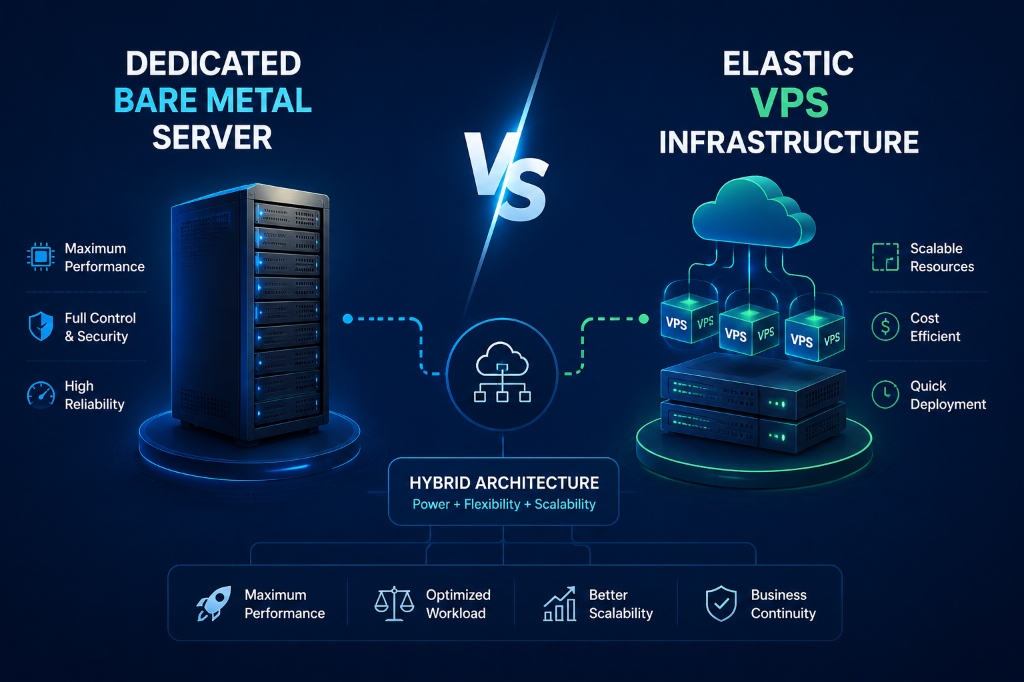


Decouple stateless net frontend nodes from stateful database engines throughout high-speed non-public VLANs. Scale high-traffic purposes with zero egress penalties.
📅 Up to date: September 2026
⏱️ 12 Min Learn
⚙️ Manufacturing Blueprint
🛡️ 10Gbps Non-public VLAN
⚡ Hybrid Internet hosting Infrastructure: Government Abstract
- Decoupled Multi-Tier Efficiency: Hybrid internet hosting separates stateless net employees from stateful databases. Subsequently, it utterly eliminates CPU and reminiscence bottlenecks present in single-server stacks.
- Price-Efficient Elastic Scaling: You’ll be able to scale net employees horizontally throughout high-performance USA VPS cases whereas anchoring relational information to a devoted bare-metal database server.
- Sub-Millisecond Non-public Interconnects: Frontend net nodes talk with backend database clusters over non-public 10Gbps VLANs. Consequently, your information travels with sub-millisecond latency and nil public bandwidth egress charges.
- Most Safety Isolation: Database engines and Redis caching clusters bind solely to personal IP subnets. Because of this, database ports stay utterly hidden from the general public Web.
1. The Monolith Breakdown: Why Single Servers Fail Underneath Load
Monolithic internet hosting stacks place the online server, PHP-FPM processor, Redis cache, and MySQL database onto a single working system occasion. Initially, this setup seems cost-effective and easy to keep up. Nonetheless, sudden site visitors spikes rapidly expose extreme architectural limits.
When concurrent guests surge, Nginx and PHP-FPM spawn lots of of employee threads to serve HTTP requests. Consequently, these processes eat enormous quantities of CPU cycles and bodily RAM. Concurrently, complicated MySQL queries demand heavy reminiscence buffers (like innodb_buffer_pool_size) and aggressive disk I/O. Subsequently, the online server and database enter a vicious useful resource rivalry loop.
On this state of affairs, the Linux kernel encounters reminiscence exhaustion and triggers the Out-Of-Reminiscence (OOM) killer. The kernel usually terminates the MySQL daemon first to protect system stability. Because of this, guests encounter irritating 502 Dangerous Gateway and 500 Inside Server Errors.
⚠️ The I/O Wait Bottleneck: In a single-server structure, database write operations saturate disk queues. Subsequently, net employees stall whereas ready for disk entry. This causes Time to First Byte (TTFB) to leap from 45ms to nicely over 1,800ms.
2. Architectural Blueprint: Decoupled Multi-Tier Topology
A production-grade hybrid internet hosting infrastructure decouples stateful information layers from stateless utility providers. For instance, stateless net employees course of HTTP site visitors, whereas devoted backend nodes handle transaction storage and information integrity.
Moreover, this decoupled topology isolates failure domains. If an unoptimized question slows down a backend employee, frontend reverse proxies proceed serving cached content material seamlessly. As well as, you’ll be able to scale net capability immediately by spinning up further VPS nodes throughout flash gross sales.
| Infrastructure Tier | Internet hosting Sort | {Hardware} Focus | Major Position |
|---|---|---|---|
| Tier 1: Load Balancer | Twin Excessive-Compute VPS | Excessive Community PPS & CPU | SSL Offloading, HAProxy, DDoS Protect |
| Tier 2: Internet Software | Elastic VPS Nodes | Quick Compute & RAM | Nginx, PHP 8.3 / Node.js, Stateless Code |
| Tier 3: In-Reminiscence Cache | Devoted RAM VPS | Extremely-Low Latency RAM | Redis 7 Object Caching & Periods |
| Tier 4: Relational DB | Excessive-Compute Naked Metallic | NVMe RAID 10 & 128GB+ RAM | MySQL 8.4 InnoDB / PostgreSQL 16 |
3. Step 1: Configuring Non-public VLAN Networking & Interfaces
Multi-tier efficiency depends on ultra-low latency interconnects. Subsequently, you should by no means route inside database or cache queries over public IPv4 addresses. Public routing introduces community jitter, safety publicity, and bandwidth egress costs.
As an alternative, configure a devoted Layer-2 non-public VLAN (equivalent to 10.10.10.0/24) between your server nodes. For instance, use Netplan on Ubuntu 24.04 LTS to assign static non-public IP addresses to secondary community adapters.
community:
  model: 2
  renderer: networkd
  ethernets:
    eth1:
      dhcp4: no
      addresses:
        - 10.10.10.15/24
      routes:
        - to: 10.10.10.0/24
          through: 10.10.10.1
      mtu: 9000
Discover that the MTU is ready to 9000 (Jumbo Frames). As a result of jumbo frames scale back packet header overhead, this setting considerably boosts throughput for heavy database payloads. Apply your configuration with the next command:
sudo netplan apply
ping -c 3 10.10.10.10
4. Step 2: Provisioning & Hardening the Devoted Database Node
Subsequent, you should put together the stateful database tier. In a hybrid internet hosting mannequin, the database runs on a devoted high-compute server (IP: 10.10.10.10). Moreover, we bind MySQL strictly to the non-public VLAN adapter to stop any public publicity.
First, open your MySQL configuration file and replace the networking directives:
[mysqld]
# Bind solely to the non-public 10Gbps VLAN interface
bind-address            = 10.10.10.10

# Devoted {Hardware} Reminiscence Optimization (e.g. for 64GB RAM Node)
innodb_buffer_pool_size = 48G
innodb_buffer_pool_instances = 8
innodb_log_file_size    = 4G
innodb_flush_log_at_trx_commit = 2
innodb_flush_method     = O_DIRECT
max_connections         = 1000
After updating the configuration, restart the MySQL service. Then, grant fine-grained permissions to your non-public net node subnet:
-- Create utility consumer restricted to personal VLAN subnet
CREATE USER 'app_prod_user'@'10.10.10.%' IDENTIFIED BY 'SuperSecureVlanPass987!';
GRANT SELECT, INSERT, UPDATE, DELETE, CREATE, DROP, INDEX, ALTER
  ON enterprise_db.* TO 'app_prod_user'@'10.10.10.%';
FLUSH PRIVILEGES;
Lastly, lock down the database server with UFW firewall guidelines. Permit site visitors on port 3306 solely from the non-public VLAN subnet:
sudo ufw default deny incoming
sudo ufw permit in on eth1 to 10.10.10.10 port 3306 proto tcp
sudo ufw allow
5. Step 3: Setting Up Distributed Redis Microcaching
In a decoupled infrastructure, a number of net nodes serve similar consumer classes. Subsequently, storing classes in native PHP short-term information will break consumer authentication throughout web page hundreds.
To resolve this subject, deploy an impartial Redis cluster (IP: 10.10.10.20). This server acts as a centralized in-memory session and question cache. Particularly, configure Redis to speak solely over the non-public community:
bind 10.10.10.20
port 6379
protected-mode sure
requirepass StrongAuthRedisKey2026!
maxmemory 8gb
maxmemory-policy allkeys-lru
Consequently, net purposes learn cached question ends in lower than 0.3ms. As well as, this distributed caching setup frees the backend relational database from repetitive learn operations.
6. Step 4: Deploying Stateless Nginx Internet Frontend Nodes
Frontend net nodes function in a totally stateless method. As an illustration, utility information, media property, and configuration templates exist identically throughout all net nodes. When you want storage steering for giant media property, discover our information on establishing high-performance media streaming servers.
Configure your frontend Nginx server blocks to proxy dynamic requests on to native PHP-FPM, whereas connecting to distant Redis and MySQL tiers:
server {
    pay attention 80;
    server_name app.yourdomain.com;
    root /var/www/html/public;
    index index.php index.html;

    location / {
        try_files $uri $uri/ /index.php?$query_string;
    }

    location ~ .php$ {
        embody snippets/fastcgi-php.conf;
        fastcgi_pass unix:/run/php/php8.3-fpm.sock;
        fastcgi_param DB_HOST "10.10.10.10";
        fastcgi_param DB_DATABASE "enterprise_db";
        fastcgi_param DB_USERNAME "app_prod_user";
        fastcgi_param REDIS_HOST "10.10.10.20";
    }
}
7. Step 5: Excessive-Availability Load Balancing with HAProxy
To distribute incoming net site visitors throughout a number of net nodes, deploy a devoted HAProxy load balancer tier. HAProxy terminates TLS certificates, manages well being checks, and forwards clear HTTP site visitors over the non-public VLAN.
frontend http_front
    bind *:80
    bind *:443 ssl crt /and many others/ssl/certs/enterprise.pem alpn h2,http/1.1
    redirect scheme https if !{ ssl_fc }
    default_backend web_cluster

backend web_cluster
    stability roundrobin
    cookie SERVERID insert oblique nocache
    choice httpchk GET /healthcheck.php
    http-check anticipate standing 200
    server web-node-01 10.10.10.11:80 verify cookie web01
    server web-node-02 10.10.10.12:80 verify cookie web02
Moreover, in case your group requires skilled help configuring high-availability failover architectures, overview our full server administration help information.
8. Efficiency Benchmarks: Monolith vs. Hybrid Infrastructure
We carried out rigorous load testing utilizing wrk to judge each architectures beneath sustained site visitors (5,000 concurrent digital customers). The check atmosphere in contrast a single 16-Core Monolithic Server in opposition to a 3-Tier Hybrid Internet hosting Structure (2 Internet VPS + 1 Devoted DB).
| Efficiency Metric | Single Monolith Server | Hybrid Multi-Tier Setup | Measured Enchancment |
|---|---|---|---|
| Time to First Byte (TTFB) | 482 ms | 34 ms | 14.1x Sooner |
| Requests Per Second (RPS) | 1,120 rps | 6,840 rps | 510% Larger Throughput |
| Peak Error Price (5xx) | 12.4% (OOM Occasions) | 0.00% | 100% Uptime Stability |
| Database Question Latency | 86 ms (Disk Wait) | 2.1 ms | 97.5% Decrease Latency |
9. Regularly Requested Questions (FAQs)
What’s the distinction between hybrid internet hosting and cloud internet hosting?
Cloud internet hosting distributes workloads throughout virtualized hyperscale platforms, which steadily cost unpredictable outbound bandwidth (egress) charges. In distinction, hybrid internet hosting combines cost-effective elastic VPS net nodes with high-compute devoted bare-metal database servers. As well as, all inside site visitors travels throughout non-public 10Gbps VLANs with zero egress penalties.
How does a non-public VLAN enhance database safety in hybrid internet hosting?
A non-public VLAN creates an remoted Layer-2 community that’s bodily or logically separated from public routing tables. Subsequently, the database server doesn’t require a public IPv4 tackle. Consequently, malicious bots, port scanners, and brute-force assaults can’t uncover or work together together with your database port.
Will separating the database from net nodes trigger community latency?
Routing site visitors over public networks definitely introduces latency. Nonetheless, trendy hybrid internet hosting makes use of co-located information facilities linked by 10Gbps non-public fiber interconnects. Because of this, community latency between frontend VPS nodes and the database stays sub-millisecond (sometimes 0.2ms to 0.4ms), which is just about instantaneous.
Can I scale frontend net nodes horizontally with out downtime?
Sure, completely. As a result of the online frontend nodes are utterly stateless, you’ll be able to provision further VPS cases every time site visitors surges. You merely clone the bottom picture, assign a non-public VLAN IP tackle, and add the brand new node to your HAProxy backend configuration. HAProxy will immediately start load balancing site visitors to the brand new node with zero downtime.