


Key takeaways
- A VPS offers you management over Node.js variations, packages, ports, and server settings.
- NVM, PM2, and Nginx present a robust basis for manufacturing functions.
- HTTPS, firewall guidelines, monitoring, and backups assist shield the applying after launch.
- Examine software and database efficiency earlier than upgrading the VPS.
Operating Node.js on a VPS offers you direct management over the runtime, networking, and deployment course of. This makes VPS internet hosting a superb match for APIs, dashboards, ecommerce backends, and real-time functions that want persistent connections or customized server settings.
What’s Node.js on a VPS?
Node.js is an open-source JavaScript runtime that lets builders execute JavaScript exterior an online browser. A VPS supplies an remoted digital server with allotted CPU, RAM, storage, and administrative entry.
Operating Node.js on a VPS means internet hosting the applying and runtime in a digital server that you simply management. Shared internet hosting usually restricts runtime variations, background processes, and customized configuration. Serverless platforms scale back server administration however might introduce execution limits, chilly begins, or much less management over the setting.
A VPS presents extra flexibility, but it surely additionally offers you extra duty for deployment, updates, safety, and monitoring.
Why run Node.js on a VPS?
Management over the server setting
You may choose the working system and Node.js model, set up system and npm packages, configure community entry, and handle software processes.
This management helps when an software depends on native packages, background jobs, setting variables, or integrations {that a} shared platform might not help.
Assist for real-time functions
Node.js makes use of an event-driven, non-blocking structure that works effectively for functions dealing with many concurrent connections. Widespread examples embody chat instruments, video games, notifications, collaborative functions, and reside dashboards.
A VPS additionally helps persistent WebSocket connections with out the execution limits that some serverless environments impose.
Predictable assets and prices
A VPS offers the applying allotted CPU, RAM, and storage. This may make capability planning and month-to-month prices extra predictable for functions with regular visitors.
A VPS received’t at all times value lower than serverless internet hosting. The higher alternative is dependent upon visitors patterns, useful resource necessities, help wants, and the way a lot time your group can spend managing the setting.
Managed help with administrative management
Managed VPS internet hosting can scale back the time your group spends on working system upkeep, patching, monitoring, and server-level troubleshooting. You may nonetheless retain the entry wanted to configure and deploy your software.
Managed help doesn’t substitute code testing, dependency administration, software debugging, or database optimization. Assessment the supplier’s administration scope earlier than deploying a manufacturing workload.
Earlier than you deploy Node.js on a VPS
Earlier than beginning, verify that you’ve an Ubuntu VPS with root or sudo entry, a website pointed to the server, deployable software code, the proper inside port and setting variables, a database plan, and a option to again up or restore the applying.
Select a supported Node.js model
Node.js publishes Present and Lengthy-Time period Assist releases. Manufacturing functions ought to usually use an energetic or upkeep LTS model until the venture requires one other supported launch.
Keep away from selecting a model primarily based solely on an older tutorial. Affirm that the applying framework, packages, and construct instruments help the model you intend to put in.
Estimate your useful resource wants
A small API or improvement software might run on one or two digital CPUs and 1 to 2 GB of RAM. A enterprise software with extra concurrent customers, database exercise, or background jobs may have extra CPU and reminiscence.
Actual-time functions, high-traffic APIs, and clustered processes might require 4 GB of RAM or extra. Deal with these figures as beginning factors. Utility design, visitors, caching, logging, and database placement can considerably change useful resource use.
Learn how to set up and deploy Node.js on a VPS
The next steps create a direct Ubuntu deployment. Instructions and paths might differ primarily based in your working system, username, area, and software construction.
1. Connect with the VPS with SSH
Open a terminal and hook up with the server:

Use a non-root account with sudo privileges for routine administration. Operating each command as root will increase the impact of configuration errors or compromised processes.
2. Replace the server
Replace the bundle index and put in packages:

This offers you present working system packages and safety fixes. Reboot the VPS if the updates set up a brand new kernel or require a restart:

Reconnect via SSH after the server comes again on-line.
3. Set up Node.js with NVM
Node Model Supervisor, or NVM, helps you to set up and swap between Node.js variations from the command line. This makes it helpful for testing upgrades and sustaining functions with completely different runtime necessities.
Set up NVM utilizing the present command from the official NVM repository. As a result of the discharge quantity modifications, confirm the installer URL within the NVM documentation earlier than operating it.
After set up, reload the shell configuration:

Set up the most recent supported LTS launch:

Set it because the default model for brand new shell periods:

4. Confirm Node.js and npm
Affirm that Node.js and npm put in accurately:

Each instructions ought to return model numbers. Resolve any set up errors earlier than deploying the applying.
5. Create an software listing
Create a devoted listing for the applying:

A devoted listing retains the deployment separate from private information and makes permissions and backups simpler to handle.
6. Deploy the applying code
Clone the venture into the applying listing:

When the venture features a present package-lock.json file, set up manufacturing dependencies with:

npm ci installs the variations recorded within the lockfile and creates a extra repeatable construct. Use npm set up when the venture doesn’t embody a suitable lockfile.
7. Configure setting variables
Don’t hard-code API keys, database passwords, or different credentials within the software repository.
A easy .env file may include:

Prohibit entry to the file:

Bigger functions might profit from a devoted secrets-management system as a substitute of a neighborhood file.
8. Take a look at the applying domestically
Begin the applying quickly:

Change server.js with the venture’s precise entry file.
From one other terminal session, check the applying on its inside port:

Affirm that the applying responds, then cease the non permanent course of with Ctrl+C.
Maintain the Node.js software operating with PM2
Beginning an software with node server.js ties the method to the terminal session. Closing the session stops the applying.
PM2 manages Node.js processes and may restart functions after crashes or server reboots.
Set up PM2
Set up PM2 globally:

Begin the applying
Begin the applying and assign a recognizable course of title:

For an software that makes use of an npm begin script, run:

Examine the method:

Restore the method after a reboot
Generate the startup configuration:

PM2 will show one other command. Run that command with the permissions proven within the output.
Save the present course of record:

Assessment software logs
View real-time logs:

Assessment course of standing, CPU use, and reminiscence use with:

PM2 can restart a failed course of, but it surely can’t appropriate software bugs, failed database connections, or inefficient code.
Configure Nginx as a reverse proxy
A manufacturing Node.js software normally listens on a personal native port whereas Nginx handles public visitors.
Nginx can route requests to Node.js, terminate HTTPS connections, serve static information, and ahead WebSocket visitors.
Set up Nginx

Affirm that the service runs:

Create a server block
Create a domain-specific configuration:

Add the next configuration, then replace the area and software port:
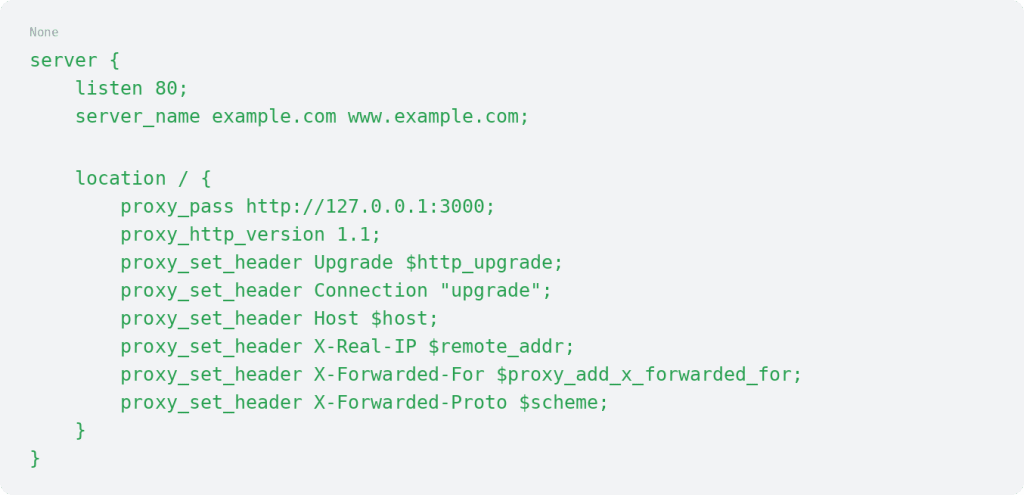
The Improve and Connection headers let Nginx ahead WebSocket connection upgrades.
Allow the server block:

Take a look at the configuration:

If the check succeeds, reload Nginx:

Disable the default Nginx configuration if it conflicts with the applying’s area.
Configure the firewall and HTTPS
Prohibit firewall entry
Enable SSH earlier than enabling the firewall so that you don’t lock your self out:

Assessment the energetic guidelines:

Most public Node.js functions solely want SSH, HTTP, and HTTPS open. Maintain the interior software port personal until the use case requires direct entry.
Add HTTPS with Certbot
Your area should resolve to the VPS earlier than Certbot can validate and set up a certificates via Nginx.
Set up Certbot:

Request and configure the certificates:

Take a look at certificates renewal:

Safe Node.js on a VPS
A manufacturing deployment wants safety on the server, runtime, dependency, and software ranges.
Restrict administrative entry
Use SSH keys as a substitute of passwords the place attainable. Prohibit root login, take away inactive accounts, and grant every administrator solely the permissions required for his or her work.
Use multifactor authentication for internet hosting portals, source-control accounts, and monitoring platforms that help it.
Shield software secrets and techniques
Don’t commit .env information, API keys, database passwords, or certificates credentials to supply management.
Rotate uncovered secrets and techniques instantly. Assessment file permissions and ensure that solely the applying account can entry delicate configuration.
Maintain software program present
Protecting your Node.js set up updated is necessary for sustaining efficiency and safety.
Replace the working system, Node.js LTS launch, npm dependencies, PM2, Nginx, and different software program within the software stack. Take a look at updates in staging earlier than making use of them to manufacturing.
Run the next command to evaluate recognized npm dependency points:

Don’t apply each automated repair with out evaluate. Main dependency modifications can break the applying.
Restrict public ports
Expose solely the community providers the applying wants. Use Nginx for public internet visitors and restrict entry to databases, caches, and inside ports.
Monitor and optimize Node.js efficiency
A gradual or unstable software doesn’t at all times want a bigger VPS. Assessment the applying, database, configuration, and useful resource use earlier than growing server capability.
Assessment logs and assets
Begin with:

These instructions show you how to evaluate course of state, latest errors, reminiscence, and storage.
Exterior uptime monitoring and software efficiency instruments can present further visibility into response occasions, failures, event-loop delay, and database exercise.
Examine database efficiency
Gradual database queries could make an software seem underpowered even when the VPS has unused assets.
Assessment question execution time, indexes, connection limits, and connection pooling. Keep away from opening a brand new database connection for each request.
Add caching the place it helps
Caching can scale back repeated database queries and enhance response occasions. It’s possible you’ll use in-memory caching for one course of or Redis when a number of Node.js processes want entry to the identical information.
Use a shared retailer for periods, charge limits, or different state when a number of processes should stay constant.
Use a number of CPU cores
A single Node.js course of primarily executes JavaScript on one major thread. PM2 cluster mode can begin a number of software processes to make use of a number of CPU cores:

Earlier than enabling cluster mode, verify that the applying doesn’t depend on native in-memory periods or state. Use Redis or one other shared retailer when processes want entry to frequent information.
Determine the place the database runs
You may run the database on the identical VPS because the Node.js software or place it on a separate server or managed database service.
Protecting each on one VPS can scale back value and community latency for smaller functions. Nonetheless, the providers compete for a similar CPU, RAM, and storage and share the identical failure level.
Separating the database can enhance isolation, scaling, upkeep, and restoration. It additionally helps you to improve software and database assets independently, but it surely prices extra and requires safe community configuration.
Select primarily based on visitors, information significance, restoration necessities, and anticipated development.
Plan backups, rollback, and restoration
Utility code in Git doesn’t substitute a whole backup. Again up the database, uploaded information, setting configuration, Nginx settings, PM2 configuration, and some other information required to revive the service. Retailer backups away from the manufacturing VPS.
Create a rollback course of
Maintain the earlier software launch, dependency lockfile, and setting configuration out there till you verify {that a} deployment works.
Assessment database migrations earlier than deployment. Some schema modifications want their very own rollback plan as a result of restoring an earlier software model might not reverse the database change. Take a look at updates in staging and doc the instructions required to revive the prior launch.
Take a look at restoration
A accomplished backup job doesn’t show that the backup will restore efficiently. Run periodic restoration exams and doc who handles software, database, and server restoration.
Managed vs. self-managed Node.js VPS internet hosting
A self-managed VPS offers your group management over the server setting, however you additionally deal with working system updates, safety, monitoring, backups, and troubleshooting.
A managed VPS shifts outlined server-level duties to the internet hosting supplier. Your group nonetheless manages the applying code, dependencies, deployment course of, and software efficiency.
| Job | Managed VPS | Self-managed VPS |
| Bodily server and community | Supplier | Supplier |
| Working system help | Supplier inside service scope | Buyer |
| Server patching and monitoring | Usually included inside scope | Buyer |
| Node.js software code | Buyer | Buyer |
| npm dependencies | Buyer | Buyer |
| Utility configuration | Buyer or shared, relying on scope | Buyer |
| Database and code optimization | Buyer | Buyer |
| Backups | Depends upon the plan | Buyer configures |
If server upkeep is taking time away from improvement, managed VPS internet hosting can scale back server-level work whereas preserving software management.
Assessment the supplier’s administration scope rigorously. Don’t assume that managed internet hosting consists of software debugging, dependency upgrades, database tuning, or code modifications.
Widespread Node.js on VPS issues
The appliance stops after you shut SSH
The appliance in all probability runs straight via the node command.
Begin it with PM2, configure the startup service, and save the method record:

Nginx returns a 502 Unhealthy Gateway error
A 502 error usually means Nginx can’t attain the Node.js course of.
Examine the applying and Nginx configuration:

Affirm that the applying runs on the port listed in proxy_pass.
npm set up fails
Examine the Node.js model, lockfile, disk area, file possession, native construct instruments, and npm error output.
Keep away from operating npm with sudo inside an NVM-managed software listing. Doing so can create file possession issues.
The appliance can’t attain the database
Assessment the connection string, credentials, firewall guidelines, bind handle, SSL necessities, and consumer permissions.
When the database runs on one other server, verify that each techniques permit visitors via the required personal or trusted community path.
The area reveals the default Nginx web page
Examine the DNS information, server_name, enabled website configuration, and default Nginx server block.
Take a look at the configuration and reload Nginx after making modifications:

WebSockets fail to attach
Affirm that the applying helps WebSockets and that the Nginx configuration consists of the required improve headers.
Additionally verify the consumer URL, HTTPS settings, proxy timeouts, and software port.
The appliance runs slowly
Examine logs, useful resource use, database efficiency, and event-loop exercise earlier than upgrading the VPS. A bigger plan won’t repair inefficient queries, blocked code, reminiscence leaks, or repeated software errors.
Node.js on VPS FAQs
Node.js on VPS subsequent steps
Deploying Node.js on a VPS entails greater than putting in the runtime. A manufacturing setting additionally wants course of administration, a reverse proxy, HTTPS, firewall controls, monitoring, backups, and a restoration plan.
Begin by provisioning an Ubuntu VPS and confirming the applying’s area, port, Node.js model, database, and useful resource necessities. Full the deployment in a staging setting earlier than directing manufacturing visitors to it.
Liquid Internet managed VPS internet hosting offers builders root entry, allotted assets, and assist with the underlying server setting. Discover Liquid Internet VPS internet hosting to check configurations and select one which helps your software because it grows.
Learn how to set up Node.js on Linux (AlmaLinux)
Putting in Node.js on Home windows Servers
Learn how to Configure and Deploy CloudLinux’s Node.js Selector