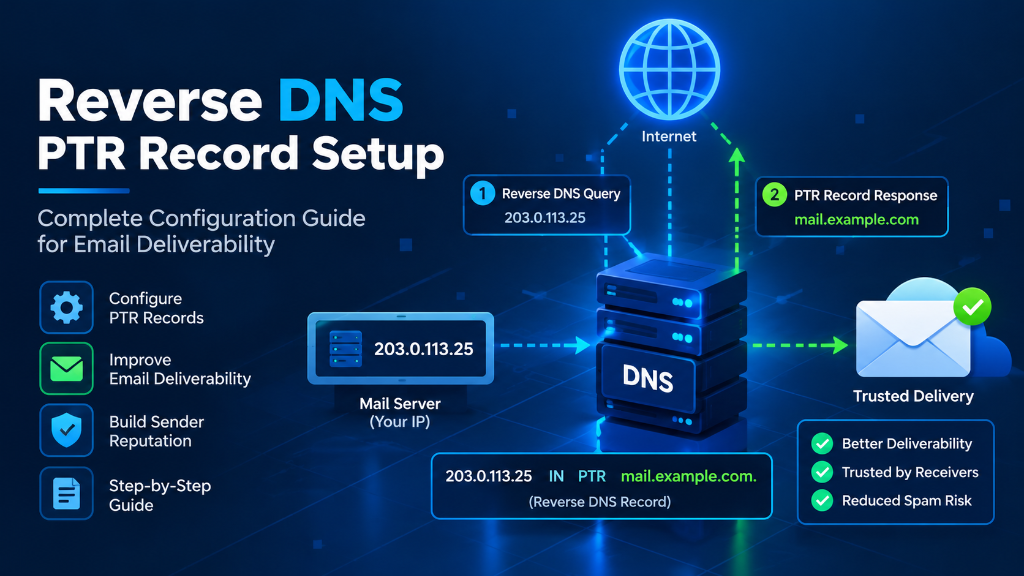


Govt Abstract: Server Identification and Deliverability Engineering
First, commonplace Ahead DNS maps human-readable domains to numerical IP addresses. Nevertheless, Reverse DNS (rDNS) performs the reciprocal operate. Particularly, it resolves an IP handle again to a licensed canonical hostname through Pointer (PTR) information.
In manufacturing internet hosting, an absent or misconfigured PTR report is the only commonest reason behind legit transactional emails being categorised as spam. Moreover, main mail receivers (like Gmail and Microsoft 365) typically silently reject them. Past e mail fame, PTR information set up the verifiable server id required for anti-abuse validation.
Subsequently, this information covers the entire reverse DNS PTR report setup, Ahead-Confirmed Reverse DNS (FCrDNS), CIDR subnet delegation, and diagnostic lookup verification.
1. The Architectural Mechanics of Ahead vs Reverse DNS
In commonplace Ahead DNS decision, an A report saved in a website’s authoritative nameserver interprets mail.instance.co.uk into an IPv4 handle like 198.51.100.25.
Conversely, Reverse DNS operates inside a devoted top-level area namespace: in-addr.arpa for IPv4 and ip6.arpa for IPv6. To resolve 198.51.100.25, the question octets are reversed. Then, they’re appended to the arpa area: 25.100.51.198.in-addr.arpa.
Possession of the DNS Zones
In contrast to ahead DNS zones that are managed by area registrars, reverse DNS zones are owned completely by Regional Web Registries (RIRs like RIPE NCC or ARIN). Consequently, they’re delegated to Web Service Suppliers (ISPs) or datacenter internet hosting suppliers that announce the IP prefixes over BGP.
Moreover, deploying on UK VPS cloud internet hosting grants directors direct management over automated PTR report task via devoted management interfaces. Moreover, when auditing hypervisor community availability, you must evaluation our walkthrough on checking VPS on-line standing in Virtualizor.
2. Ahead-Confirmed Reverse DNS (FCrDNS): The Gold Normal
Fashionable receiving mail switch brokers (MTAs) and safety scanners implement Ahead-Confirmed Reverse DNS (FCrDNS). That is often known as full-circle reverse DNS. Primarily, FCrDNS creates a cryptographic-style circle of belief between hostname and IP handle. Right here is the way it works:
- First, the receiving mail server inspects the connecting shopper IP (e.g.,
198.51.100.25) and queries its PTR report, receivingmail.instance.co.uk. - Subsequent, the receiver instantly performs a Ahead DNS lookup on
mail.instance.co.ukto resolve its A report. - Lastly, if the A report returns
198.51.100.25(matching the preliminary connecting IP), the handshake succeeds. Nevertheless, if the ahead lookup fails or returns a special IP handle, the connection is rejected as spoofed.
For a deeper dive, reviewing our full tutorial on area registration, DNS information, and safety highlights how aligning ahead A information with reverse PTR zones establishes bulletproof deliverability.
3. Reverse DNS PTR Report Setup Throughout Internet hosting Interfaces
As a result of PTR zones belong to the IP netblock proprietor, directors can’t create PTR information inside commonplace cPanel or Cloudflare ahead DNS dashboards. As an alternative, your reverse DNS PTR report setup should be configured via your internet hosting supplier’s portal. Observe these steps:
- Log into your server supplier’s administration console.
- Navigate to IP Administration or Community Settings.
- Find your server’s static IPv4 and IPv6 addresses.
- Beneath the Reverse DNS / PTR subject, enter the absolutely certified canonical area identify (e.g.,
mail.instance.co.uk). - Make sure the area doesn’t have a trailing dot until required by your supplier’s particular portal syntax.
4. Configuring Postfix and Exim MTA Identification to Match PTR
Configuring the PTR report in your supplier’s portal is just half the equation. Crucially, your native Mail Switch Agent (MTA) should announce the equivalent hostname in its SMTP HELO/EHLO greeting.
In Postfix (/and many others/postfix/important.cf), configure the next:
Alternatively, in Exim (/and many others/exim4/exim4.conf.template), set:
If Postfix proclaims vps1042.localdomain whereas your PTR factors to mail.instance.co.uk, strict mail servers will flag the mismatch. In consequence, they might deal with it as suspicious bot exercise, thereby decreasing e mail deliverability scores.
5. IPv6 Reverse DNS Configuration: ip6.arpa Nibble Format
With the widespread adoption of IPv6 throughout international web service suppliers, configuring reverse DNS for IPv6 addresses is simply as important as IPv4. Nevertheless, IPv6 rDNS introduces architectural complexity as a result of 128-bit handle illustration.
Understanding IPv6 Nibbles
In IPv6, reverse lookups function within the ip6.arpa area, the place every particular person hexadecimal character (nibble) is separated by a dot and reversed. For instance, the IPv6 handle 2001:0db8:85a3:0000:0000:8a2e:0370:7334 interprets to:
As a result of guide zone configuration for 32 particular person nibbles is very liable to typographical errors, fashionable internet hosting administration management panels present automated IPv6 PTR turbines. Subsequently, when finishing your reverse DNS PTR report setup for IPv6, all the time confirm that your authoritative ahead DNS zone accommodates a corresponding AAAA report. This maintains strict FCrDNS alignment.
6. E mail Receiver Filtering: Gmail & Microsoft SMTP Edge
Main shopper e mail suppliers preserve automated edge filtering gateways. These examine connecting IP addresses earlier than a single line of e mail content material is transmitted. When your mail server opens a TCP port 25 connection to Gmail’s MX servers, a number of steps happen:
- Step 1: IP Popularity Question: First, Google queries inside telemetry and international DNSBL allowlists to guage the connecting IP’s previous transmission quantity.
- Step 2: Reverse DNS Enforcement: Subsequent, the receiving server executes an instantaneous PTR lookup on the connecting IP. If no PTR report exists, the connection is immediately rejected with an SMTP 550 everlasting bounce code.
- Step 3: Generic Hostname Detection: Lastly, Google and Yahoo examine the PTR hostname string. If the hostname seems automated or generic, the incoming e mail is assigned a heavy spam penalty. Setting a clear, branded area eliminates this penalty solely.
7. Automating rDNS Report Updates through Datacenter REST APIs
In fashionable DevOps pipelines and dynamic cloud environments, servers are steadily provisioned, destroyed, or re-IPed robotically. Consequently, manually opening internet portals to replace PTR information introduces deployment delays and human error. Infrastructure engineers automate PTR provisioning utilizing datacenter REST APIs:
8. Subnet Reverse Delegation through RFC 2317
When a company leases a fractional subnet smaller than a full /24 block, commonplace byte-boundary reverse delegation fails. This occurs as a result of commonplace DNS delegation happens solely on octet boundaries. Nevertheless, RFC 2317 defines the business commonplace for classless reverse delegation utilizing CNAME information:
Finally, this mechanism permits datacenter suppliers at hand over rDNS authority for particular person IP ranges on to shopper clusters.
9. Troubleshooting and Diagnostic Lookups
When updating an current PTR report to level to a brand new mail area, directors typically encounter irritating delays. Particularly, exterior mail servers could proceed seeing the previous hostname for hours.
DNS Time to Stay (TTL)
This delay is ruled by DNS Time to Stay (TTL) values. In contrast to ahead DNS information the place site owners steadily set 5-minute TTLs, upstream datacenter rDNS zones typically implement conservative default TTLs of 24 to 48 hours. To troubleshoot caching delays and confirm reside authoritative standing:
If the authoritative nameserver returns the up to date PTR hostname, any remaining lookup discrepancies are purely short-term caching artifacts. These will clear robotically as soon as the upstream TTL window expires.
10. Continuously Requested Questions (FAQ)
Q1: What’s a reverse DNS (rDNS) PTR report?
A reverse DNS (PTR) report maps an IP handle again to its related area identify, performing the precise reverse operate of a ahead DNS A report. Mail servers use PTR information to confirm that the IP handle transmitting an e mail genuinely belongs to the hostname declared within the mail server’s HELO/EHLO greeting.
Q2: The place do you configure a reverse DNS PTR report setup for a digital non-public server?
You configure a reverse DNS PTR report setup via your internet hosting or cloud infrastructure supplier’s administration portal, not at your area registrar. As a result of the internet hosting supplier owns the bodily IP handle block, solely their authoritative nameservers can publish the PTR report within the corresponding in-addr.arpa DNS zone.
Q3: How do you confirm that your PTR report is working appropriately from the Linux terminal?
You confirm your PTR report from the Linux terminal utilizing the dig or host diagnostic command: dig -x <Your-Server-IP> +brief or host <Your-Server-IP>. The output ought to return your absolutely certified area identify (FQDN) matching your mail server’s HELO hostname with out errors.