

System integration has develop into considerably extra essential with the elevated adoption of automation applied sciences, bringing an inherent have to streamline processes for profitable administration. Companies want efficient technological integration between totally different techniques to simplify workflows and increase effectivity.
Along with enhancing effectivity, built-in techniques cut back prices, delivering a greater return on funding no matter dimension or sector.
However what’s a system integration precisely, and the way do you add this providing to your managed companies enterprise?
What’s System Integration?
System integration is the act of taking many disparate techniques and workflows and bringing them collectively right into a single system that operates extra successfully. For instance, a system integration may mix software program, workflows, networks, and even {hardware} to enhance effectivity and effectiveness all through a corporation.
From one workforce in a bigger enterprise to an integration that touches each a part of an enterprise, system integration is about bringing sub-systems collectively in a method that positively impacts the enterprise.
5 Benefits of System Integration
At its core, each enterprise is a group of processes and procedures. Knowledge collected from clients and the market transfer the enterprise ahead, ideally within the route of development and prosperity.
Think about a enterprise the place these processes and procedures don’t work in live performance. Think about an surroundings the place buyer info and information don’t attain those that want it to succeed.
System integration ensures that processes, procedures, and information are serving to the enterprise transfer ahead.
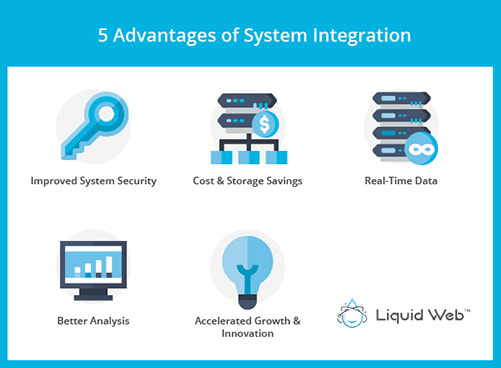
Beneath are some organizational benefits of system integration:
- Improved System Safety: Built-in techniques assist IT groups and enterprise leaders keep watch over what information is seen by which people or teams. An utility that’s not correctly built-in have to be managed and maintained independently, opening the door to a information breach or theft.
- Value and Storage Financial savings: Built-in techniques take away redundancy in functions and information. For instance, as a substitute of storing the identical enterprise info inside a number of locations and a number of techniques, an built-in surroundings means a single occasion of knowledge may be accessed by totally different functions, all from the identical place.
- Actual-Time Knowledge: With built-in techniques, information may be up to date in real-time as a substitute of solely after somebody manually uploads or updates it. A database that connects to all functions can ingest info consistently.
- Higher Evaluation: Built-in techniques additionally remedy the age-old drawback of 1 hand not realizing what the opposite is doing. Integration implies that information and insights may be shared throughout functions, departments, and groups.
- Accelerated Progress and Innovation: Progress and innovation speed up because of improved effectivity and effectiveness. Fewer technical or course of roadblocks profit the enterprise as an entire.
What are the System Integration Sorts?
There are lots of alternative ways to combine techniques inside a enterprise. For instance, bringing several types of software program collectively by way of API is totally different than connecting a community of servers in numerous areas, but each are examples of integrations.
Most system integrations fall into one of many following three classes:
1. Vertical Integration:
Vertical integration may be regarded as top-to-bottom or start-to-finish. Vertical integration means bringing collectively instruments that work in live performance from the start of a course of till the completion of that course of.
For instance, vertical integration in accounting would come with integrating the techniques that create invoices, obtain funds, difficulty accounts payable, run payroll, and reconcile accounts.
A vertical integration creates effectivity by making a course of run easily with fewer friction factors between the beginning and end of that course of. For a managed service supplier (MSP), vertical integration may embody serving to a shopper string collectively several types of software program and {hardware}. This could make a complete set of workflows be accomplished with out interruption.
2. Horizontal Integration
In contrast, horizontal system integration may be regarded as left-to-right or throughout. In horizontal system integration, instruments combine to streamline or enhance a course of throughout various totally different departments or groups.
For instance, the gross sales workforce, the advertising workforce, and the IT workforce don’t want their very own time-and-attendance monitoring system. Subsequently, using the identical functions and workflows throughout every workforce after which feeding the knowledge to human sources (HR) streamlines the workflow. The HR workforce doesn’t have to make use of a distinct device when logging hours labored for workers on totally different groups.
Horizontal system integration creates operational effectivity and lowers software program license and upkeep prices that will accompany a number of totally different instruments. Horizontal integrations may embody leveraging a VMware Non-public Cloud for different divisions or integrating a brand new stock system into totally different warehouse areas.
3. Star Integration
A star integration is much less widespread and usually born out of an incapacity to service horizontal or vertical integration. A star integration connects totally different techniques independently to at least one central system.
The important thing to the sort of integration is that the central level is chargeable for passing information or exercise to different factors within the system as wanted. As such, the middle of the mixing is of crucial significance to maintain all the system working.
Every a part of a star integration occurs unbiased of the opposite factors and in isolation. For instance, IT or engineering groups testing totally different instruments or code can profit from the sort of integration.
Moreover, companies with a number of areas or enterprise models that function independently of one another, however all roll as much as headquarters, would profit from a star integration.
Delivering System Integrations for Your MSP Purchasers
With successfully built-in techniques, your corporation will see improved effectivity. As well as, alignment between information, processes, and workflows removes vital aggravation and complications for everybody concerned.
As a managed service supplier, your function in serving to shoppers combine techniques is essential. Your technical understanding of the what and the how of integration can open many doorways for your corporation.
Moreover, horizontal and vertical scaling of functions and processes can uncover further alternatives for you. Understanding which kinds of integrations would most profit your shoppers begins with understanding their wants, their targets, and the sources obtainable.
Our workforce at Liquid Internet has labored with managed service suppliers for greater than 20 years to assist ship highly effective system integrations for his or her enterprise shoppers. In case your managed service enterprise might use a accomplice in delivering essentially the most highly effective attainable integrations to your shoppers, let’s discuss. Contact us now to discover how a partnership with Liquid Internet could make system integrations an excellent greater a part of your corporation.