


Key factors
- Cloud elasticity refers back to the capacity of a cloud computing system to dynamically allocate and deallocate computing sources based mostly on demand. Primarily, it implies that sources, comparable to digital machines, storage, or community bandwidth, can routinely scale up or down in response to modifications in workload or consumer demand.
- Cloud elasticity ensures companies can deal with spikes in demand, like Black Friday gross sales for eCommerce websites or viral content material for media retailers, with out compromising efficiency.
- By effectively using sources, cloud elasticity helps a greener, extra sustainable strategy to cloud computing, lowering the environmental impression of IT operations.
Liquid Net gives Cloud Devoted Servers and VMware Personal Cloud options that present each elasticity and scalability to companies seeking to optimize their cloud infrastructure.
Cloud computing has turn out to be essential for contemporary enterprise operations. On this cloud-centric world, cloud elasticity thrives as an idea that is revolutionizing the best way we handle and make the most of cloud infrastructure. This dynamic functionality permits companies to regulate their cloud sources simply, scaling up or all the way down to completely match their calls for.
Whether or not you are a small startup or a worldwide enterprise, understanding and implementing cloud elasticity can considerably optimize your operations. This could make sure you’re not simply holding tempo with the digital transformation however main the cost.
This information is your complete journey into the world of cloud elasticity. It’ll deal with the challenges head-on, offering sensible options and actionable steps to realize and optimize cloud elasticity in your operations.
What’s cloud elasticity?
Cloud elasticity permits a cloud atmosphere to regulate useful resource provisioning (CPU, reminiscence, storage, and so forth.) in response to altering demand ranges. This implies cloud infrastructure can develop or shrink in capability, guaranteeing the correct quantity of sources on the proper time.
The idea of cloud elasticity is a departure from conventional computing fashions, which frequently depend on static sources. Prior to now, companies needed to predict their most useful resource wants and buy accordingly, resulting in both wasteful overspending or detrimental shortages throughout peak occasions. Cloud elasticity brings a dynamic resolution to this downside, providing a versatile and environment friendly approach to make use of cloud providers.”
— Ken Wallace, VMware Product Supervisor at Liquid Net.
Cloud elasticity will be automated or guide, giving organizations management based mostly on their preferences or their cloud service supplier’s capabilities. Monitoring instruments allow dynamic useful resource changes, guaranteeing environment friendly allocation and responsiveness to enterprise wants. This ensures that sources should not simply allotted effectively however are additionally conscious of the precise wants of the enterprise.
One of the crucial interesting points of cloud elasticity is its non-disruptive nature. When sources are adjusted, they’re reallocated from underutilized areas, guaranteeing that there isn’t any detrimental impression on ongoing operations. This scaling is especially advantageous in public cloud setups, the place sources are ample and will be reallocated with ease.
Being termed as an “elastic” cloud supplier signifies the supplier’s prowess in autonomously provisioning and de-provisioning sources based mostly on utilization calls for. This aligns completely with a pay-as-you-go mannequin, making cloud elasticity not only a technical function however a monetary profit.
What are the advantages of cloud elasticity?
Value financial savings and enhanced Return on Funding (ROI)
By aligning prices immediately with real-time demand, companies solely pay for the sources they use. This prevents over-provisioning and ensures environment friendly use of monetary sources. Such cost-efficiency is important in at the moment’s aggressive panorama, the place maximizing each greenback counts.
Optimum efficiency throughout peak occasions
Elasticity ensures that cloud environments are all the time primed for optimum efficiency, even throughout surprising surges in demand. Take into account an eCommerce web site throughout a flash sale; cloud elasticity can routinely provision further sources to deal with the elevated site visitors, guaranteeing clean and uninterrupted service to clients. This agility and responsiveness make an elastic cloud a cornerstone of recent, user-centric digital providers.
Environment friendly useful resource utilization
By dynamically adjusting sources, cloud elasticity promotes a greener, extra sustainable strategy to cloud computing. It considerably reduces the waste of computing sources, resulting in not simply value financial savings but additionally a smaller carbon footprint. This effectivity resonates nicely with the rising emphasis on sustainability in enterprise operations.
Automation frees up human sources
Automated cloud elasticity mechanisms free IT employees from the fixed monitoring of useful resource utilization. This enables them to focus on extra strategic initiatives that may drive enterprise progress and innovation as a substitute.
Encouraging innovation
The pliability supplied by cloud elasticity encourages companies to experiment and innovate with out the concern of hitting useful resource limits. This freedom to discover new concepts can considerably velocity up the event and deployment of recent services and products.
Nevertheless, embracing cloud elasticity additionally presents sure challenges that organizations should navigate.
Challenges of cloud elasticity
- Elastic provisioning time: For companies with regular, predictable demand, the slight delay in provisioning that may accompany elasticity could not supply a lot of a bonus over a static cloud setup designed to cowl anticipated utilization.
- Technical complexities: Managing a extremely elastic cloud atmosphere introduces complexities, particularly in monitoring and controlling useful resource provisioning to make sure effectivity and efficiency.
- Value visibility and predictability: The pay-per-use mannequin, whereas advantageous for aligning prices with precise utilization, can result in unpredictable bills, particularly during times of unexpectedly excessive demand.
- Safety concerns: Scaling sources dynamically can complicate safety administration, notably if compromised servers are inadvertently introduced on-line or dropped from the community.
- Useful resource competitors: In a multi-tenant cloud atmosphere, there’s potential for competitors over sources, though respected suppliers typically have measures in place to stop this and guarantee dependable useful resource availability.
Regardless of these obstacles, with cautious planning, the appropriate instruments, and a good cloud supplier comparable to Liquid Net, companies can leverage cloud elasticity successfully to boost their operations whereas mitigating potential drawbacks.
How does cloud elasticity work?
In cloud computing, bodily server sources are abstracted and offered as digital providers. Because of this sources like CPU energy, reminiscence, and storage should not tied to a particular {hardware} gadget. As a substitute, they are often allotted from a pool of sources. This digital infrastructure permits sources to be simply shifted between customers inside a cloud and even between completely different clouds, offering flexibility that’s not doable in conventional bodily server setups.
A cloud atmosphere will routinely alter sources in response to fluctuating demand. This automated scaling is essential for sustaining optimum efficiency and value effectivity. For instance, throughout occasions of excessive demand, further sources are seamlessly provisioned to deal with the load, and equally, sources are scaled down when demand decreases.
The technical pprocess behind this includes monitoring instruments and algorithms that regularly assess the necessity for sources based mostly on present utilization patterns. When a threshold is crossed, the system routinely initiates the provisioning or de-provisioning of sources, guaranteeing that the cloud atmosphere is all the time right-sized for the present demand.”
— Ken Wallace, VMware Product Supervisor at Liquid Net.
Cloud environments sometimes supply each guide and auto-scaling choices. Handbook scaling permits directors to regulate sources based mostly on anticipated wants. Auto-scaling, alternatively, occurs in actual time based mostly on precise utilization. This mixture of capabilities ensures that companies can preserve management over their cloud sources whereas benefiting from the agility and effectivity of automated scaling.
Additionally, cloud elasticity helps a pay-per-use mannequin, that means that prices immediately correlate with the quantity of sources consumed. This mannequin ensures companies should not paying for idle capability, making cloud computing less expensive. Automation performs an important function in managing this elasticity. It permits for the dynamic adjustment of sources with out the necessity for fixed human intervention.
Cloud elasticity typical use circumstances
For instance the sensible advantages of cloud elasticity, let’s discover some real-world examples:
- eCommerce web site throughout Black Friday: For an eCommerce web site experiencing a large surge in site visitors throughout Black Friday gross sales, cloud elasticity will permit for automated scaling up of sources to deal with the elevated load, guaranteeing a clean buying expertise for patrons.
- Viral information web site: If a information web site out of the blue goes viral on account of a breaking information occasion, cloud elasticity rapidly provisions further sources to deal with the spike in site visitors, sustaining web site efficiency and availability.
- Non permanent tasks: For brief-term tasks like information analytics or annual IT coaching, cloud elasticity offers the required sources on demand, scaling again down as soon as the mission is full and optimizing each efficiency and value.
- Companies with fluctuating demand: Streaming providers like Netflix might even see spikes in demand with the discharge of standard reveals. Cloud elasticity ensures these spikes will be accommodated seamlessly, offering a constant streaming expertise.
These circumstances spotlight how cloud elasticity eliminates the necessity for guide intervention and optimizes each efficiency and prices.
Cloud elasticity vs cloud scalability
Whereas cloud elasticity and scalability could appear comparable, they serve completely different functions. Cloud scalability refers back to the deliberate, everlasting adjustment of sources to accommodate progress with out compromising efficiency or cost-effectiveness. Not like elasticity, which is reactive and momentary, scalability is about proactive and stuck modifications to useful resource allocation.
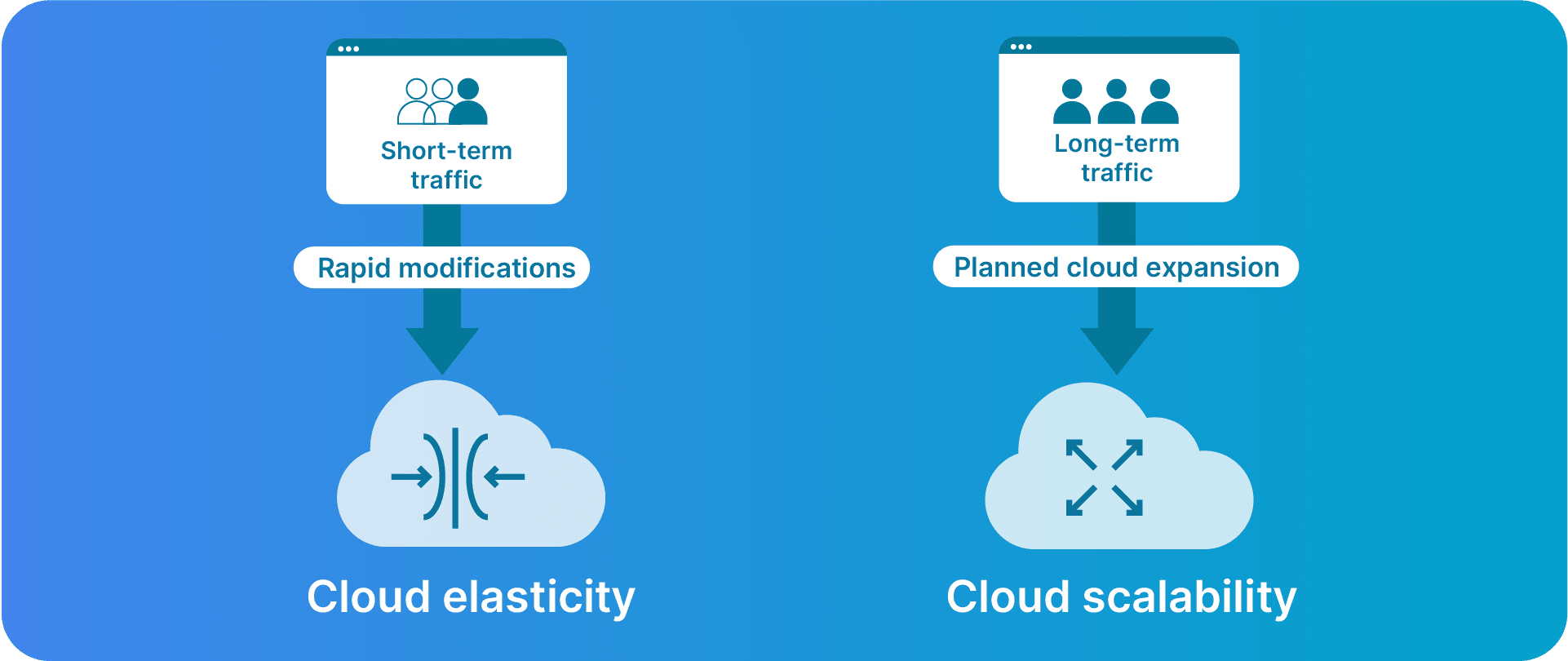
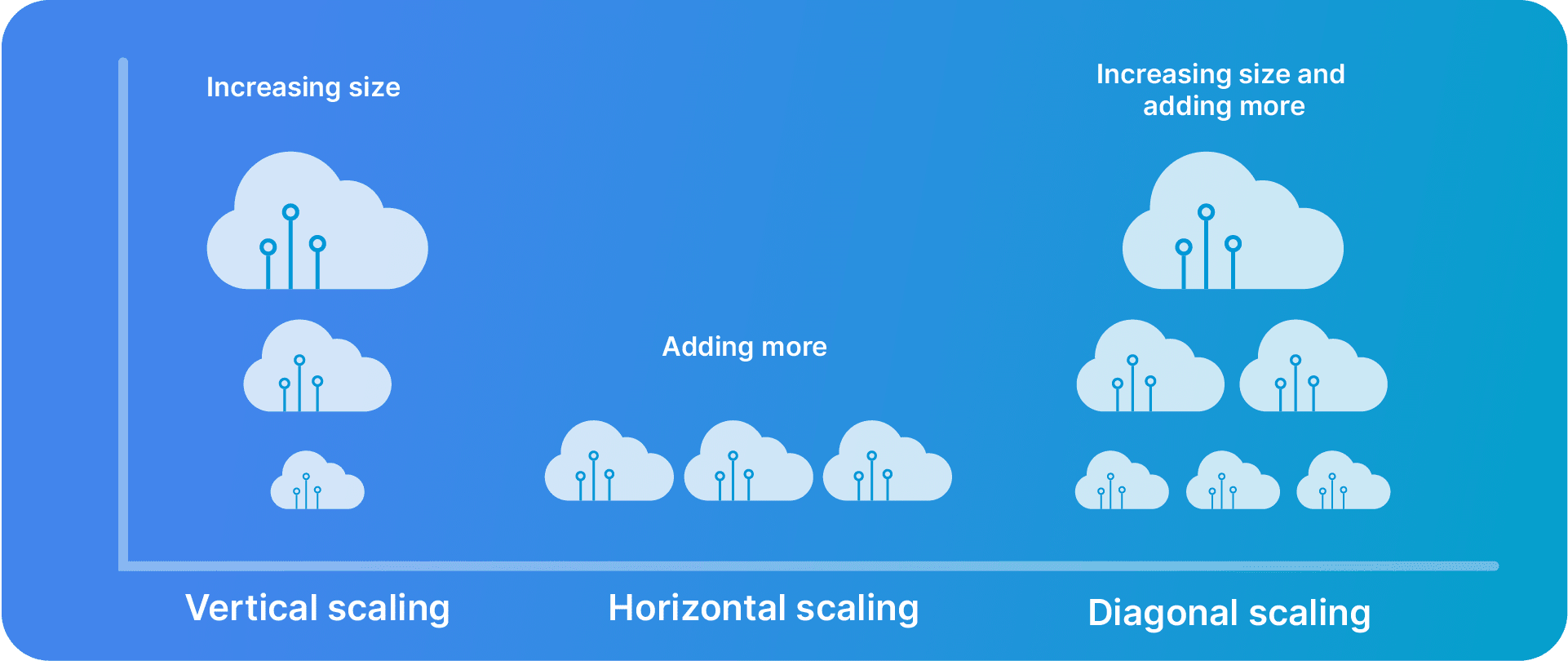
Cloud scalability will be vertical (including extra sources to a single server), horizontal (including extra servers), or diagonal (each). Each ideas goal to regulate sources effectively. However elasticity is about speedy, automated changes to short-term fluctuations, whereas scalability focuses on long-term progress and capability planning.
Attaining and optimizing elasticity in cloud computing: A step-by-step information
In case you’re contemplating making the leap in direction of a extra elastic cloud atmosphere, right here’s an outline of how one can begin:
Step 1: Assess your present infrastructure
Earlier than diving into cloud elasticity or scalability, take a complete take a look at your current IT infrastructure. Perceive the sources you at present have, the way you’re using them, and the place there is perhaps gaps or overprovisions. Figuring out bottlenecks or efficiency points is important at this stage.
This evaluation will assist decide whether or not shifting in direction of an elastic or scalable cloud mannequin is the appropriate transfer. It would additionally inform you the place this transfer might have probably the most impression.
Step 2: Set clear aims
Having a transparent set of targets is important for any strategic IT resolution. With cloud elasticity or scalability, outline what you’re aiming to realize. Are you seeking to deal with spikes in consumer site visitors extra successfully, accommodate seasonal enterprise fluctuations, or enhance general system reliability and efficiency?
Resolve whether or not your targets are extra aligned with the momentary, demand-driven nature of elasticity or the long-term progress focus of scalability.
Step 3: Select the appropriate cloud scalability mannequin
Choosing the suitable mannequin for cloud scalability includes rigorously evaluating your enterprise wants. Take into account your anticipated progress, finances, software structure, and the way a lot management you want to preserve over your cloud atmosphere. Talking immediately with cloud suppliers can supply invaluable insights into which providers and fashions will greatest help your aims.
Step 4: Monitor efficiency
As soon as you have applied cloud elasticity or scalability options, steady monitoring turns into key to making sure optimum efficiency. Make use of monitoring instruments to control the way you make the most of sources and determine any new bottlenecks or inefficiencies.
Many cloud suppliers supply efficiency monitoring instruments and providers designed that will help you preserve the effectivity of your cloud atmosphere. Frequently reviewing and adjusting your useful resource allocation will allow you to keep aligned together with your efficiency aims and budgetary constraints.
Cloud elasticity with Liquid Net
Discovering a service supplier that not solely understands your wants but additionally gives strong and versatile options is critical. Liquid Net, recognized for its skilled and dependable IT providers tailor-made to a variety of enterprise necessities, is a perfect selection.

Amongst its premier choices are the Cloud Devoted Servers, a strong mix of conventional devoted servers’ reliability and bodily useful resource transparency with the cloud platform’s on the spot provisioning and adaptability. They meet the excessive calls for of safety and reliability whereas offering the complete transparency of {hardware} sources. This distinctive mixture ensures companies can get pleasure from the perfect of each worlds: the devoted sources and efficiency of a bodily server alongside the agility and scalability of cloud computing.
These cloud devoted servers embrace elasticity and scalability at their core for immediate provisioning. This implies companies can reallocate sources to match their present wants with out the delays sometimes related to bodily server deployments.

For these looking for extra specialised options, Liquid Net’s VMware Personal Cloud and enterprise internet hosting options supply an elevated stage of scalability and effectivity. These options give companies the liberty to scale sources in a cheap method, guaranteeing that their IT infrastructure can evolve in tandem with their progress with out incurring pointless prices or complexity.
Whether or not you are seeking to accommodate sudden surges in internet site visitors, scale sources for a large-scale mission, or just search a extra environment friendly solution to handle your IT infrastructure, Liquid Net’s suite of cloud providers, together with its elasticity and scalability choices, offers a complete reply.
Optimize your cloud effectivity via cloud elasticity with Liquid Net
The adaptability of cloud elasticity empowers companies to thrive in an atmosphere the place demand is unpredictable. By leveraging elasticity in cloud computing successfully, companies stand to realize immensely, experiencing advantages that vary from substantial value financial savings to enhanced efficiency, from burstable bandwidth for dealing with site visitors spikes to unparalleled flexibility that enables for swift adaptation to market modifications.
For companies able to embrace the complete potential of their cloud infrastructure, reaching out to a trusted associate like Liquid Net is a clever subsequent step. With a complete suite of cloud options designed for each elasticity and scalability, Liquid Net stands able to information you thru the method of optimizing your cloud atmosphere.
Need a clean and profitable journey towards optimized cloud useful resource utilization? Attain out to Liquid Net at the moment for skilled recommendation tailor-made to your enterprise wants.