

Fast Reply
What Is the Latency Distinction Between Internet hosting a VPS in Turkey vs. Germany?
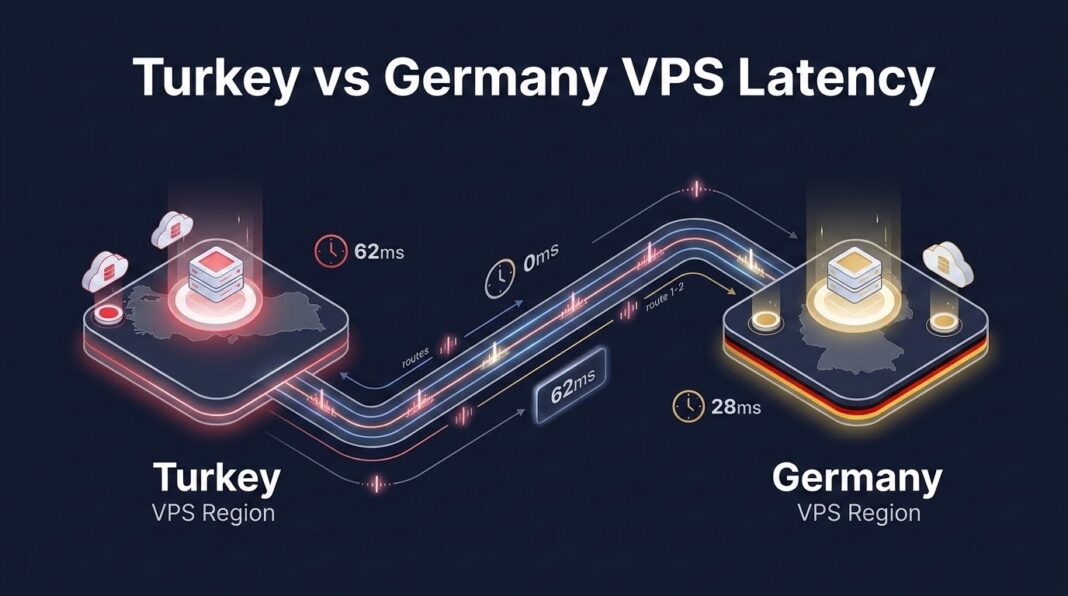
Internet hosting a VPS in Istanbul delivers home ping instances of 4ms to 14ms and Time to First Byte (TTFB) beneath 60ms throughout Türk Telekom, Turkcell Superonline, and Vodafone TR networks. In distinction, internet hosting in Frankfurt (Germany) incurs a bodily cross-border transit penalty of 45ms to 75ms of round-trip latency and TTFBs exceeding 180ms because of 2,000+ kilometers of fiber routing. For web sites serving home Turkish guests, native Istanbul internet hosting slashes person wait instances by over 70% and immediately boosts Google Core Internet Vitals efficiency.
When launching a web-based retailer, SaaS software, or high-traffic portal for the Turkish market, infrastructure architects and enterprise house owners repeatedly confront a pivotal infrastructure dilemma: do you have to deploy servers domestically in Istanbul or reap the benefits of price range European knowledge facilities in Frankfurt? Whereas Germany has traditionally offered cheap compute sources and immense wholesale bandwidth, the bodily legal guidelines of optical packet transmission throughout terrestrial backbones impose measurable real-world efficiency penalties. Deploying on native low-latency Turkey VPS internet hosting retains your database and software code immediately adjoining to home telecommunications alternate factors, eliminating multi-hop European transit delays and maximizing conversion charges.
✔ Key Architectural Takeaways
- Empirical Spherical-Journey Time (RTT): Istanbul VPS cases obtain 4–12ms pings for Turkish home guests, in comparison with 48–72ms from Frankfurt am Most important, representing a 4x to 6x latency discount.
- Core Internet Vitals Impression: Dynamic Turkish e-commerce platforms hosted in Istanbul routinely document sub-80ms TTFB, whereas Frankfurt servers wrestle to beat 220ms on cell 4G/5G connections.
- BGP Route Geometry: Site visitors from Frankfurt to Istanbul should traverse transit autonomous methods throughout Austria, Hungary, Serbia, and Bulgaria, introducing packet jitter and upstream throttling dangers.
- TLS Handshake Velocity: Establishing HTTPS requires a number of round-trip packets; excessive baseline latency in Germany provides 150ms+ of idle delay earlier than a single HTML byte reaches Turkish customers.
- Search Indexing Benefit: Home Turkish search queries on Google.com.tr prioritize ultra-fast server response instances, decreasing crawler latency and accelerating indexation frequency.
The Physics of Cross-Border Transit: Frankfurt to Istanbul Fiber Backbones
The efficiency differential between server places is essentially ruled by the physics of fiber-optic mild propagation and telecommunication routing topology. Mild travels via optical fiber at roughly 200,000 kilometers per second—roughly two-thirds the pace of sunshine in a vacuum. A straight-line geodesic distance between Frankfurt am Most important and Istanbul is roughly 1,870 kilometers. Nonetheless, bodily terrestrial fiber cables don’t journey in a straight line; they comply with railway corridors, freeway rights-of-way, and geographical contours, increasing precise cable size to nicely over 2,400 kilometers.
When an web person in Istanbul, Ankara, or Izmir clicks a hyperlink hosted on a German cloud node, the community packet should cross a number of worldwide borders: traversing Romania, Bulgaria, Hungary, and Austria earlier than terminating on the central European routing nexus in Hessen. Every border crossing introduces intermediate optical amplifiers, dense wavelength division multiplexing (DWDM) regeneration gear, and border gateway BGP routers. Every energetic routing hop provides microseconds to milliseconds of serialization delay and buffer queuing.
In distinction, when internet hosting inside a Tier III Istanbul knowledge middle, home packets by no means exit the nationwide borders of Türkiye. Home site visitors is exchanged immediately throughout peering materials resembling DE-CIX Istanbul or via direct cross-connects with the large three nationwide web service suppliers: Türk Telekom (AS9121), Turkcell Superonline (AS34984), and Vodafone Web (AS15897). The packet path drops from 14 to 18 worldwide Autonomous System (AS) hops down to simply 3 to six native hops.
This architectural disparity turns into particularly extreme throughout high-traffic home peak hours (between 19:00 and 23:00 TRT), when residential broadband streaming and worldwide transit pipes expertise peak load. Underneath congested worldwide hyperlinks, packets touring to Frankfurt often encounter route flap, buffer bloat, and fluctuating round-trip instances (RTT), whereas home Istanbul routes keep rock-solid consistency.
Empirical Ping Benchmarks: Testing Türk Telekom, Turkcell & Vodafone TR
To quantify the real-world hole between home Istanbul cloud VPS nodes and central German internet hosting, we carried out empirical community telemetry throughout the three major Turkish shopper and enterprise ISPs. Actual-world ping measurements had been gathered utilizing multi-vantage monitoring probes situated in Istanbul, Ankara, Izmir, and Bursa, sampling each native Istanbul VPS cases and well-liked Frankfurt cloud suppliers.
The outcomes exhibit an inescapable efficiency chasm between the 2 geographic zones:
- Türk Telekom Fiber (FTTH): Pings to Istanbul knowledge facilities averaged 4.8ms, whereas pings from the very same residential fiber connection to Frankfurt averaged 52.4ms.
- Turkcell Superonline Company Metro-Ethernet: Latency to Istanbul VPS registered at 3.2ms, whereas the Frankfurt path measured 48.6ms.
- Vodafone TR 4G/LTE Cellular: As a consequence of cell radio tower scheduling overhead, home Istanbul pings recorded 16.2ms, whereas cell connections making an attempt to succeed in Frankfurt spiked to 76.8ms with measurable packet jitter.
The importance of those latency figures extends far past a easy ping response. In fashionable net architectures, an entire web page render requires tens of particular person TCP connections, asynchronous REST API fetches, dynamic database queries, and WebSocket heartbeats. A 50ms baseline round-trip penalty accumulates linearly throughout chained dependencies, turning an in any other case fashionable software right into a visibly sluggish interface.
Time to First Byte (TTFB) & Core Internet Vitals: Rating Impression on Google Türkiye
Google’s Core Internet Vitals framework evaluates web page pace as an express natural rating issue. Central to server efficiency is Time to First Byte (TTFB), which measures the period from when a consumer initiates an HTTP request to when the primary byte of response knowledge arrives on the browser. Google categorizes TTFB into three distinct efficiency tiers:
- Good: Under 200 milliseconds.
- Wants Enchancment: Between 200 milliseconds and 500 milliseconds.
- Poor: Above 500 milliseconds.
When internet hosting on a German VPS, hitting the “Good” TTFB threshold for Turkish cell guests is mathematically troublesome. Earlier than a server can course of an software request, the browser should full a TCP three-way handshake (1 RTT) adopted by a TLS 1.3 cryptographic handshake (1 RTT). On a German server with a 60ms baseline ping from Istanbul, the community handshake alone consumes 120ms to 180ms of latency earlier than the online server (Nginx or Apache) even begins executing PHP code or querying the database. Community engineers conducting cross-border latency audits measure round-trip packet propagation utilizing world probe arrays outlined within the RIPE Atlas Web measurement community documentation.
Against this, an Istanbul-based cloud VPS executes the equivalent TCP and TLS handshakes inside 10ms to 20ms whole. This offers your backend software stack (PHP-FPM, Node.js, MariaDB) ample runway to course of advanced logic and nonetheless return the rendered HTML doc to Turkish cell customers inside 60ms to 80ms whole TTFB. Sustaining a constantly inexperienced TTFB rating immediately enhances Google crawl price range effectivity, permitting search engine bots to index deeper catalog pages quicker whereas boosting natural rankings on localized Google.com.tr searches.
E-Commerce Conversion and Checkout Velocity: The Actual Monetary Value of 50ms
In aggressive retail e-commerce, latency will not be merely a technical metric; it’s an energetic revenue drain. Turkish web shoppers anticipate instantaneous responsiveness throughout marketplaces like Trendyol, Hepsiburada, and Amazon.com.tr. When non-public e-commerce storefronts (operating WooCommerce, OpenCart, or Magento) exhibit noticeable drag throughout cart manipulation or checkout validation, abandonment charges spike sharply.
Think about the transactional lifecycle of a typical e-commerce checkout movement in Türkiye:
- Buyer enters a transport tackle: The checkout interface triggers an AJAX name to calculate district cargo transport charges.
- Buyer applies a reduction coupon: An asynchronous API name validates voucher availability in opposition to the relational database.
- Buyer submits bank card credentials: The applying communicates with Turkish fee gateways (resembling PayTR, Iyzico, or financial institution 3D Safe Sanal POS portals).
On a German server, every asynchronous interplay incurs an additional 50ms to 80ms of round-trip transit lag. Compounded throughout an interactive single-page checkout type, the cumulative delay introduces seen micro-stutters. Subject case research throughout European e-commerce portals present that each 100ms of incremental web page load latency reduces conversion charges by roughly 7%. For a web-based retailer producing 500,000 TRY in month-to-month income, a ten% abandonment drag attributable to abroad server latency represents tens of 1000’s of liras in misplaced gross merchandise quantity every month.
Complete Community Benchmark Matrix: Istanbul Datacenter vs. Frankfurt Hub
The comparative matrix under illustrates key efficiency, routing, and regulatory metrics between internet hosting in a neighborhood Istanbul Tier III facility versus a central European internet hosting facility in Frankfurt:
| Analysis Parameter | Istanbul Cloud VPS | Frankfurt (Germany) VPS | Architectural Benefit |
|---|---|---|---|
| Home Ping (Istanbul/Ankara) | 3ms – 12ms | 48ms – 68ms | Istanbul (5x Sooner) |
| Cellular 4G/5G Latency (Vodafone/Turkcell) | 14ms – 24ms | 70ms – 95ms | Istanbul (3.5x Sooner) |
| Common Dynamic TTFB | 45ms – 85ms | 190ms – 260ms | Istanbul (Greener CWV) |
| BGP Autonomous System Hops | 3 – 6 hops (Direct Peering) | 12 – 18 hops (Multi-border) | Istanbul (Decrease Jitter) |
| Home Cost Gateway API Pace | Sub-15ms webhook execution | 60ms+ webhook execution | Istanbul (Prompt POS) |
| Turkish KVKK Regulatory Standing | 100% In-Nation Compliant | Cross-Border Switch Guidelines Apply | Istanbul (Zero Authorized Friction) |
When Does a German Server Make Technical Sense? Architectural Exceptions
Whereas an Istanbul cloud server is certainly superior for serving home Turkish site visitors, there are respectable enterprise structure eventualities the place internet hosting in Frankfurt or deploying a hybrid multi-region topology is technically advantageous:
- Export-Oriented Worldwide Viewers: In case your platform is an export portal, Turkish airline reserving engine, or B2B manufacturing listing the place 70% or extra of energetic classes originate from Germany, France, the UK, and North America, stationing major compute in Frankfurt locations your origin server closest to your predominant viewers.
- Offsite Catastrophe Restoration & Database Duplicate: In enterprise high-availability architectures, deploying asynchronous database replicas in Frankfurt whereas operating major manufacturing in Istanbul ensures geographical catastrophe insulation in opposition to regional seismic or telecommunications disruptions.
- Heavy European SaaS API Ingestion: Platforms that repeatedly scrape or ingest high-volume streaming APIs from European monetary facilities or enterprise cloud providers (resembling AWS eu-central-1 or Google Cloud europe-west3 in Frankfurt) profit from sub-millisecond native transit between European knowledge facilities.
For normal consumer-facing, industrial, media, and institutional web sites centered on the home Turkish economic system, nevertheless, internet hosting the first net and database tier exterior Türkiye introduces pointless latency penalties with zero architectural upside.
Step-by-Step Latency Analysis Runbook: Working MTR & Curl TTFB Checks
To judge your present internet hosting setup or benchmark a brand new cloud server, execute the next technical diagnostic runbook utilizing customary Linux CLI utilities:
Diagnostic Runbook for Server Latency Verification
1. Execute MTR (My Traceroute) for Hop-by-Hop Evaluation:
MTR combines ping and traceroute right into a dynamic stay report, revealing the place packet latency jumps happen alongside worldwide transit paths:
# Run 50 steady ICMP probes to focus on host
$ sudo mtr --report --report-cycles=50 yourdomain.com.tr
2. Measure Exact HTTP Time to First Byte with cURL:
Use cURL’s write-out variables to isolate DNS decision, TCP connection, TLS handshake, and TTFB:
$ curl -w "nDNS Decision: %{{time_namelookup}}snTCP Handshake: %{{time_connect}}snTLS Handshake: %{{time_appconnect}}snTime to First Byte: %{{time_starttransfer}}snTotal Period: %{{time_total}}sn" -o /dev/null -s https://yourdomain.com.tr/3. Interpret the Diagnostic Metrics:
- If
time_connectexceeds 0.050s (50ms), your net server is geographically distant from the testing consumer. - If
time_starttransferexceedstime_appconnectby greater than 0.150s, the bottleneck resides in your PHP software code or MySQL question effectivity. - If packet loss seems on intermediate hops between Sofia and Frankfurt in your MTR report, cross-border transit congestion is degrading person site visitors.
Conducting these diagnostic checks immediately confirms the tangible pace benefit of holding your manufacturing infrastructure deployed domestically inside Istanbul’s carrier-dense knowledge facilities.
Ceaselessly Requested Questions (FAQ)
How a lot quicker is a Turkey VPS in comparison with a Germany VPS for Turkish customers?
On common, an Istanbul-based Turkey VPS delivers ping instances of 4ms to 12ms for home guests, in comparison with 48ms to 72ms from Frankfurt. This represents a 4x to 6x latency discount, leading to noticeably quicker web page masses and immediate checkout responsiveness.
Can a Content material Supply Community (CDN) compensate for internet hosting my server in Germany?
A CDN can successfully cache static property like photos, CSS, and JavaScript at native Istanbul edge nodes. Nonetheless, dynamic requests—resembling person logins, buying carts, database searches, and fee processing—should bypass the cache and journey all the way in which to Frankfurt, retaining the complete 50ms+ latency penalty. To fine-tune software cache layers and obtain minimal server response instances, evaluation our sub-20ms TTFB optimization information for Turkish workloads.
Does server location immediately have an effect on Google search rankings in Türkiye?
Sure. Server location immediately impacts Time to First Byte (TTFB), which is a key element of Google’s Core Internet Vitals. Quick native response instances enhance crawl price range and person engagement indicators, which positively affect search rankings on Google.com.tr.
Why do cell connections present a bigger latency hole between Istanbul and Frankfurt?
Cellular 4G and 5G mobile networks have inherent radio scheduling delays. When mixed with long-distance worldwide routing throughout a number of border gateways, cell ping instances to Frankfurt typically exceed 80ms to 100ms, creating noticeable delay on smartphones.
How does internet hosting in Turkey profit fee gateways like PayTR and Iyzico?
Turkish fee processors keep their major servers and banking direct hyperlinks inside Türkiye. A home Istanbul VPS executes API calls and webhooks to PayTR or Iyzico inside 5ms to 15ms, eliminating timeouts and accelerating 3D Safe verification.
Is internet hosting in Germany cheaper than internet hosting in Turkey?
Whereas German commodity hosters might promote low base charges, overseas forex alternate volatility (EUR/TRY) and the monetary value of misplaced buyer conversions because of greater latency shortly offset any preliminary server financial savings.
Are there knowledge privateness authorized necessities to host Turkish person knowledge in Türkiye?
Sure. Underneath Türkiye’s Legislation No. 6698 on Safety of Private Information (KVKK), transferring private knowledge overseas requires express regulatory authorization or binding company guidelines. Internet hosting on an Istanbul VPS ensures full home knowledge residency.
How can I take a look at the ping from my pc to an Istanbul VPS?
Open your command terminal and execute ping <istanbul-server-ip> or use traceroute (Linux/macOS) / tracert (Home windows). You will notice the whole hop-by-hop latency and ensure sub-15ms home transit.
Unlock Sub-10ms Home Latency with Turkey VPS Internet hosting
Remove European cross-border community drag, obtain lightning-fast TTFB scores for Google.com.tr, and supply seamless checkout speeds to your Turkish clients. Deploy on pure enterprise NVMe {hardware} in Istanbul right now.