

Cloud computing is a scalable and cost-effective approach to host your knowledge and functions, which is why 75% of companies plan emigrate to the cloud by 2026.
Nonetheless, whereas a cloud setting has a number of advantages, it poses sure safety dangers. The 2023 Cloud Safety Report by ISC2 discovered that 95% of companies are involved about cloud safety, making it a prime concern for enterprises.
For those who use a cloud-based infrastructure or are planning emigrate to the cloud, it’s important to know its safety dangers and mitigate them. On this information, you’ll study what to search for in cloud safety and its finest practices.
Cloud safety 101
Cloud safety encompasses the instruments, protocols, and applied sciences used to safe a cloud computing setting. These safety measures shield an organization’s cloud-hosted knowledge and functions from malicious actors, unauthorized entry, and knowledge loss.
Not like a standard enterprise community the place bodily servers are positioned on the corporate premises, cloud computing servers are positioned in distant knowledge facilities. Relying in your chosen cloud service supplier (CSP) and the service you go for, your corporation may need restricted entry to those servers, so guaranteeing server safety may be difficult.
In a standard enterprise community, customers entry the info and functions by the enterprise’s community. In a cloud setting, customers might make the most of public networks, and it’d result in cloud safety vulnerabilities.
Most cloud environments use a multi-tenant structure, the place completely different companies run their functions on the identical server. As a result of a number of customers share server assets, your corporation might develop into weak to safety threats, knowledge breaches, and efficiency points.
To totally perceive mitigate these dangers, let’s dive into how cloud safety works.
How does cloud safety work?
A cloud setting is a fancy system with a number of layers, such because the infrastructure, platform, and utility layers. An efficient cloud safety technique incorporates instruments and methods to stop knowledge breaches and malicious assaults at every layer.
Let’s discover these cloud computing layers and the principle safety measures to implement.
1. Infrastructure layer
The infrastructure layer includes the bodily servers internet hosting the cloud setting and the community gadgets interconnecting these hosts.
The cloud safety measures to implement on the infrastructure layer embrace:
- Proscribing bodily entry to the servers.
- Making certain right configuration of bodily servers and community gadgets.
- Updating server working methods and software program.
2. Platform layer
The platform layer runs on prime of the infrastructure layer and offers an setting for utility growth, deployment, and testing. The working system and utility framework are two most important elements of the platform layer.
Securing your cloud computing setting on the platform layer entails:
- Creating person teams and roles to stop unauthorized entry.
- Implementing authentication mechanisms like multi-factor authentication (MFA).
- Monitoring person actions to detect threats and unauthorized entry.
3. Utility layer
The appliance layer encompasses a set of functions that entry and modify person knowledge to carry out particular features.
The next practices stop knowledge leaks and unauthorized utility modifications on the utility layer:
- Information encryption.
- Controlling person privileges.
- Securing utility programming interfaces (APIs).
The shared duty mannequin for cloud safety
Relying on the cloud service and the internet hosting mannequin, the CSP and the client share the safety duties as follows:
- Infrastructure-as-a-Service (IaaS): The CSP secures server {hardware} and maintains the servers by configuring and patching them. The shopper is liable for securing their working methods, knowledge, and functions.
- Platform-as-a-Service (PaaS): Within the PaaS mannequin, the CSP presents the working system and utility framework as a service. The CSP secures the bodily {hardware}, the appliance framework, and the working system whereas the shopper secures their functions.
- Software program-as-a-Service (SaaS): The CSP offers ready-to-use functions hosted on the cloud. It secures the server {hardware}, working system, and functions whereas the shopper ensures safe person entry to those functions.
Why is cloud safety essential?
A safe cloud computing structure ensures regulatory compliance, strengthens your model’s fame, ensures continuity, and protects business-critical knowledge. Let’s contemplate these advantages intimately.
Regulatory compliance
Governments throughout the globe are imposing strict legal guidelines to make sure knowledge privateness. In 2023, eight U.S. states handed strong shopper privateness laws.
That is along with long-standing state-specific laws, like:
- California Shopper Privateness Act.
- Colorado Privateness Act.
- Virginia Shopper Information Safety Act.
An efficient cloud safety technique allows you to keep compliant with these laws and keep away from fines and authorized fits. These laws immediate companies to develop pointers and insurance policies that may create a safe cloud setting in the long term.
Enterprise continuity
Cloud safety protects delicate info and recordsdata from knowledge leaks and malicious assaults (e.g., malware and phishing), guaranteeing your corporation can at all times entry its knowledge.
By implementing strict knowledge safety measures, your corporation can keep its operations with out being considerably impacted by safety breaches, energy outages, pure disasters, and different disruptions.
Buyer belief
A enterprise that operates in an unsecured cloud setting is susceptible to knowledge leaks. Cybercriminals can use leaked buyer knowledge (e.g., private, monetary, or well being info) to commit identification theft or fraud. This may result in reputational harm and lack of buyer belief.
Against this, a safe cloud computing setting enhances model fame, making it simpler for purchasers to belief your corporation with delicate info.
Information safety
Companies typically retailer delicate knowledge like undertaking roadmaps, designs, and analysis paperwork within the cloud infrastructure. If there’s a cybersecurity breach, an intruder would possibly achieve entry to this knowledge and delete it or maintain it for a ransom.
Cloud safety insurance policies might help you determine and mitigate dangers. This protects your mental property from unauthorized entry, providing you with a aggressive benefit.
What are the safety dangers of cloud computing?
- Wider assault floor.
- Lack of cloud visibility and management.
- Advanced configuration.
- Multitenancy.
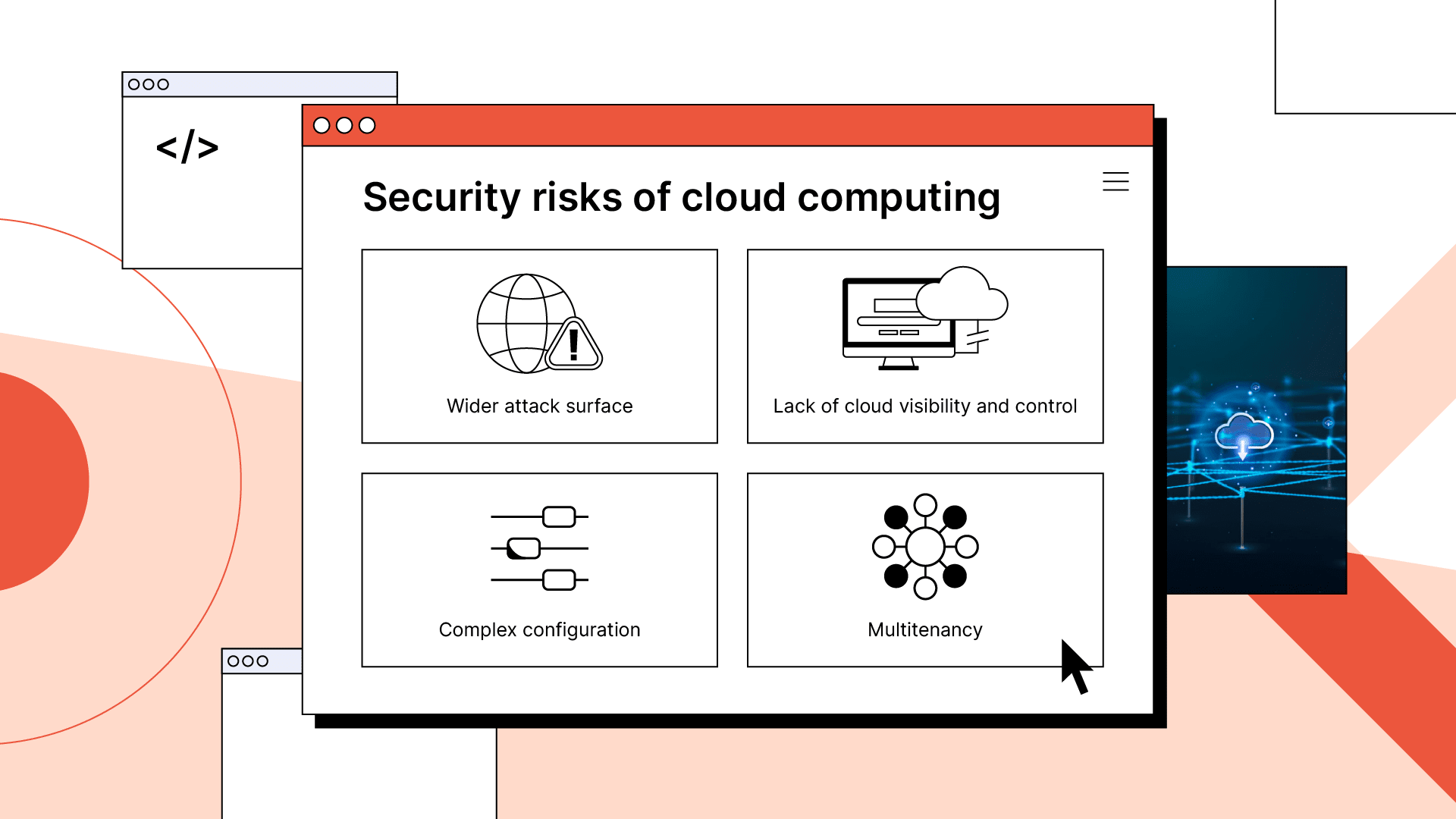
Whereas cloud computing presents scalability and suppleness, its distributed mannequin and digital servers pose some safety challenges.
Wider assault floor
An assault floor consists of all of the community endpoints weak to an assault. Companies with an on-premise infrastructure have tighter management over their bodily servers and enterprise networks. This narrows the assault floor.
In a cloud setting, digital servers are added and deleted dynamically. There’s a likelihood of server misconfiguration, making these servers prone to assaults and thus widening the assault floor.
When companies use a cloud service supplier, they’ve restricted visibility over who’s accessing the cloud setting and from the place. Customers would possibly make the most of unsecured networks and gadgets, heightening the possibilities of an assault.
Lack of cloud visibility and management
The cloud is a fancy setting the place a number of customers log in from completely different places. If your corporation makes use of a SaaS or PaaS cloud service mannequin, it may not get full info on who’s logging in to the cloud setting.
Additional, in PaaS and SaaS fashions, a cloud service supplier handles a big a part of cloud safety, so your corporation may not find out about potential cyberattacks, nor can it detect or stop them.
Advanced configuration
A cloud setting would possibly include a whole lot and even 1000’s of digital machines. Every machine ought to have the proper safety configurations (e.g., passwords, person teams, roles, and entry controls) to guard delicate info.
In a 2023 cloud safety report, Cybersecurity Insider recognized the shortage of skilled workers as the highest cloud safety barrier for corporations. To stop misconfigurations, you’ll be able to both spend money on worker coaching or rent exterior consultants with specialised cloud safety expertise.
Multitenancy
In a public cloud setting, a enterprise shares a bodily server with a number of different customers.
This might result in safety points like:
- A co-tenant initiating an assault.
- An assault geared toward a co-tenant affecting the opposite tenants.
- A co-tenant’s safety breach making the cloud setting weak to assaults.
Though CSPs present isolation, there’s a safety danger related to multi-tenant environments. A personal cloud is a superb choice to keep away from the vulnerabilities of multitenancy — you get unique entry to your cloud setting.
Whereas there are some dangers related to cloud computing, selecting the best resolution might help you keep a strong cloud safety posture.
What to search for in cloud safety
- Identification and entry administration (IAM).
- Risk monitoring and prevention.
- Superior knowledge safety.
- Safety info and occasion administration.
- Information loss prevention.
- Catastrophe restoration resolution.
Securing the cloud computing setting is a prime precedence for enterprises. Listed here are the important components of cloud safety it is best to search for.
Identification and entry administration (IAM)
A cloud setting could have customers logging in from across the globe utilizing unsecured gadgets and public networks. Therefore, attackers can fake to be authentic customers.
This makes identification and entry administration a vital a part of cloud safety. IAM has a number of entry management methods to make sure solely authentic customers can log in to a cloud community.
- Position-based permissions and person privileges.
- Multi-factor authentication and the enforcement of robust passwords.
- Dynamic updation of person entry privileges with enterprise modifications.
- Steady monitoring of login exercise and reporting of suspicious actions.
Risk monitoring and prevention
Superior applied sciences like intrusion detection methods (IDS) and intrusion prevention methods (IPS) can detect potential threats and take countermeasures.
The IDS will monitor your cloud setting and flag any exercise that matches a cyberattack signature. This consists of irregular modifications in entry privileges and the overall slowing down of the community.
The IDS can detect varied cloud safety breaches like:
- Distributed denial of service (DDoS).
- Man-in-the-middle (MITM) assaults.
- Zero-day assaults.
- Malware assaults.
- Insider threats.
The IPS enhances the IDS by enjoying a extra proactive position. It prevents assaults by dropping malicious packets and blocking suspicious customers, along with different methods.
Superior knowledge safety
Information safety is a necessary characteristic to search for in cloud safety. It protects knowledge from unauthorized entry, knowledge breaches, and knowledge loss.
Encryption is the first method used to guard knowledge in a cloud setting. It entails coding the info into an unreadable format, which may solely be deciphered with a secret key.
There are two sorts of knowledge to think about in a cloud setup, and every requires a special encryption technique:
- Information at relaxation: Use an encrypted arduous disk to retailer knowledge. The cloud safety resolution will encrypt the info whereas writing into the disk.
- Information in transit: Use SSL/TLS applied sciences to encrypt knowledge whereas it travels from the server to the shopper or vice versa.
You may additionally use public key infrastructure (PKI) to concern digital certificates. The digital certificates helps functions make sure the legitimacy of incoming knowledge. It’s possible you’ll assign digital certificates to a person, machine, or utility.
Safety info and occasion administration (SIEM)
The SIEM system collects log knowledge from the complete cloud setting and collates it in a centralized platform. You need to use this knowledge to automate safety monitoring and menace detection within the cloud setting.
SIEM makes use of synthetic intelligence and machine studying to investigate your log knowledge and detect suspicious actions.
Information loss prevention (DLP)
Shedding business-critical knowledge might end in monetary setbacks, regulatory fines, authorized fits, and broken buyer relationships. In response to IBM, knowledge loss value corporations $4.45 million in 2023.
Utilizing predefined knowledge sorts or templates, DLP classifies buyer knowledge like bank card or social safety numbers, serving to organizations adjust to knowledge safety laws. It additionally makes use of methods like de-identification, tokenization, and masking to scale back cloud safety dangers.
Catastrophe restoration options
A catastrophe restoration system backs up important knowledge so a enterprise can restore the info misplaced throughout a pure or man-made catastrophe.
A catastrophe restoration system has three components:
- A preventive ingredient constantly displays the cloud setting, in search of configuration errors or compliance violations.
- A detective ingredient identifies knowledge loss in actual time and automates restoration.
- A corrective ingredient plans for potential disasters and routinely backs up important knowledge and apps.
Cloud safety finest practices
To safe cloud computing environments, companies and CSPs should comply with cloud safety finest practices, use the precise instruments, and undertake the precise applied sciences. Let’s discover these finest practices.
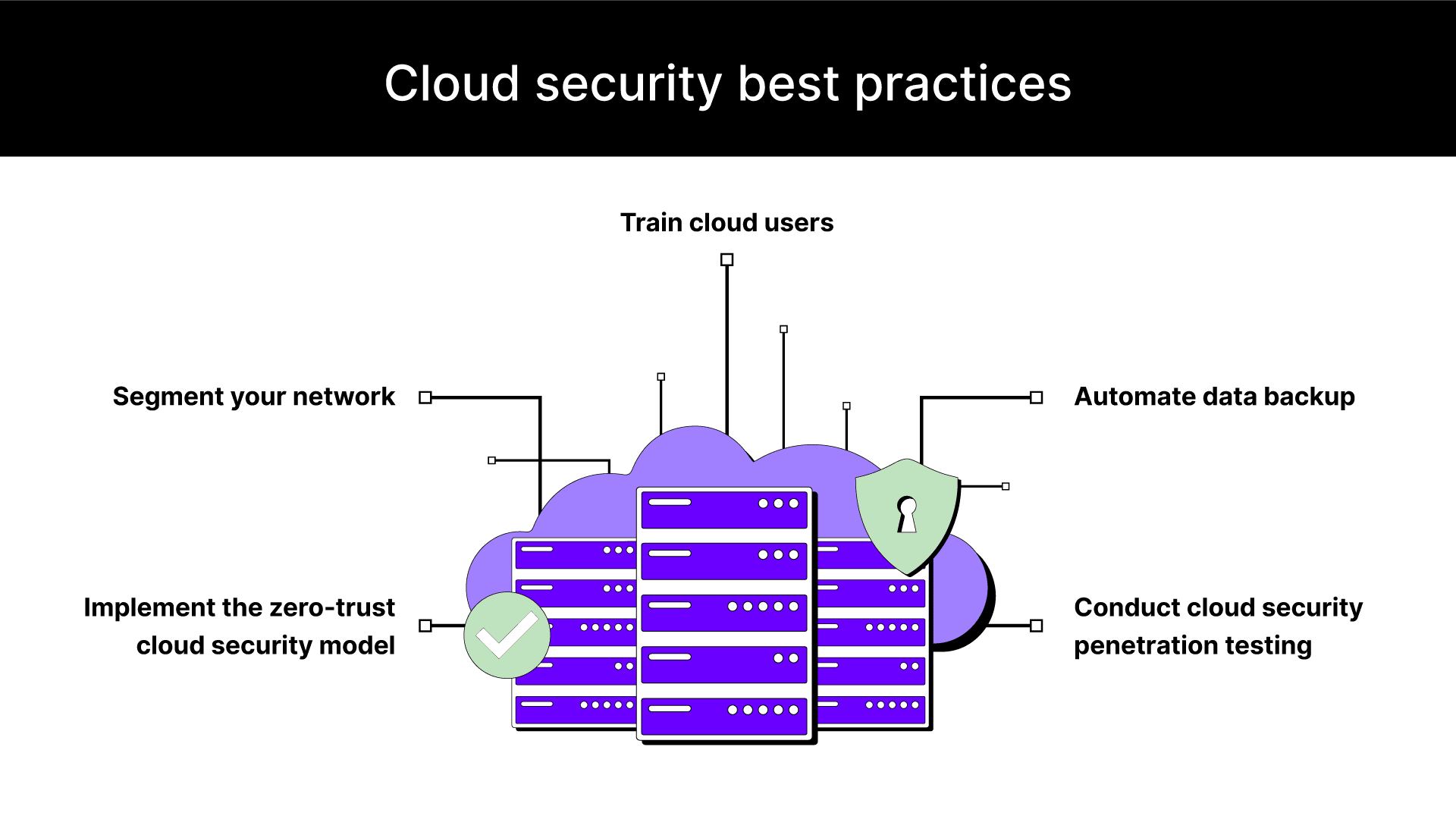
Implement the zero-trust cloud safety mannequin
The zero-trust protocol provides customers simply sufficient entry privileges to get their jobs achieved. Customers who’ve extra privileges than they want may not concentrate on knowledge safety methods and would possibly unintentionally leak important info. Attackers may also goal such person accounts to realize entry to your cloud setting.
Together with minimal essential privilege, the zero-trust protocol mandates the authentication of each person, irrespective of the place they entry the community from. It authenticates customers based mostly on a number of parameters, comparable to their credentials, location, and machine well being.
Section your community
Segmentation is the method of dividing your cloud community into subnetworks based mostly on the data it comprises and the workloads it runs. You possibly can create cloud community segments for every division or at a workload degree. Firewalls between segments will stop malicious knowledge packets from transmitting from one phase to the opposite.
Community segmentation is an effective follow to stop an attacker from destroying your complete cloud setting. To entry your knowledge, the attacker must breach phase by phase, which is tough and time-consuming. At any time when there’s an information breach, you possibly can isolate that phase, stopping the assault from progressing.
Conduct cloud safety penetration testing
Penetration testing is an moral hacking technique used to judge the energy of your cloud safety. In penetration testing, a tester (or a hacker) research your cloud community and identifies weak factors to use.
- The tester identifies potential safety vulnerabilities in a cloud setting.
- They exploit these vulnerabilities to launch an assault.
- The tester observes how the cloud community responds to the menace.
- The tester submits a report back to the group’s cybersecurity crew.
Common penetration testing will make it easier to assess your cloud safety posture and put together for real-life assaults.
Automate knowledge backup
Creating common knowledge backups is an efficient approach to safe a cloud computing setting. Many cloud service suppliers embrace knowledge backup of their companies. However in instances the place it’s not included, it’s essential to create your individual backup routine.
Information backup ensures enterprise continuity even throughout a malware or ransomware assault. Automating backups will remove the necessity on your IT crew to be concerned in day-to-day backups, saving you time and assets.
Practice cloud customers
A cloud setting has varied customers, together with staff, contractors, and enterprise companions. A person’s lack of cloud safety consciousness would possibly result in vulnerabilities, so 74% of companies are involved about knowledge loss as a result of untrained customers.
Right here’s prepare cloud customers:
- Allow multi-factor authentication wherever potential.
- Encourage using robust passwords and frequent password modifications.
- Implement using community and utility firewalls.
- Practice them to detect and report phishing makes an attempt.
Coaching customers to stick to cloud safety finest practices reduces the chance of human errors and ensures compliance with related laws.
Closing ideas: What to search for in cloud safety
Cloud-based infrastructure is a extremely versatile resolution that may make it easier to scale your corporation with ease. However it’s also weak to safety threats like malware, ransomware assaults, and knowledge leaks. Therefore, cloud safety must be a prime precedence for companies that depend on cloud computing.
Whereas your CSP handles some cloud safety duties, you’ll be able to guarantee most safety by implementing the zero-trust coverage, automating knowledge backups, conducting penetration testing, and coaching your customers.
Nonetheless, securing your cloud computing setting begins with selecting the best service supplier. For those who’re in search of a cloud service supplier that ensures scalability, most safety, and excessive efficiency, take a look at Liquid Internet Cloud Studio right now.