

WordPress internet hosting has turn into the go-to selection for bloggers, small companies, and even giant firms. The pliability of this content material administration system and ease of use make it a well-liked selection for these trying to handle their web site content material while not having in-depth technical data.
Nevertheless, different CMSs provide distinctive options and performance which will higher swimsuit the wants of sure customers.
So, which CMS is best for you? Let’s dive in and evaluate WordPress towards different CMSs that can assist you make an knowledgeable selection.
What are Content material Administration Programs (CMSs)?
Content material Administration Programs (CMSs) are software program platforms designed to facilitate the creation, administration, and group of digital content material, sometimes for web sites. They supply customers with intuitive interfaces to create, edit, publish, and replace content material with out requiring superior technical data.
CMSs provide a variety of options together with customizable templates, person permissions, model management, and plugin integrations, making it simpler for people and organizations to construct and preserve their on-line presence effectively.
The Significance of Selecting the Proper CMS
Content material Administration Programs (CMSs) function as standalone platforms, every with its personal distinctive structure, database construction, and administrative interface.
As a result of there is no such thing as a inherent cross-compatibility between completely different CMSs, we advocate deciding which platform you’d like to make use of previous to constructing your web site.
Selecting the best Content material Administration System (CMS) on your web site is essential for a number of causes.
- Design and Growth: Preselecting your CMS offers you an thought of what your web site will want and lets you discover specialists in that area.
- Scalability and Future Development: Choosing a platform aligned with long-term targets ensures adaptability and capability for future updates and enhancements.
- Content material Migration and Information Administration: Selecting your software program earlier than you construct your web site ensures smoother migration course of in case you modify hots and minimizes danger of information loss or compatibility points.
Now that you simply perceive what content material administration methods are, lets evaluate them towards one another.
WordPress vs. Different CMSs Fast Comparability
Observe: Please be suggested that the data offered under pertains completely to the packages themselves, distinct from our internet hosting plans, and originates from their respective mother or father corporations.
| CMS | Internet hosting Sort | Licensing | Enterprise Measurement | Drag-and-Drop Builder | Technical Information |
|---|---|---|---|---|---|
| WordPress | Shared + | Open Supply | Small + | Sure | Newbie |
| Joomla! | Shared + | Open Supply | Small + | No** | Intermediate |
| Drupal | Shared + | Open Supply | Small + | Sure | Intermediate |
| Wix | N/A | Propriertary | Small | Sure | Newbie |
| Squarespace | N/A | Proprietary | Small | Sure | Newbie |
**Drag and Drop Builders obtainable by way of add-ons.
Enhance the efficiency and safety of your WordPress web site with our new WordPress VPS Internet hosting plans. Get 40x quicker speeds with devoted sources, server caching, and optimization instruments.
 Excessive-Efficiency VPS 99.99% Uptime Free SSL & Devoted IP Superior Server Caching
WordPress vs. Different CMSs
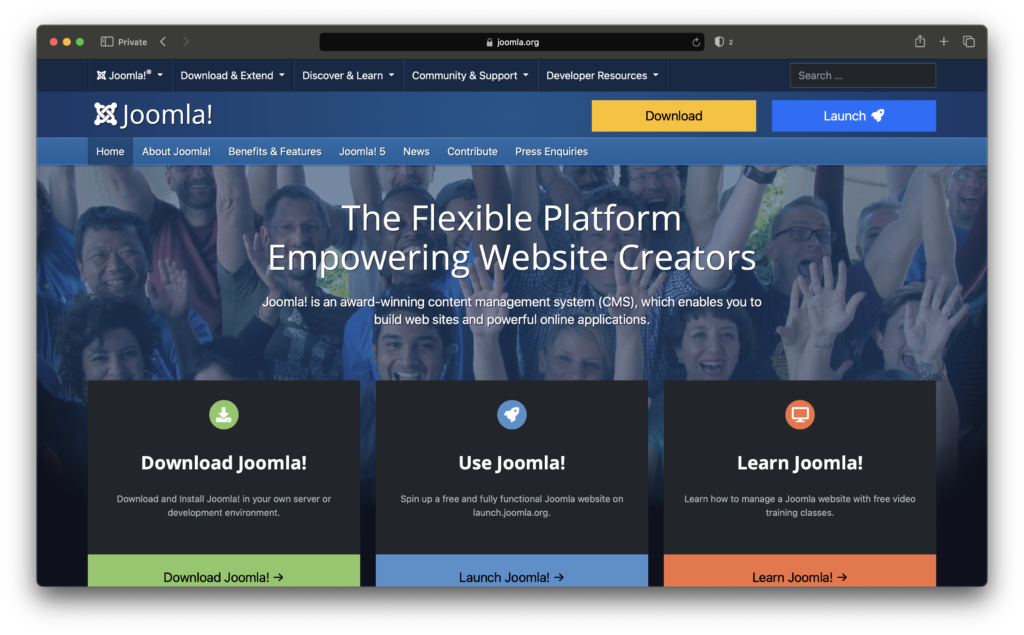
Joomla!
Joomla! was first launched in 2005 as a free and open-source CMS. It’s constructed on PHP and makes use of MySQL or PostgreSQL for its database construction.
Joomla! presents a variety of options, together with person administration, content material administration, extensions, templates for web site design, multilingual assist, and extra.
Though nonetheless thought of user-friendly, Joomla! is thought to have a steeper studying curve than WordPress does, and as such might pose a problem to newbie web site house owners; nonetheless, its passionate group and giant documentation database provide the help new customers want.
WordPress vs. Joomla!
- Ease of Use: Whereas Joomla! additionally presents a user-friendly interface, it may be thought of barely extra complicated than WordPress, particularly for newbies.
- Customization: Joomla! offers flexibility and customization choices akin to WordPress however might require extra technical data to totally make the most of its capabilities. It additionally has a smaller collection of templates and extensions in comparison with WordPress, nevertheless it nonetheless presents a variety of choices for personalisation.
- Group: Though Joomla!’s group is just not as giant or energetic as WordPress’, customers can nonetheless discover assist by way of boards, documentation, and third-party sources.
- Safety: Each WordPress and Joomla take safety severely and launch common updates to deal with vulnerabilities. Nevertheless, since WordPress is extra broadly used, it may be a much bigger goal for hackers. Correct safety measures, comparable to utilizing robust passwords, maintaining themes and plugins up to date, and utilizing safety plugins, are important for each platforms.
Drupal
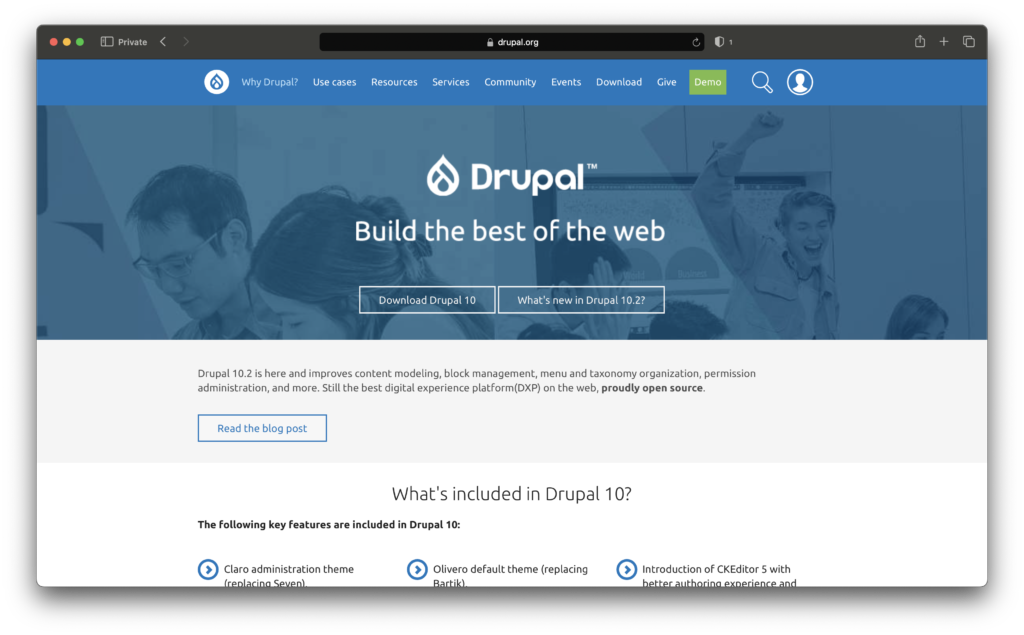
Drupal is an open-source CMS written in PHP launched in 2001. Like Joomla! and WordPress, Drupal permits customers to create and handle web sites and net functions.
Just like plugins in WordPress, Drupal presents a modular method to web site constructing by including modules to its core infrastructure. Modules add options comparable to eCommerce, boards, person administration and extra.
Drupal is commonly favored by builders and organizations that require a excessive degree of customization and management over their web sites and net functions. It’s utilized by a various vary of internet sites, together with authorities websites, instructional establishments, non-profits, and huge firms.
WordPress vs. Drupal
- Ease of Use: Whereas Drupal presents highly effective options, it may well have a steeper studying curve in comparison with WordPress, particularly for newbies. It’s extra developer-centric and will require some technical experience to totally make the most of its capabilities.
- Customization: Drupal is thought for its scalability and skill to deal with high-traffic web sites and complicated functions. It presents a modular structure the place performance is added by way of modules, permitting customers to create extremely tailor-made options.
- Group: Identical to Joomla!, Drupal has a small however passionate group that share ideas and recommendation by way of documentation, boards, and extra.
- Safety: WordPress and Drupal take safety severely and have strong safety measures in place. Nevertheless, because of their variations in structure, ecosystem, and recognition, they might have various ranges of vulnerability to safety dangers.
Wix and Squarespace
Conventional CMSs, comparable to WordPress provide extra flexibility and customization choices in comparison with web site builders like Squarespace and Wix.
Web site builders like Squarespace are extra user-friendly and cater to people or small companies who need to create a web site rapidly and simply with out the necessity for technical experience. They supply a drag-and-drop interface and pre-designed templates, permitting customers to create professional-looking web sites with none coding data.
Nevertheless, due to their proprietary licensing, these builders could also be restricted to the options and templates offered by the platform, and as such customers might have much less management over their web site’s internet hosting and information.
WordPress vs. eCommerce CMSs
In comparison with conventional CMSs like WordPress or Joomla!, eCommerce CMSs provide particular functionalities centered on on-line gross sales and transactions.
eCommerce CMSs embrace built-in instruments for managing product listings, processing orders, dealing with transport and tax calculations, and integrating with varied fee gateways.
With the intention to evaluate WordPress to eCommerce CMSs it could want a plugin comparable to WooCommerce to allow the options enterprise house owners must run a profitable on-line store.
View a full breakdown of WooCommerce vs. different eCommerce platforms in our weblog article.
Components to Take into account When Selecting a CMS
- Person Friendliness and studying Curve: A user-friendly CMS makes it simpler for customers, particularly these with restricted technical experience, to navigate the interface, create content material, and handle their web site successfully. Intuitive options and easy workflows cut back frustration and enhance productiveness.
- Flexibility and Customization Choices: Search for a CMS that gives a variety of customization choices to tailor your web site’s design and performance to your particular wants.
- search engine optimization Settings: Select a software program that helps SEO (search engine optimization) greatest practices, comparable to customizable metadata, clear code construction, and cellular responsiveness, to enhance your web site’s visibility in search engine rankings.
- eCommerce Compatibility: If you happen to plan to promote services or products on-line, be sure that your CMS offers strong eCommerce options, comparable to stock administration, fee gateways, and procuring cart performance.
- Safety: Choose a CMS with a powerful safety monitor report, common updates, and built-in security measures to safeguard your web site and delicate data
- Value: Select a platform that matches inside your funds whereas nonetheless assembly your web site necessities. Take into account each, the preliminary setup prices and ongoing bills related to the CMS, comparable to paying for a professional license.
- Case Research and Critiques: Reviewing case research and examples of internet sites constructed on completely different CMS platforms can present invaluable insights into every CMS’s strengths, weaknesses, and real-world efficiency.
Closing Ideas
Every CMS coated on this article presents distinctive strengths and capabilities, from user-friendly interfaces to eCommerce functionalities and in depth customization choices.
Finally, the most effective CMS on your web site is determined by your particular necessities, targets, and degree of experience. By rigorously evaluating the options, advantages, and disadvantages of every CMS, you may make an knowledgeable resolution that aligns together with your wants and empowers you to create a profitable on-line presence.